Li Jian-Long, Wang Peng, Fung Wing Kam, Zhou Ji-Yuan
State Key Laboratory of Organ Failure Research, Ministry of Education, and Guangdong Provincial Key Laboratory of Tropical Disease Research, Department of Biostatistics, School of Public Health, Southern Medical University, Guangzhou, China.
State Key Laboratory of Ophthalmology, Zhongshan Ophthalmic Center, Sun Yat-sen University, Guangzhou, China.
BMC Genet. 2017 Oct 16;18(1):90. doi: 10.1186/s12863-017-0560-0.
For dichotomous traits, the generalized disequilibrium test with the moment estimate of the variance (GDT-ME) is a powerful family-based association method. Genomic imprinting is an important epigenetic phenomenon and currently, there has been increasing interest of incorporating imprinting to improve the test power of association analysis. However, GDT-ME does not take imprinting effects into account, and it has not been investigated whether it can be used for association analysis when the effects indeed exist.
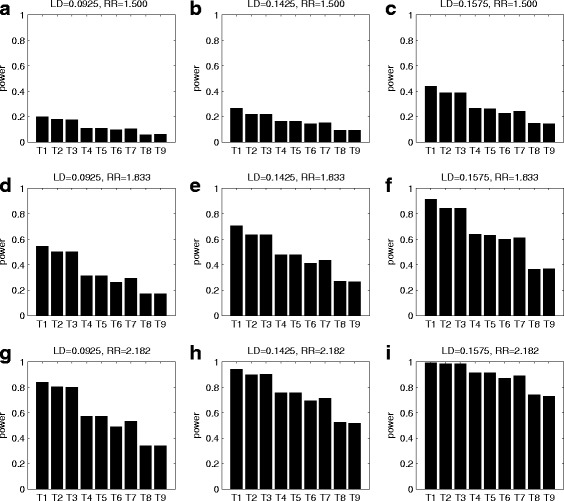
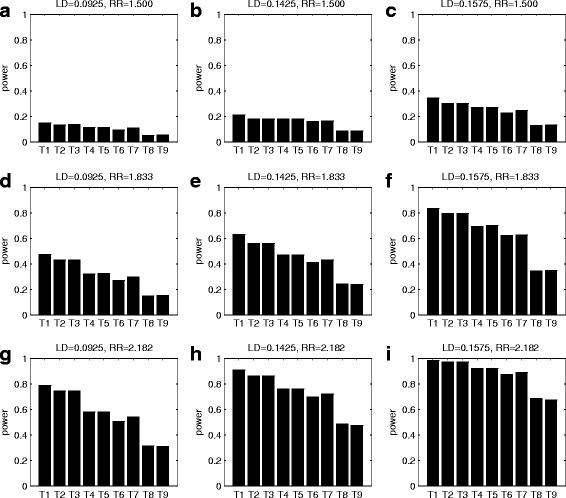
In this article, based on a novel decomposition of the genotype score according to the paternal or maternal source of the allele, we propose the generalized disequilibrium test with imprinting (GDTI) for complete pedigrees without any missing genotypes. Then, we extend GDTI and GDT-ME to accommodate incomplete pedigrees with some pedigrees having missing genotypes, by using a Monte Carlo (MC) sampling and estimation scheme to infer missing genotypes given available genotypes in each pedigree, denoted by MCGDTI and MCGDT-ME, respectively. The proposed GDTI and MCGDTI methods evaluate the differences of the paternal as well as maternal allele scores for all discordant relative pairs in a pedigree, including beyond first-degree relative pairs. Advantages of the proposed GDTI and MCGDTI test statistics over existing methods are demonstrated by simulation studies under various simulation settings and by application to the rheumatoid arthritis dataset. Simulation results show that the proposed tests control the size well under the null hypothesis of no association, and outperform the existing methods under various imprinting effect models. The existing GDT-ME and the proposed MCGDT-ME can be used to test for association even when imprinting effects exist. For the application to the rheumatoid arthritis data, compared to the existing methods, MCGDTI identifies more loci statistically significantly associated with the disease.
Under complete and incomplete imprinting effect models, our proposed GDTI and MCGDTI methods, by considering the information on imprinting effects and all discordant relative pairs within each pedigree, outperform all the existing test statistics and MCGDTI can recapture much of the missing information. Therefore, MCGDTI is recommended in practice.
对于二分性状,基于方差矩估计的广义不平衡检验(GDT-ME)是一种强大的基于家系的关联分析方法。基因组印记是一种重要的表观遗传现象,目前,人们越来越有兴趣纳入印记以提高关联分析的检验效能。然而,GDT-ME未考虑印记效应,并且尚未研究当印记效应确实存在时它是否可用于关联分析。
在本文中,基于根据等位基因的父源或母源对基因型得分进行的新颖分解,我们针对无任何缺失基因型的完整家系提出了带有印记的广义不平衡检验(GDTI)。然后,我们扩展了GDTI和GDT-ME以适应存在一些家系有缺失基因型的不完整家系,通过使用蒙特卡罗(MC)抽样和估计方案,根据每个家系中的可用基因型推断缺失基因型,分别记为MCGDTI和MCGDT-ME。所提出的GDTI和MCGDTI方法评估家系中所有不一致相对对的父本和母本等位基因得分的差异,包括一级亲属对之外的相对对。在各种模拟设置下的模拟研究以及对类风湿关节炎数据集的应用表明,所提出的GDTI和MCGDTI检验统计量相对于现有方法具有优势。模拟结果表明,所提出的检验在无关联的零假设下能很好地控制检验规模,并且在各种印记效应模型下优于现有方法。即使存在印记效应,现有的GDT-ME和所提出的MCGDT-ME也可用于检验关联。对于类风湿关节炎数据的应用,与现有方法相比,MCGDTI识别出更多与疾病有统计学显著关联的位点。
在完整和不完整的印记效应模型下,我们提出的GDTI和MCGDTI方法通过考虑印记效应信息以及每个家系内所有不一致的相对对,优于所有现有的检验统计量,并且MCGDTI可以重新获取许多缺失信息。因此在实际应用中推荐使用MCGDTI。