Greaney Mary L, Askew Sandy, Wallington Sherrie F, Foley Perry B, Quintiliani Lisa M, Bennett Gary G
Department of Kinesiology and Health Studies, 25 West Independence Way, University of Rhode Island, Kingston, RI, 02881, USA.
Duke Global Digital Health Science Center, Duke Global Health Institute, Duke University, Durham, NC, 27710, USA.
Int J Behav Nutr Phys Act. 2017 Oct 16;14(1):139. doi: 10.1186/s12966-017-0596-6.
Rates of physical inactivity are high among Black women living in the United States with overweight or obesity, especially those living in the rural South. This study was conducted to determine if an efficacious weight gain prevention intervention increased moderate-vigorous physical activity (MVPA).
The Shape Program, a weight gain prevention intervention implemented in community health centers in rural North Carolina, was designed for socioeconomically disadvantaged Black women with overweight or obesity. MVPA was measured using accelerometers, and summarized into 1- and 10-min bouts. We employed analyses of covariance (ANCOVA) to assess the relationship between changes in MVPA over 12 months, calculated as a change score, and intervention assignment (intervention versus usual care).
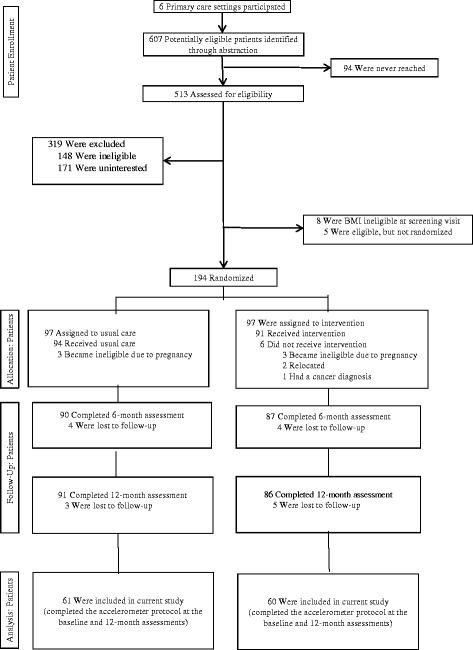
Participants completing both baseline and 12-month accelerometer assessments (n = 121) had a mean age of 36.1 (SD = 5.43) years and a mean body mass index of 30.24 kg/m (SD = 2.60). At baseline, 38% met the physical activity recommendation (150 min of MVPA/week) when assessed using 10-min bouts, and 76% met the recommendation when assessed using 1-min bouts. There were no significant differences in change in MVPA participation among participants randomized to the intervention from baseline to 12-months using 1-min bouts (adjusted intervention mean [95% CI]: 20.50 [-109.09 to 150.10] vs. adjusted usual care mean [95% CI]: -80.04 [-209.21 to 49.13], P = .29), or 10-min bouts (adjusted intervention mean [95% CI]: 7.39 [-83.57 to 98.35] vs. adjusted usual care mean [95% CI]: -17.26 [-107.93 to 73.40], P = .70).
Although prior research determined that the Shape intervention promoted weight gain prevention, MVPA did not increase significantly among intervention participants from baseline to 12 months. The classification of bouts had a marked effect on the prevalence estimates of those meeting physical activity recommendations. More research is needed to understand how to promote increased MVPA in weight gain prevention interventions.
This study is registered at www.clinicaltrials.gov database (No. NCT00938535. Retrospectively Registered 7/10/2009).
在美国,超重或肥胖的黑人女性身体活动不足的比例很高,尤其是生活在南部农村地区的女性。本研究旨在确定一种有效的体重增加预防干预措施是否能增加中等强度至剧烈身体活动(MVPA)。
“塑形计划”是在北卡罗来纳州农村社区卫生中心实施的一项体重增加预防干预措施,针对社会经济地位不利的超重或肥胖黑人女性设计。使用加速度计测量MVPA,并汇总为1分钟和10分钟的运动时段。我们采用协方差分析(ANCOVA)来评估12个月内MVPA变化(以变化分数计算)与干预分配(干预组与常规护理组)之间的关系。
完成基线和12个月加速度计评估的参与者(n = 121)平均年龄为36.1岁(标准差 = 5.43),平均体重指数为30.24 kg/m²(标准差 = 2.60)。在基线时,使用10分钟运动时段评估时,38%的人达到身体活动建议(每周150分钟MVPA),使用1分钟运动时段评估时,76%的人达到建议。从基线到12个月,随机分配到干预组的参与者在MVPA参与度变化方面,使用1分钟运动时段时无显著差异(调整后的干预组均值[95%置信区间]:20.50[-109.09至150.10]与调整后的常规护理组均值[95%置信区间]:-80.04[-209.21至49.13],P = 0.29),使用10分钟运动时段时也无显著差异(调整后的干预组均值[95%置信区间]:7.39[-83.57至98.35]与调整后的常规护理组均值[95%置信区间]:-17.26[-107.93至73.40]),P = 0.70)。
尽管先前的研究确定“塑形”干预措施可促进体重增加预防,但从基线到12个月,干预参与者的MVPA并未显著增加。运动时段的分类对达到身体活动建议者的患病率估计有显著影响。需要更多研究来了解如何在体重增加预防干预措施中促进MVPA增加。
本研究已在www.clinicaltrials.gov数据库注册(编号NCT00938535。2009年7月10日追溯注册)。