• 文献检索
  • 文档翻译
  • 深度研究
  • 学术资讯
  • Suppr Zotero 插件Zotero 插件
  • 邀请有礼
  • 套餐&价格
  • 历史记录
应用&插件
Suppr Zotero 插件Zotero 插件浏览器插件Mac 客户端Windows 客户端微信小程序
定价
高级版会员购买积分包购买API积分包
服务
文献检索文档翻译深度研究API 文档MCP 服务
关于我们
关于 Suppr公司介绍联系我们用户协议隐私条款
关注我们

Suppr 超能文献

核心技术专利:CN118964589B侵权必究
粤ICP备2023148730 号-1Suppr @ 2026

文献检索

告别复杂PubMed语法,用中文像聊天一样搜索,搜遍4000万医学文献。AI智能推荐,让科研检索更轻松。

立即免费搜索

文件翻译

保留排版,准确专业,支持PDF/Word/PPT等文件格式,支持 12+语言互译。

免费翻译文档

深度研究

AI帮你快速写综述,25分钟生成高质量综述,智能提取关键信息,辅助科研写作。

立即免费体验

一种理解肿瘤细胞侵袭的新方法:通过“选择性固化”将细胞外基质模拟层整合到微流控芯片中。

A novel method to understand tumor cell invasion: integrating extracellular matrix mimicking layers in microfluidic chips by "selective curing".

作者信息

Eslami Amirabadi H, SahebAli S, Frimat J P, Luttge R, den Toonder J M J

机构信息

Microsystems Group, Department of Mechanical Engineering and Institute for Complex Molecular systems (ICMS), Eindhoven University of Technology, Groene Loper 15, 5612AZ, Eindhoven, the Netherlands.

出版信息

Biomed Microdevices. 2017 Oct 17;19(4):92. doi: 10.1007/s10544-017-0234-8.

DOI:10.1007/s10544-017-0234-8
PMID:29038872
原文链接:https://pmc.ncbi.nlm.nih.gov/articles/PMC5644704/
Abstract

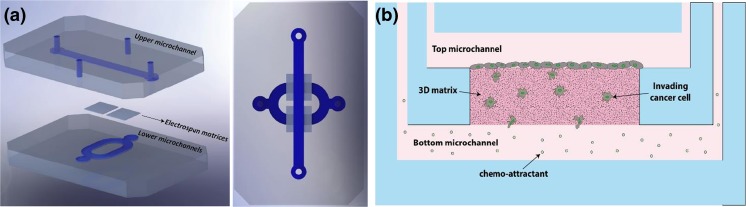
A major challenge in studying tumor cell invasion into its surrounding tissue is to identify the contribution of individual factors in the tumor microenvironment (TME) to the process. One of the important elements of the TME is the fibrous extracellular matrix (ECM) which is known to influence cancer cell invasion, but exactly how remains unclear. Therefore, there is a need for new models to unravel mechanisms behind the tumor-ECM interaction. In this article, we present a new microfabrication method, called selective curing, to integrate ECM-mimicking layers between two microfluidic channels. This method enables us to study the effect of 3D matrices with controlled architecture, beyond the conventionally used hydrogels, on cancer invasion in a controlled environment. As a proof of principle, we have integrated two electrospun Polycaprolactone (PCL) matrices with different fiber diameters in one chip. We then studied the 3D migration of MDA-MB-231 breast cancer cells into the matrices under the influence of a chemotactic gradient. The results show that neither the invasion distance nor the general cell morphology is affected significantly by the difference in fiber size of these matrices. The cells however do produce longer and more protrusions in the matrix with smaller fiber size. This microfluidic system enables us to study the influence of other factors in the TME on cancer development as well as other biological applications as it provides a controlled compartmentalized environment compatible with cell culturing.

摘要

研究肿瘤细胞侵入周围组织的一个主要挑战是确定肿瘤微环境(TME)中各个因素对这一过程的作用。TME的重要组成部分之一是纤维状细胞外基质(ECM),已知其会影响癌细胞的侵袭,但具体机制尚不清楚。因此,需要新的模型来揭示肿瘤与ECM相互作用背后的机制。在本文中,我们提出了一种新的微制造方法,称为选择性固化,用于在两个微流体通道之间整合模拟ECM的层。这种方法使我们能够在可控环境中研究具有可控结构的3D基质(超越传统使用的水凝胶)对癌症侵袭的影响。作为原理验证,我们在一个芯片中整合了两种不同纤维直径的电纺聚己内酯(PCL)基质。然后,我们研究了在趋化梯度影响下MDA-MB-231乳腺癌细胞向基质中的3D迁移。结果表明,这些基质的纤维尺寸差异对侵袭距离和一般细胞形态均无显著影响。然而,细胞在纤维尺寸较小的基质中确实会产生更长、更多的突起。这种微流体系统使我们能够研究TME中的其他因素对癌症发展的影响以及其他生物学应用,因为它提供了一个与细胞培养兼容的可控分隔环境。
https://cdn.ncbi.nlm.nih.gov/pmc/blobs/fb80/5644704/4bbb0e25e8f4/10544_2017_234_Fig5_HTML.jpg
https://cdn.ncbi.nlm.nih.gov/pmc/blobs/fb80/5644704/9e0bb19ded5b/10544_2017_234_Fig1_HTML.jpg
https://cdn.ncbi.nlm.nih.gov/pmc/blobs/fb80/5644704/a86db1b81fcf/10544_2017_234_Fig2_HTML.jpg
https://cdn.ncbi.nlm.nih.gov/pmc/blobs/fb80/5644704/cdc55b5b5256/10544_2017_234_Fig3_HTML.jpg
https://cdn.ncbi.nlm.nih.gov/pmc/blobs/fb80/5644704/10f2137b13a2/10544_2017_234_Fig4_HTML.jpg
https://cdn.ncbi.nlm.nih.gov/pmc/blobs/fb80/5644704/4bbb0e25e8f4/10544_2017_234_Fig5_HTML.jpg
https://cdn.ncbi.nlm.nih.gov/pmc/blobs/fb80/5644704/9e0bb19ded5b/10544_2017_234_Fig1_HTML.jpg
https://cdn.ncbi.nlm.nih.gov/pmc/blobs/fb80/5644704/a86db1b81fcf/10544_2017_234_Fig2_HTML.jpg
https://cdn.ncbi.nlm.nih.gov/pmc/blobs/fb80/5644704/cdc55b5b5256/10544_2017_234_Fig3_HTML.jpg
https://cdn.ncbi.nlm.nih.gov/pmc/blobs/fb80/5644704/10f2137b13a2/10544_2017_234_Fig4_HTML.jpg
https://cdn.ncbi.nlm.nih.gov/pmc/blobs/fb80/5644704/4bbb0e25e8f4/10544_2017_234_Fig5_HTML.jpg

相似文献

1
A novel method to understand tumor cell invasion: integrating extracellular matrix mimicking layers in microfluidic chips by "selective curing".一种理解肿瘤细胞侵袭的新方法:通过“选择性固化”将细胞外基质模拟层整合到微流控芯片中。
Biomed Microdevices. 2017 Oct 17;19(4):92. doi: 10.1007/s10544-017-0234-8.
2
Biomimetic 3D Clusters Using Human Adipose Derived Mesenchymal Stem Cells and Breast Cancer Cells: A Study on Migration and Invasion of Breast Cancer Cells.使用人脂肪来源间充质干细胞和乳腺癌细胞构建的仿生3D聚集体:乳腺癌细胞迁移和侵袭的研究
Mol Pharm. 2016 Jul 5;13(7):2204-13. doi: 10.1021/acs.molpharmaceut.5b00953. Epub 2016 May 19.
3
Microfluidic modeling of the biophysical microenvironment in tumor cell invasion.肿瘤细胞浸润中的生物物理微环境的微流控建模。
Lab Chip. 2017 Sep 26;17(19):3221-3233. doi: 10.1039/c7lc00623c.
4
Characterizing the invasion of different breast cancer cell lines with distinct E-cadherin status in 3D using a microfluidic system.使用微流控系统在 3D 中描绘具有不同 E-钙黏蛋白状态的不同乳腺癌细胞系的侵袭。
Biomed Microdevices. 2019 Nov 23;21(4):101. doi: 10.1007/s10544-019-0450-5.
5
Construction of in vitro 3-D model for lung cancer-cell metastasis study.构建用于肺癌细胞转移研究的体外 3D 模型。
BMC Cancer. 2022 Apr 21;22(1):438. doi: 10.1186/s12885-022-09546-9.
6
The phenotype of cancer cell invasion controlled by fibril diameter and pore size of 3D collagen networks.三维胶原网络中纤维直径和孔径控制的癌细胞侵袭表型。
Biomaterials. 2015 Jun;52:367-75. doi: 10.1016/j.biomaterials.2015.02.022. Epub 2015 Mar 3.
7
An model of cancer invasion with heterogeneous ECM created with droplet microfluidics.一种利用微滴微流控技术创建的具有异质细胞外基质的癌症侵袭模型。
Front Bioeng Biotechnol. 2023 Nov 23;11:1267021. doi: 10.3389/fbioe.2023.1267021. eCollection 2023.
8
A Programmable Multifunctional 3D Cancer Cell Invasion Micro Platform.可编程多功能 3D 癌症细胞侵袭微平台。
Small. 2022 May;18(20):e2107757. doi: 10.1002/smll.202107757. Epub 2022 Mar 9.
9
FAP-overexpressing fibroblasts produce an extracellular matrix that enhances invasive velocity and directionality of pancreatic cancer cells.FAP 过表达的成纤维细胞产生细胞外基质,增强胰腺癌细胞的侵袭速度和方向。
BMC Cancer. 2011 Jun 13;11:245. doi: 10.1186/1471-2407-11-245.
10
The role of ADAM8 in the mechanophenotype of MDA-MB-231 breast cancer cells in 3D extracellular matrices.ADAM8在三维细胞外基质中MDA-MB-231乳腺癌细胞机械表型中的作用。
Front Cell Dev Biol. 2023 May 23;11:1148162. doi: 10.3389/fcell.2023.1148162. eCollection 2023.

引用本文的文献

1
Breaking the mold: 3D cell cultures reshaping the future of cancer research.打破常规:3D细胞培养重塑癌症研究的未来。
Front Cell Dev Biol. 2024 Nov 26;12:1507388. doi: 10.3389/fcell.2024.1507388. eCollection 2024.
2
In Vitro Models of Ovarian Cancer: Bridging the Gap between Pathophysiology and Mechanistic Models.卵巢癌的体外模型:连接病理生理学和机制模型之间的差距。
Biomolecules. 2023 Jan 4;13(1):103. doi: 10.3390/biom13010103.
3
Employing hydrogels in tissue engineering approaches to boost conventional cancer-based research and therapies.

本文引用的文献

1
Comprehensive study on cellular morphologies, proliferation, motility, and epithelial-mesenchymal transition of breast cancer cells incubated on electrospun polymeric fiber substrates.关于在电纺聚合物纤维基质上培养的乳腺癌细胞的细胞形态、增殖、运动性和上皮-间质转化的综合研究。
J Mater Chem B. 2017 Apr 14;5(14):2588-2600. doi: 10.1039/c7tb00207f. Epub 2017 Mar 15.
2
Biomimetic on-a-chip platforms for studying cancer metastasis.用于研究癌症转移的仿生芯片平台。
Curr Opin Chem Eng. 2016 Feb;11:20-27. doi: 10.1016/j.coche.2015.12.001. Epub 2015 Dec 18.
3
Tumor-associated stromal cells as key contributors to the tumor microenvironment.
在组织工程方法中应用水凝胶以促进传统的基于癌症的研究和治疗。
RSC Adv. 2021 Mar 12;11(18):10646-10669. doi: 10.1039/d1ra00855b. eCollection 2021 Mar 10.
4
Microfluidics for the study of mechanotransduction.用于机械转导研究的微流控技术
J Phys D Appl Phys. 2020 May 27;53(22). doi: 10.1088/1361-6463/ab78d4. Epub 2020 Apr 2.
5
Characterizing the invasion of different breast cancer cell lines with distinct E-cadherin status in 3D using a microfluidic system.使用微流控系统在 3D 中描绘具有不同 E-钙黏蛋白状态的不同乳腺癌细胞系的侵袭。
Biomed Microdevices. 2019 Nov 23;21(4):101. doi: 10.1007/s10544-019-0450-5.
6
Coupling Microfluidic Platforms, Microfabrication, and Tissue Engineered Scaffolds to Investigate Tumor Cells Mechanobiology.耦合微流控平台、微加工技术和组织工程支架以研究肿瘤细胞的力学生物学
Micromachines (Basel). 2019 Jun 22;10(6):418. doi: 10.3390/mi10060418.
7
Polarity as a physiological modulator of cell function.极性作为细胞功能的生理调节剂。
Front Biosci (Landmark Ed). 2019 Jan 1;24(3):451-462. doi: 10.2741/4728.
8
Microfabricated tuneable and transferable porous PDMS membranes for Organs-on-Chips.用于器官芯片的微加工可调谐和可转移多孔 PDMS 膜。
Sci Rep. 2018 Sep 10;8(1):13524. doi: 10.1038/s41598-018-31912-6.
9
Nano-scale microfluidics to study 3D chemotaxis at the single cell level.纳米级微流控技术用于单细胞水平的 3D 趋化性研究。
PLoS One. 2018 Jun 7;13(6):e0198330. doi: 10.1371/journal.pone.0198330. eCollection 2018.
10
Metastasis in context: modeling the tumor microenvironment with cancer-on-a-chip approaches.语境中的转移:利用癌症芯片方法模拟肿瘤微环境。
Dis Model Mech. 2018 Mar 16;11(3):dmm033100. doi: 10.1242/dmm.033100.
肿瘤相关基质细胞是肿瘤微环境的关键促成因素。
Breast Cancer Res. 2016 Aug 11;18(1):84. doi: 10.1186/s13058-016-0740-2.
4
Imaging Extracellular Matrix Remodeling In Vitro by Diffusion-Sensitive Optical Coherence Tomography.通过扩散敏感光学相干断层扫描体外成像细胞外基质重塑
Biophys J. 2016 Apr 26;110(8):1858-1868. doi: 10.1016/j.bpj.2016.03.014.
5
Tumor cell intravasation.肿瘤细胞内渗
Am J Physiol Cell Physiol. 2016 Jul 1;311(1):C1-C14. doi: 10.1152/ajpcell.00238.2015. Epub 2016 Apr 13.
6
Microfluidic cytometric analysis of cancer cell transportability and invasiveness.癌细胞迁移能力和侵袭性的微流控细胞分析
Sci Rep. 2015 Sep 25;5:14272. doi: 10.1038/srep14272.
7
Investigating breast cancer cell behavior using tissue engineering scaffolds.利用组织工程支架研究乳腺癌细胞行为。
PLoS One. 2015 Apr 2;10(3):e0118724. doi: 10.1371/journal.pone.0118724. eCollection 2015.
8
The phenotype of cancer cell invasion controlled by fibril diameter and pore size of 3D collagen networks.三维胶原网络中纤维直径和孔径控制的癌细胞侵袭表型。
Biomaterials. 2015 Jun;52:367-75. doi: 10.1016/j.biomaterials.2015.02.022. Epub 2015 Mar 3.
9
Biphasic response of cell invasion to matrix stiffness in three-dimensional biopolymer networks.细胞在三维生物聚合物网络中对基质硬度的双相反应。
Acta Biomater. 2015 Feb;13:61-7. doi: 10.1016/j.actbio.2014.11.003. Epub 2014 Nov 11.
10
Modeling human carcinomas: physiologically relevant 3D models to improve anti-cancer drug development.模拟人类癌:生理相关的 3D 模型以改进抗癌药物开发。
Adv Drug Deliv Rev. 2014 Dec 15;79-80:50-67. doi: 10.1016/j.addr.2014.10.015. Epub 2014 Oct 23.