Departments of Cardiometabolic Disorders and Comparative Biology and Safety Sciences, Amgen Inc., One Amgen Center Drive, MS: 36-2-A, Thousand Oaks, CA, 91320, USA.
Calcif Tissue Int. 2017 Dec;101(6):641-653. doi: 10.1007/s00223-017-0319-7. Epub 2017 Oct 16.
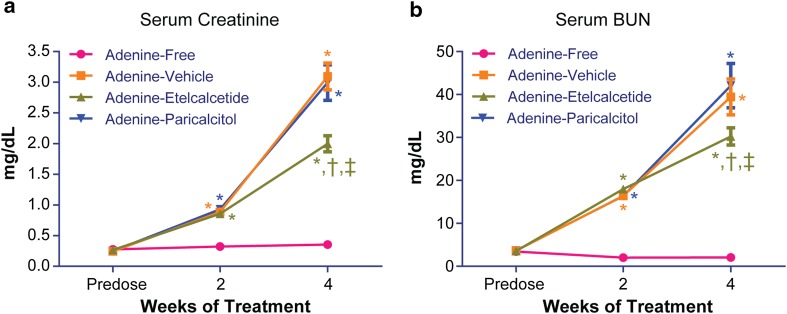
Etelcalcetide, a novel peptide agonist of the calcium-sensing receptor, prevents vascular calcification in a rat model of renal insufficiency with secondary hyperparathyroidism. Vascular calcification occurs frequently in patients with chronic kidney disease (CKD) and is a consequence of impaired mineral homeostasis and secondary hyperparathyroidism (SHPT). Etelcalcetide substantially lowers parathyroid hormone (PTH) and fibroblast growth factor-23 (FGF23) levels in SHPT patients on hemodialysis. This study compared the effects of etelcalcetide and paricalcitol on vascular calcification in rats with adenine-induced CKD and SHPT. Uremia and SHPT were induced in male Wistar rats fed a diet supplemented with 0.75% adenine for 4 weeks. Rats were injected with vehicle, etelcalcetide, or paricalcitol for 4 weeks from the beginning of adenine diet. Rats fed an adenine-free diet were included as nonuremic controls. Similar reductions in plasma PTH and parathyroid chief cell proliferation were observed in both etelcalcetide- and paricalcitol-treated rats. Serum calcium and phosphorus were significantly lower in etelcalcetide-treated uremic rats and was unchanged in paricalcitol-treated rats. Both serum FGF23 and aortic calcium content were significantly lower in etelcalcetide-treated uremic rats compared with either vehicle- or paricalcitol-treated uremic rats. The degree of aortic calcium content for etelcalcetide-treated rats was similar to that in nonuremic controls and corroborated findings of lack of histologic aortic mineralization in those groups. In conclusion, etelcalcetide and paricalcitol similarly attenuated progression of SHPT in an adenine rat model of CKD. However, etelcalcetide differentially prevented vascular calcification, at least in part, due to reductions in serum FGF23, calcium, and phosphorus levels.
依特卡塞肽是一种新型钙敏感受体肽激动剂,可预防继发甲状旁腺功能亢进的肾功能不全大鼠模型中的血管钙化。血管钙化在慢性肾脏病(CKD)患者中很常见,是矿物质稳态受损和继发甲状旁腺功能亢进(SHPT)的后果。依特卡塞肽可显著降低血液透析的 SHPT 患者的甲状旁腺激素(PTH)和成纤维细胞生长因子 23(FGF23)水平。本研究比较了依特卡塞肽和帕立骨化醇对腺嘌呤诱导的 CKD 和 SHPT 大鼠血管钙化的影响。雄性 Wistar 大鼠给予补充 0.75%腺嘌呤的饮食 4 周,诱导尿毒症和 SHPT。从腺嘌呤饮食开始的 4 周内,大鼠分别注射载体、依特卡塞肽或帕立骨化醇。给予不含腺嘌呤饮食的大鼠作为非尿毒症对照。在依特卡塞肽和帕立骨化醇治疗的大鼠中,均观察到血浆 PTH 和甲状旁腺主细胞增殖相似的降低。尿毒症大鼠的血清钙和磷明显低于依特卡塞肽治疗组,而帕立骨化醇治疗组的血清钙和磷无变化。与尿毒症对照组相比,依特卡塞肽治疗的尿毒症大鼠的血清 FGF23 和主动脉钙含量均显著降低。依特卡塞肽治疗的大鼠的主动脉钙含量程度与非尿毒症对照组相似,并证实了这些组中缺乏组织学主动脉矿化的发现。总之,依特卡塞肽和帕立骨化醇在腺嘌呤诱导的 CKD 大鼠模型中相似地减轻了 SHPT 的进展。然而,依特卡塞肽不同程度地预防了血管钙化,至少部分原因是血清 FGF23、钙和磷水平降低。