Food Policy Division, The George Institute for Global Health, The University of New South Wales, P.O. Box 20, Missenden Road, Sydney NSW 2006, Australia.
Menzies Centre for Health Policy, School of Public Health, University of Sydney, Sydney NSW 2006, Australia.
Nutrients. 2017 Oct 17;9(10):1128. doi: 10.3390/nu9101128.
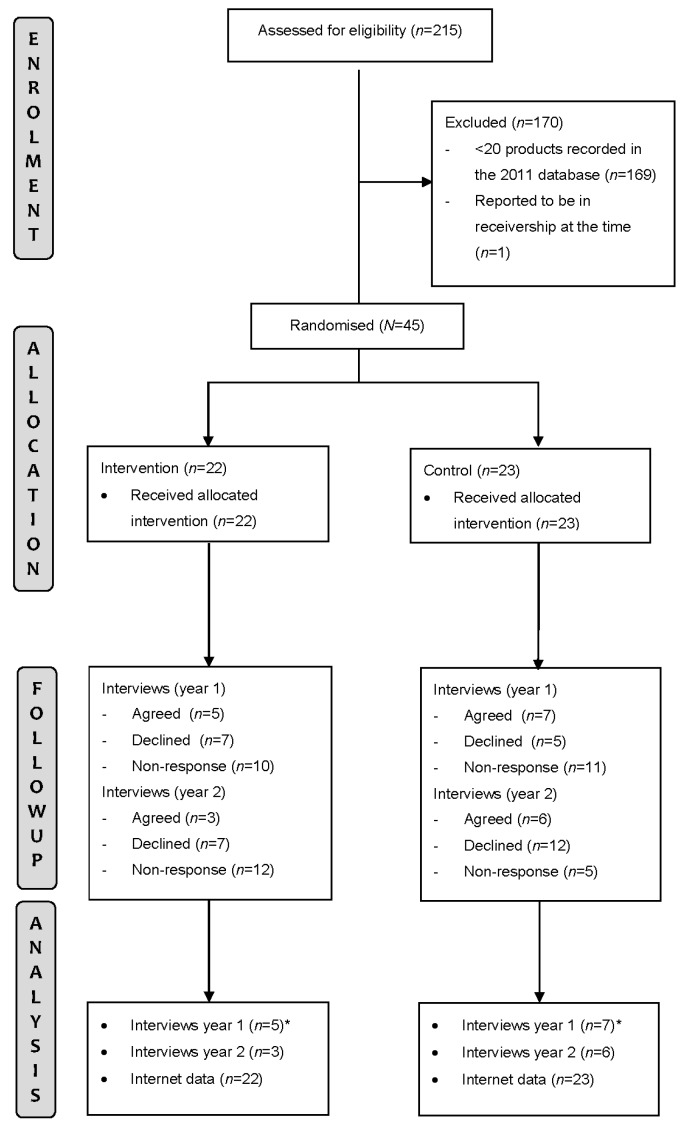
The decisions made by food companies are a potent factor shaping the nutritional quality of the food supply. A number of non-governmental organizations (NGOs) advocate for corporate action to reduce salt levels in foods, but few data define the effectiveness of advocacy. This present report describes the process evaluation of an advocacy intervention delivered by one Australian NGO directly to food companies to reduce the salt content of processed foods. Food companies were randomly assigned to intervention ( = 22) or control ( = 23) groups. Intervention group companies were exposed to pre-planned and opportunistic communications, and control companies to background activities. Seven pre-defined interim outcome measures provided an indication of the effect of the intervention and were assessed using intention-to-treat analysis. These were supplemented by qualitative data from nine semi-structured interviews. The mean number of public communications supporting healthy food made by intervention companies was 1.5 versus 1.8 for control companies ( = 0.63). Other outcomes, including the mean number of news articles, comments and reports (1.2 vs. 1.4; = 0.72), a published nutrition policy (23% vs. 44%; = 0.21), public commitment to the Australian government's Food and Health Dialogue (FHD) (41% vs. 61%; = 0.24), evidence of a salt reduction plan (23% vs. 30%; = 0.56), and mean number of communications with the NGO (15 vs. 11; = 0.28) were also not significantly different. Qualitative data indicated the advocacy trial had little effect. The absence of detectable effects of the advocacy intervention on the interim markers indicates there may be no impact of the NGO advocacy trial on the primary outcome of salt reduction in processed foods.
食品公司的决策是塑造食品供应营养质量的一个重要因素。一些非政府组织(NGO)倡导企业采取行动降低食品中的盐含量,但很少有数据定义宣传的效果。本报告描述了一个澳大利亚 NGO 直接向食品公司进行的倡导干预措施的过程评估,以降低加工食品中的盐含量。食品公司被随机分配到干预组(=22)或对照组(=23)。干预组公司接触到预先计划和偶然的沟通,而对照组公司则接触到背景活动。七个预先定义的中期结果衡量标准提供了干预效果的指示,并使用意向治疗分析进行评估。这些结果由来自九次半结构化访谈的定性数据补充。支持健康食品的公开沟通数量,干预组公司的平均值为 1.5,对照组公司的平均值为 1.8(=0.63)。其他结果,包括新闻文章、评论和报告的平均数量(1.2 比 1.4;=0.72)、公布的营养政策(23%比 44%;=0.21)、对澳大利亚政府食品与健康对话(FHD)的公开承诺(41%比 61%;=0.24)、减少盐计划的证据(23%比 30%;=0.56)以及与 NGO 的沟通平均数量(15 比 11;=0.28)也没有显著差异。定性数据表明,宣传试验几乎没有效果。宣传干预对中期指标没有可检测到的影响,这表明 NGO 宣传试验对加工食品中盐含量减少的主要结果可能没有影响。