Trieu Kathy, Neal Bruce, Hawkes Corinna, Dunford Elizabeth, Campbell Norm, Rodriguez-Fernandez Rodrigo, Legetic Branka, McLaren Lindsay, Barberio Amanda, Webster Jacqui
Food Policy Division, The George Institute for Global Health, The University of Sydney, Sydney, NSW, Australia.
Policy and Public Affairs, World Cancer Research Fund, London, United Kingdom.
PLoS One. 2015 Jul 22;10(7):e0130247. doi: 10.1371/journal.pone.0130247. eCollection 2015.
To quantify progress with the initiation of salt reduction strategies around the world in the context of the global target to reduce population salt intake by 30% by 2025.
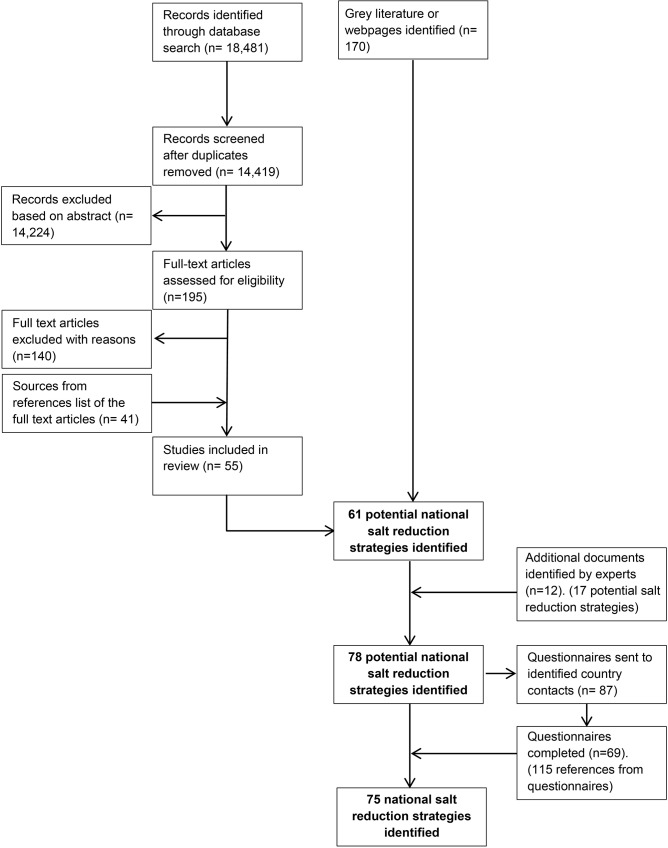
A systematic review of the published and grey literature was supplemented by questionnaires sent to country program leaders. Core characteristics of strategies were extracted and categorised according to a pre-defined framework.
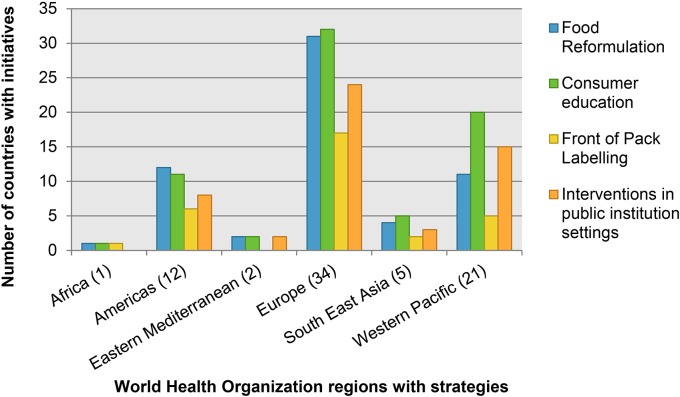
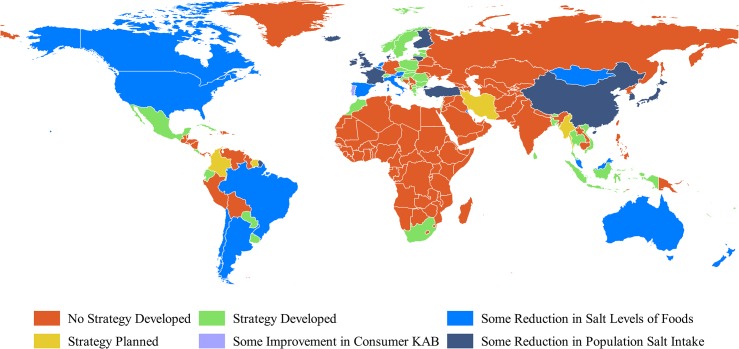
A total of 75 countries now have a national salt reduction strategy, more than double the number reported in a similar review done in 2010. The majority of programs are multifaceted and include industry engagement to reformulate products (n = 61), establishment of sodium content targets for foods (39), consumer education (71), front-of-pack labelling schemes (31), taxation on high-salt foods (3) and interventions in public institutions (54). Legislative action related to salt reduction such as mandatory targets, front of pack labelling, food procurement policies and taxation have been implemented in 33 countries. 12 countries have reported reductions in population salt intake, 19 reduced salt content in foods and 6 improvements in consumer knowledge, attitudes or behaviours relating to salt.
The large and increasing number of countries with salt reduction strategies in place is encouraging although activity remains limited in low- and middle-income regions. The absence of a consistent approach to implementation highlights uncertainty about the elements most important to success. Rigorous evaluation of ongoing programs and initiation of salt reduction programs, particularly in low- and middle- income countries, will be vital to achieving the targeted 30% reduction in salt intake.
在到2025年将全球人口盐摄入量降低30%这一全球目标的背景下,量化全球盐减少策略启动方面的进展。
对已发表文献和灰色文献进行系统综述,并向各国项目负责人发送问卷作为补充。根据预先定义的框架提取并分类策略的核心特征。
目前共有75个国家制定了国家盐减少策略,这一数字是2010年类似综述中报告数字的两倍多。大多数项目涉及多个方面,包括与行业合作重新配方产品(n = 61)、设定食品钠含量目标(39个)、消费者教育(71个)、包装正面标签计划(31个)、对高盐食品征税(3个)以及对公共机构的干预(54个)。33个国家已实施了与盐减少相关的立法行动,如强制性目标、包装正面标签、食品采购政策和税收。12个国家报告了人口盐摄入量的减少,19个国家降低了食品中的盐含量,6个国家在消费者对盐的知识、态度或行为方面有所改善。
尽管低收入和中等收入地区的活动仍然有限,但制定盐减少策略的国家数量众多且不断增加,这令人鼓舞。实施方法缺乏一致性凸显了对成功最为重要的要素的不确定性。对正在进行的项目进行严格评估并启动盐减少项目,特别是在低收入和中等收入国家,对于实现将盐摄入量降低30%的目标至关重要。