Medical Research Council Integrative Epidemiology Unit.
School of Social and Community Medicine, Barley House.
Int J Epidemiol. 2017 Dec 1;46(6):1948-1957. doi: 10.1093/ije/dyx109.
There is limited evidence about the effectiveness of varenicline and nicotine replacement therapy (NRT) for long-term smoking cessation in primary care, or whether the treatment effectiveness differs by socioeconomic position (SEP). Therefore, we estimated the long-term effectiveness of varenicline versus NRT (> 2 years) on smoking cessation, and investigated whether effectiveness differs by SEP.
This is a prospective cohort study of electronic medical records from 654 general practices in England, within the Clinical Practice Research Datalink, using three different analytical methods: multivariable logistic regression, propensity score matching and instrumental variable analyses. Exposure was prescription of varenicline versus NRT, and the primary outcome was smoking cessation at 2 years' follow-up; outcome was also assessed at 3, 6, and 9 months, and at 1 and 4 years after exposure. SEP was defined using the Index of Multiple Deprivation.
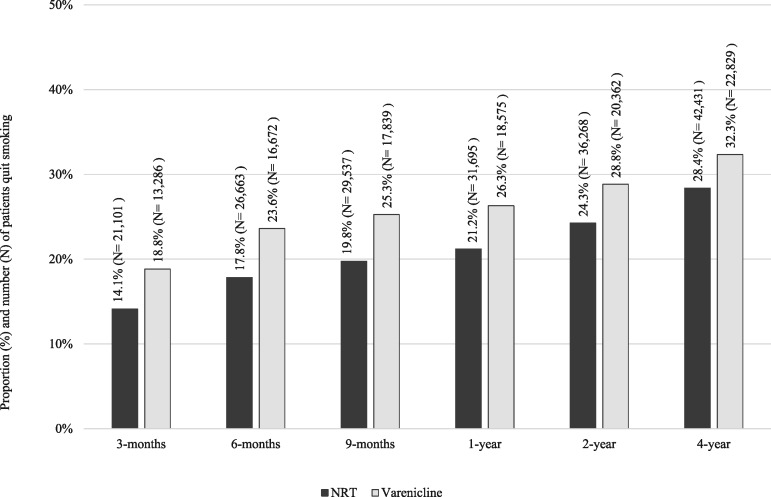
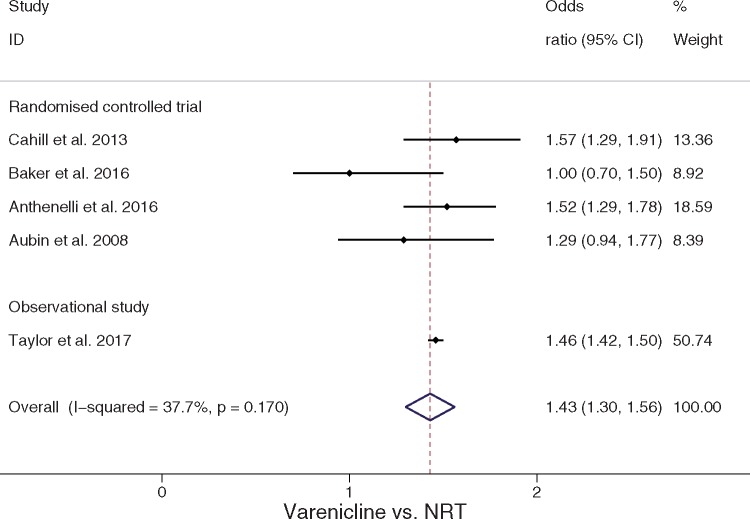
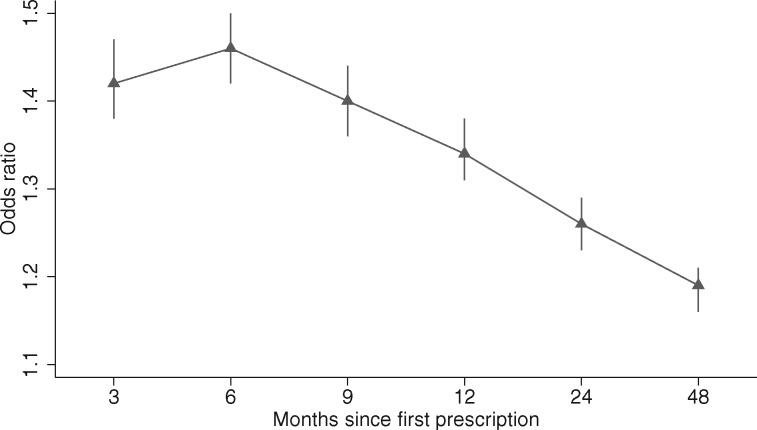
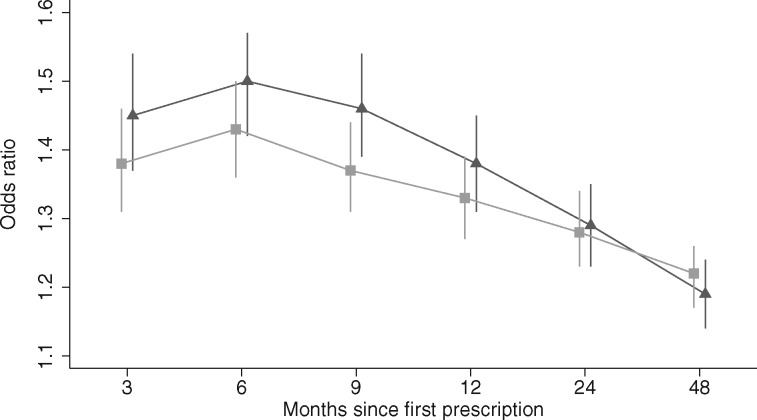
At 2 years, 28.8% (N = 20 362/70 610) of participants prescribed varenicline and 24.3% (N = 36 268/149 526) of those prescribed NRT quit; adjusted odds ratio was 1.26 [95% confidence interval (CI): 1.23 to 1.29], P < 0.0001. The association persisted for up to 4 years and was consistent across all analyses. We found little evidence that the effectiveness of varenicline differed greatly by SEP. However, patients from areas of higher deprivation were less likely to be prescribed varenicline; adjusted odds ratio was 0.91 (95% CI: 0.90 to 0.92), P < 0.0001.
Patients prescribed varenicline were more likely to be abstinent up to 4 years after first prescription than those prescribed NRT. In combination with other evidence, the results from this study may be used to update clinical guidelines on the use of varenicline for smoking cessation.
在初级保健中,关于伐伦克林和尼古丁替代疗法(NRT)长期戒烟的效果,以及治疗效果是否因社会经济地位(SEP)而异,证据有限。因此,我们评估了伐伦克林与 NRT(>2 年)对戒烟的长期效果,并调查了效果是否因 SEP 而异。
这是一项来自英格兰 654 家普通诊所的电子病历的前瞻性队列研究,来自临床实践研究数据链接,使用了三种不同的分析方法:多变量逻辑回归、倾向评分匹配和工具变量分析。暴露因素是开处方使用伐伦克林与 NRT,主要结局是 2 年随访时戒烟;结局还在 3、6 和 9 个月,以及暴露后 1 年和 4 年进行评估。使用多因素剥夺指数来定义 SEP。
在 2 年时,28.8%(N=20362/70610)接受伐伦克林治疗的参与者和 24.3%(N=36268/149526)接受 NRT 治疗的参与者戒烟;调整后的优势比为 1.26(95%置信区间[CI]:1.23 至 1.29),P<0.0001。该关联持续了 4 年,在所有分析中都一致。我们发现几乎没有证据表明伐伦克林的效果因 SEP 而有很大差异。然而,来自贫困程度较高地区的患者不太可能被开伐伦克林处方;调整后的优势比为 0.91(95%置信区间[CI]:0.90 至 0.92),P<0.0001。
与开处方 NRT 的患者相比,首次处方后长达 4 年,服用伐伦克林的患者更有可能保持戒烟状态。结合其他证据,这项研究的结果可用于更新关于使用伐伦克林戒烟的临床指南。