Laboratory for Molecular Dynamics of Mental Disorders, RIKEN Brain Science Institute, Saitama, Japan.
Department of Neuropsychiatry, Osaka City University, Graduate School of Medicine, Osaka, Japan.
Int J Neuropsychopharmacol. 2018 Mar 1;21(3):207-215. doi: 10.1093/ijnp/pyx089.
Diagnostic biomarkers of major depressive disorder, bipolar disorder, and schizophrenia are urgently needed, because none are currently available.
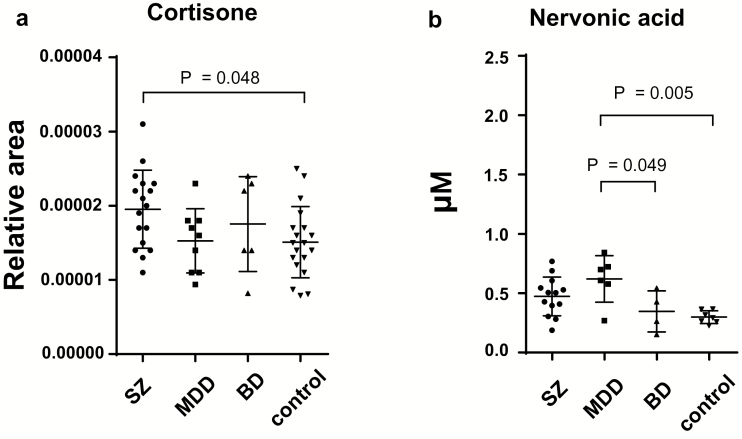
We performed a comprehensive metabolome analysis of plasma samples from drug-free patients with major depressive disorder (n=9), bipolar disorder (n=6), schizophrenia (n=17), and matched healthy controls (n=19) (cohort 1) using liquid chromatography time-of-flight mass spectrometry. A significant effect of diagnosis was found for 2 metabolites: nervonic acid and cortisone, with nervonic acid being the most significantly altered. The reproducibility of the results and effects of psychotropic medication on nervonic acid were verified in cohort 2, an independent sample set of medicated patients [major depressive disorder (n=45), bipolar disorder (n=71), schizophrenia (n=115)], and controls (n=90) using gas chromatography time-of-flight mass spectrometry.
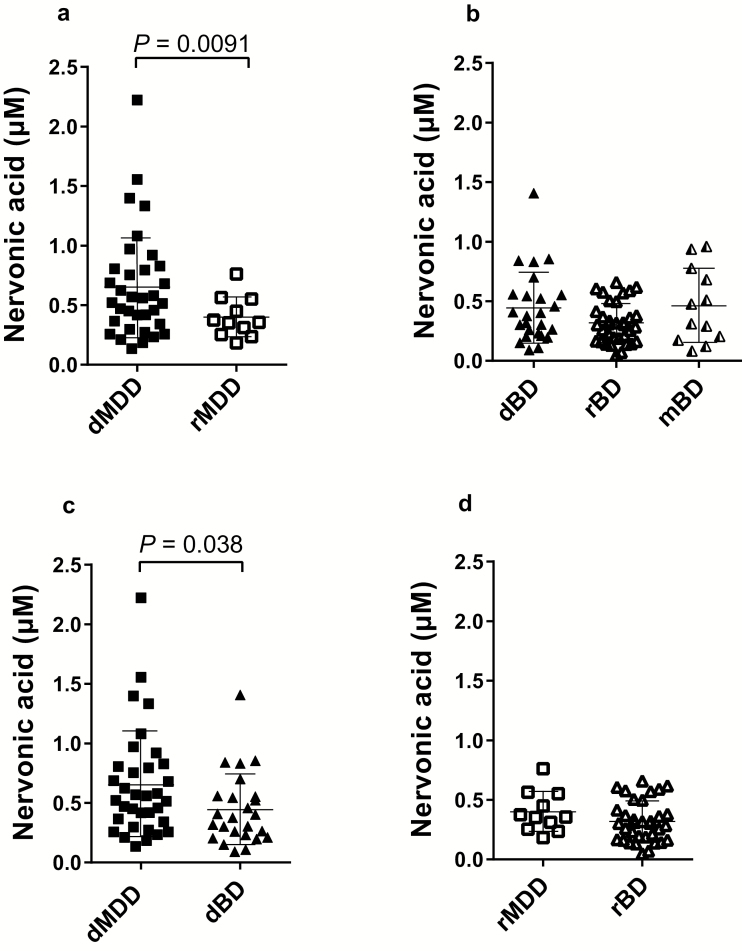
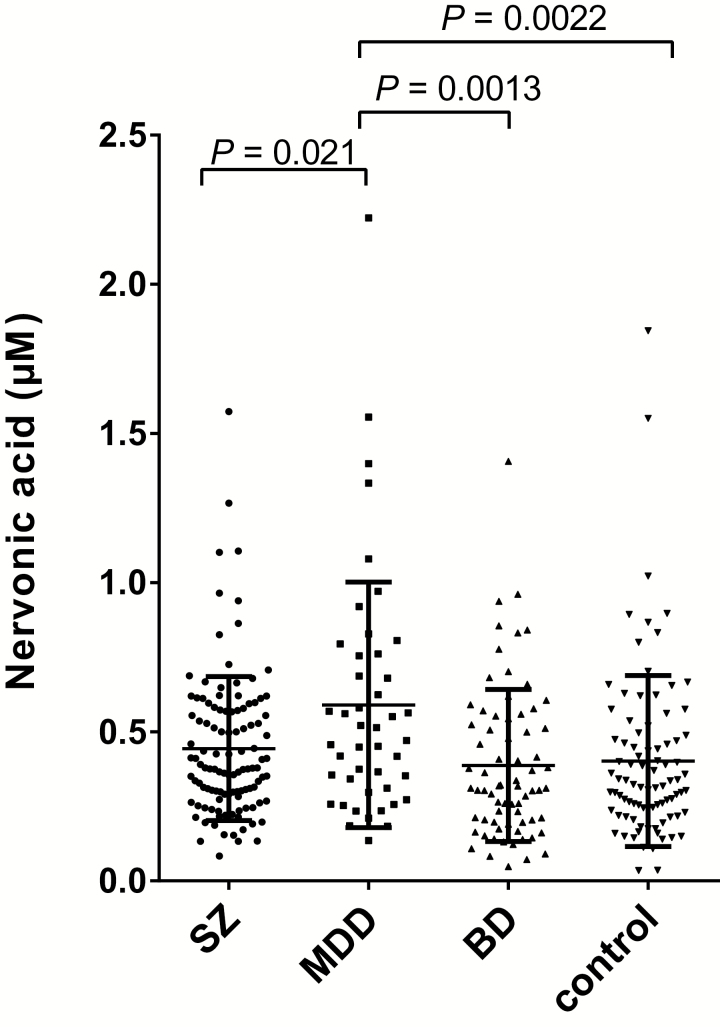
The increased levels of nervonic acid in patients with major depressive disorder compared with controls and patients with bipolar disorder in cohort 1 were replicated in the independent sample set (cohort 2). In cohort 2, plasma nervonic acid levels were also increased in the patients with major depressive disorder compared with the patients with schizophrenia. In cohort 2, nervonic acid levels were increased in the depressive state in patients with major depressive disorder compared with the levels in the remission state in patients with major depressive disorder and the depressive state in patients with bipolar disorder.
These results suggested that plasma nervonic acid is a good candidate biomarker for the depressive state of major depressive disorder.
目前迫切需要用于重度抑郁症、双相情感障碍和精神分裂症的诊断生物标志物,但目前尚无此类标志物。
我们采用液相色谱飞行时间质谱法对来自未经药物治疗的重度抑郁症(n=9)、双相情感障碍(n=6)、精神分裂症(n=17)患者及相匹配的健康对照者(n=19)(队列 1)的血浆样本进行了全面代谢组学分析。诊断对 2 种代谢物(神经酸和皮质酮)有显著影响,其中神经酸的变化最显著。我们使用气相色谱飞行时间质谱法,在另一个包括接受精神药物治疗的患者[重度抑郁症(n=45)、双相情感障碍(n=71)、精神分裂症(n=115)]及相匹配的健康对照者(n=90)(队列 2)中验证了结果的可重复性以及神经酸受精神药物影响的情况。
在队列 1 中,与对照组和双相情感障碍患者相比,重度抑郁症患者的神经酸水平升高,该结果在独立样本集(队列 2)中得到了复制。在队列 2 中,与精神分裂症患者相比,重度抑郁症患者的血浆神经酸水平也升高。在队列 2 中,与重度抑郁症患者缓解期相比,重度抑郁症患者的抑郁期血浆神经酸水平升高,与双相情感障碍患者的抑郁期相比也升高。
这些结果表明,血浆神经酸可能是重度抑郁症抑郁状态的一个很好的候选生物标志物。