Eye and Brain Mapping Laboratory (iBMLab), Department of Psychology, University of Fribourg, Fribourg, Switzerland.
Department of Neuroscience, Psychology, Drug Research & Child's Health, University of Florence, Florence, Italy.
Soc Cogn Affect Neurosci. 2017 Dec 1;12(12):1959-1971. doi: 10.1093/scan/nsx110.
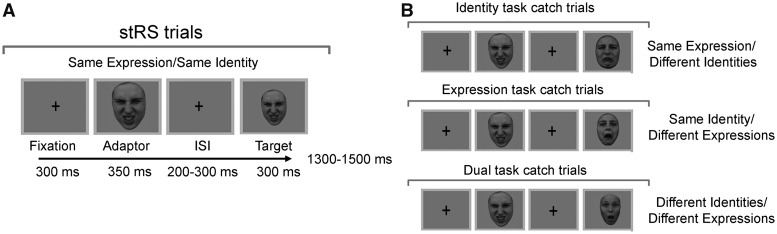
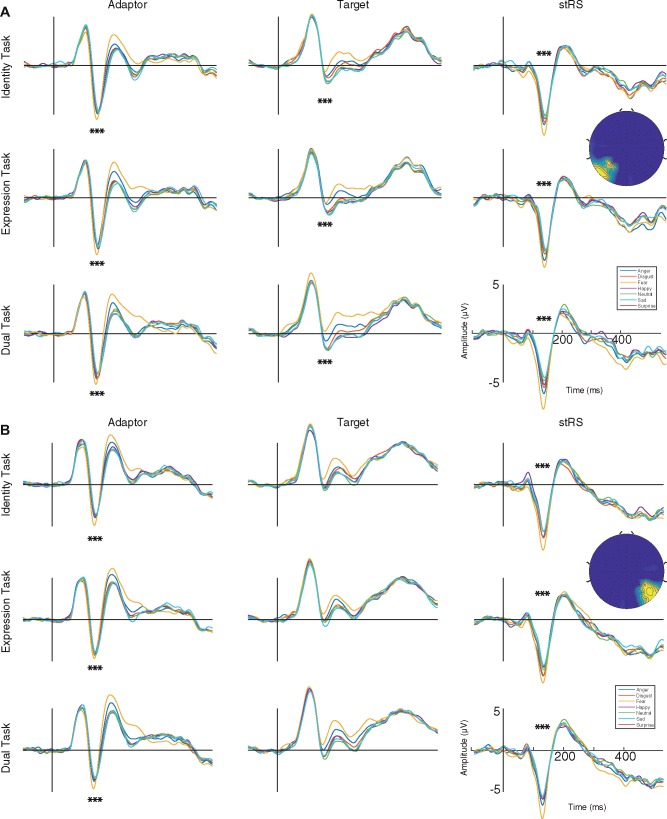
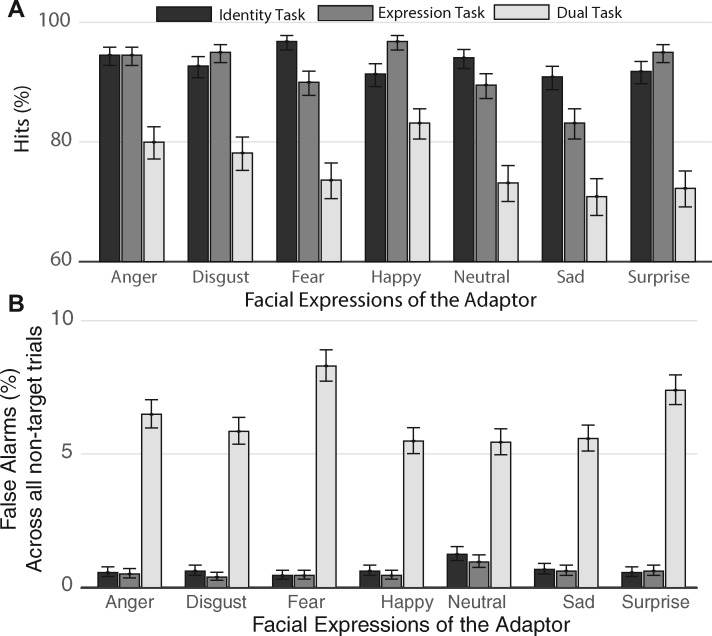
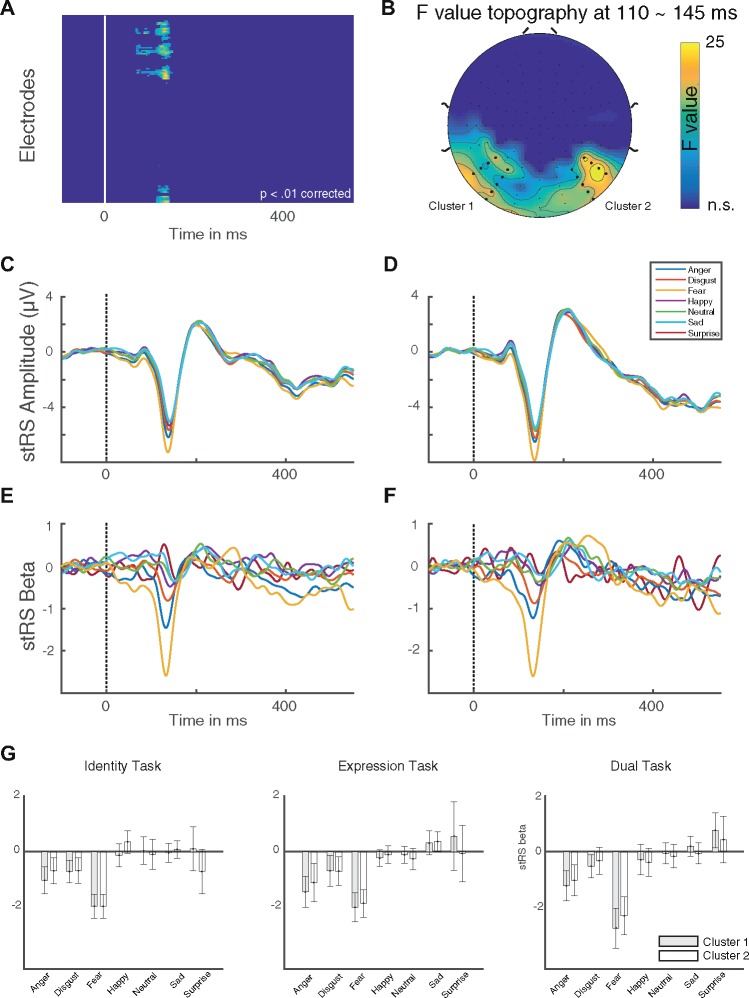
The rapid extraction of facial identity and emotional expressions is critical for adapted social interactions. These biologically relevant abilities have been associated with early neural responses on the face sensitive N170 component. However, whether all facial expressions uniformly modulate the N170, and whether this effect occurs only when emotion categorization is task-relevant, is still unclear. To clarify this issue, we recorded high-resolution electrophysiological signals while 22 observers perceived the six basic expressions plus neutral. We used a repetition suppression paradigm, with an adaptor followed by a target face displaying the same identity and expression (trials of interest). We also included catch trials to which participants had to react, by varying identity (identity-task), expression (expression-task) or both (dual-task) on the target face. We extracted single-trial Repetition Suppression (stRS) responses using a data-driven spatiotemporal approach with a robust hierarchical linear model to isolate adaptation effects on the trials of interest. Regardless of the task, fear was the only expression modulating the N170, eliciting the strongest stRS responses. This observation was corroborated by distinct behavioral performance during the catch trials for this facial expression. Altogether, our data reinforce the view that fear elicits distinct neural processes in the brain, enhancing attention and facilitating the early coding of faces.
快速提取面部身份和情感表达对于适应社交互动至关重要。这些与生物相关的能力与面部敏感的 N170 成分的早期神经反应有关。然而,所有面部表情是否都均匀地调节 N170,以及这种效应是否仅在情绪分类与任务相关时发生,仍然不清楚。为了澄清这个问题,我们在 22 名观察者感知六种基本表情加中性表情时记录了高分辨率的电生理信号。我们使用了重复抑制范式,在适应器之后,目标面部显示相同的身份和表情(感兴趣的试验)。我们还包括了捕捉试验,参与者必须对目标面部的身份(身份任务)、表情(表情任务)或两者(双重任务)做出反应。我们使用具有稳健层次线性模型的数据驱动时空方法提取单次试验重复抑制(stRS)反应,以分离试验中适应效应的影响。无论任务如何,恐惧是唯一能调节 N170 的表情,引起最强的 stRS 反应。这一观察结果通过对这种面部表情的捕捉试验中的独特行为表现得到了证实。总的来说,我们的数据强化了这样一种观点,即恐惧在大脑中引发了不同的神经过程,增强了注意力并促进了面部的早期编码。