Dedukh Dmitry, Litvinchuk Spartak, Rosanov Juriy, Shabanov Dmitry, Krasikova Alla
Saint-Petersburg State University, Saint-Petersburg, Russia.
Institute of Cytology, Russian Academy of Sciences, Saint-Petersburg, Russia.
BMC Evol Biol. 2017 Oct 17;17(1):220. doi: 10.1186/s12862-017-1063-3.
Interspecies animal hybrids can employ clonal or hemiclonal reproduction modes where one or all parental genomes are transmitted to the progeny without recombination. Nevertheless, some interspecies hybrids retain strong connection with the parental species needed for successful reproduction. Appearance of polyploid hybrid animals may play an important role in the substitution of parental species and in the speciation process.
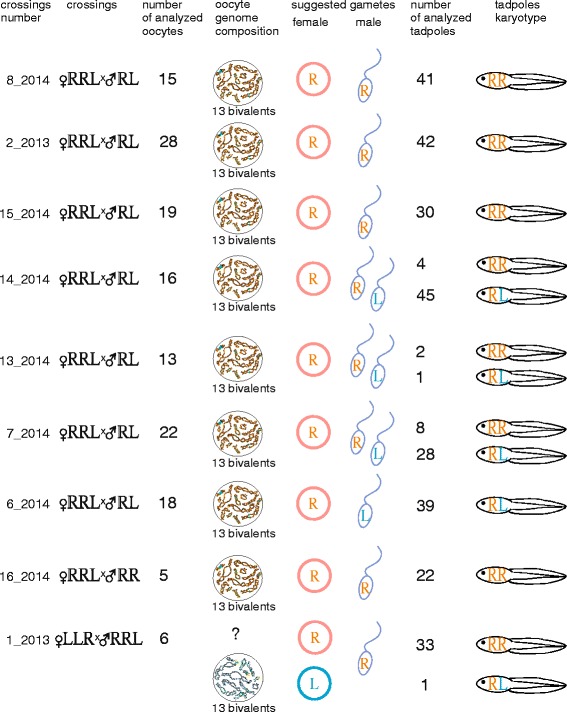
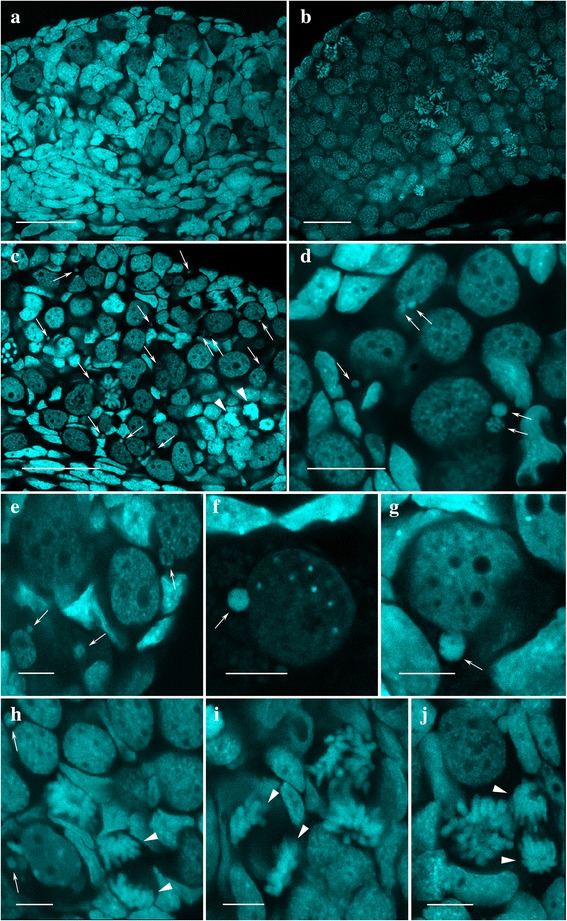
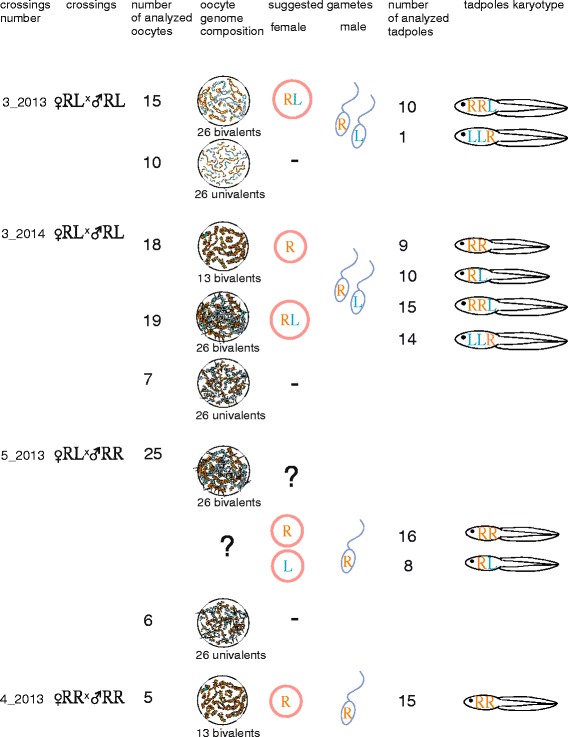
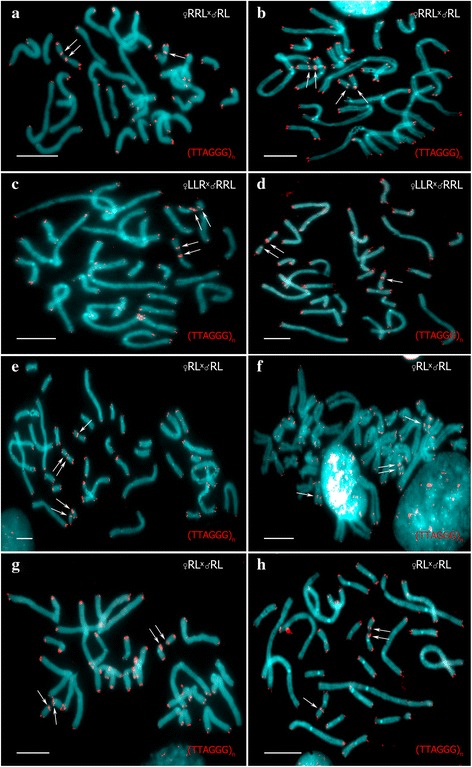
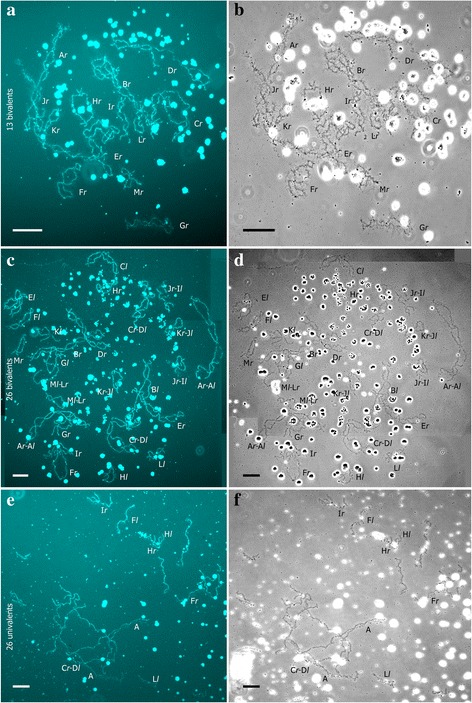
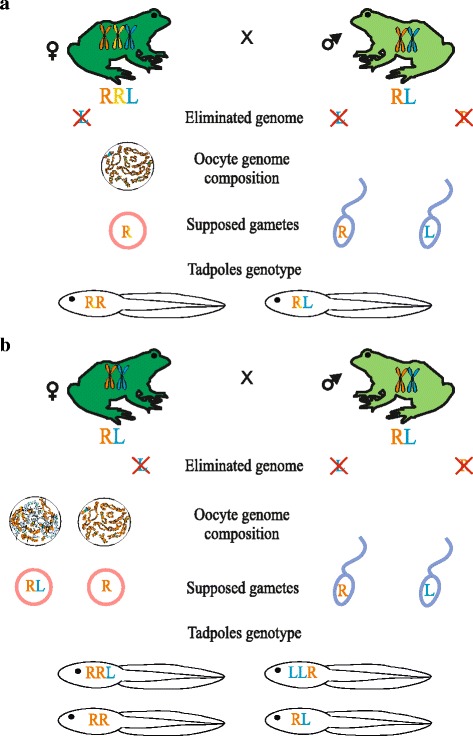
To establish the mechanisms that enable parental species, diploid and polyploid hybrids coexist we have performed artificial crossing experiments of water frogs of Pelophylax esculentus complex. We identified tadpole karyotypes and oocyte genome composition in all females involved in the crossings. The majority of diploid and triploid hybrid frogs produced oocytes with 13 bivalents leading to haploid gametes with the same genome as parental species hybrids usually coexist with. After fertilization of such gametes only diploid animals appeared. Oocytes with 26 bivalents produced by some diploid hybrid frogs lead to diploid gametes, which give rise to triploid hybrids after fertilization. In gonads of all diploid and triploid hybrid tadpoles we found DAPI-positive micronuclei (nucleus-like bodies) involved in selective genome elimination. Hybrid male and female individuals produced tadpoles with variable karyotype and ploidy even in one crossing owing to gametes with various genome composition.
We propose a model of diploid and triploid hybrid frog reproduction in R-E population systems. Triploid Pelophylax esculentus hybrids can transmit genome of parental species they coexist with by producing haploid gametes with the same genome composition. Triploid hybrids cannot produce triploid individuals after crossings with each other and depend on diploid hybrid females producing diploid eggs. In contrast to other population systems, the majority of diploid and triploid hybrid females unexpectedly produced gametes with the same genome as parental species hybrids coexist with.
种间动物杂交种可采用克隆或半克隆繁殖模式,其中一个或所有亲代基因组可在不发生重组的情况下传递给后代。然而,一些种间杂交种与成功繁殖所需的亲代物种仍保持着紧密联系。多倍体杂交动物的出现可能在亲代物种替代和物种形成过程中发挥重要作用。
为了确定使亲代物种、二倍体和多倍体杂交种共存的机制,我们对食用蛙复合种(Pelophylax esculentus complex)的水蛙进行了人工杂交实验。我们确定了所有参与杂交的雌性个体的蝌蚪核型和卵母细胞基因组组成。大多数二倍体和三倍体杂交蛙产生的卵母细胞有13个二价体,导致单倍体配子的基因组与杂交种通常共存的亲代物种相同。此类配子受精后仅出现二倍体动物。一些二倍体杂交蛙产生的有26个二价体的卵母细胞导致二倍体配子,受精后产生三倍体杂交种。在所有二倍体和三倍体杂交蝌蚪的性腺中,我们发现了参与选择性基因组消除的DAPI阳性微核(类核体)。即使在一次杂交中,杂交的雄性和雌性个体也会产生核型和倍性不同的蝌蚪,这是由于配子具有不同的基因组组成。
我们提出了R-E种群系统中二倍体和三倍体杂交蛙繁殖的模型。三倍体食用蛙杂交种可通过产生具有相同基因组组成的单倍体配子来传递与其共存的亲代物种的基因组。三倍体杂交种相互杂交后不能产生三倍体个体,而是依赖于产生二倍体卵的二倍体杂交雌性。与其他种群系统不同的是,大多数二倍体和三倍体杂交雌性意外地产生了与杂交种共存的亲代物种具有相同基因组的配子。