Sugimoto Keisuke, Ueda Satoshi, Okada Mitsuru, Takemura Tsukasa
Department of Pediatrics, Kinki University Faculty of Medicine, Osaka, Japan.
Clin Nephrol Case Stud. 2017 Aug 30;5:54-59. doi: 10.5414/CNCS108856. eCollection 2017.
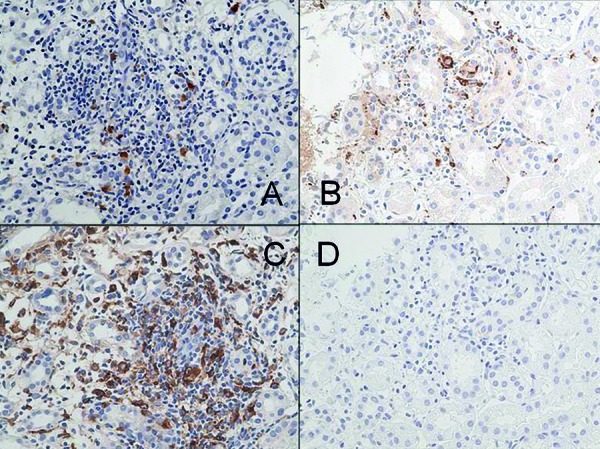
Rosai-Dorfman disease is also known as sinus histiocytosis with massive lymphadenopathy. Extranodal Rosai-Dorfman disease has been reported in ~ 43% of cases; the most frequent extranodal sites - skin, soft tissue, bone, respiratory tract, and eye - are usually involved in association with lymphadenopathy. Lack of lymph node involvement is rare, especially when patients manifest renal disease. Here, we describe a patient who developed membranoproliferative glomerulonephritis when lymphadenopathy was absent. During follow-up for sinus histiocytosis, a 7-year-old Japanese boy developed proteinuria and hematuria. No renal abnormality was present in ultrasound imaging. Histologic examination of a renal biopsy specimen disclosed moderate mesangial proliferation, focal thickening of glomerular capillary walls, and mesangial interposition. Mononuclear cells infiltrated the interstitium. Immunofluorescence showed intense IgG, C3, and C4 reactivity in portions of the mesangium and glomerular capillary walls. Electron microscopy depicted nodular deposits in mesangial, endocapillary, and subepithelial areas. Immunohistochemistry for S-100 protein, CD68, and lysozyme was positive within the interstitium. CD1a staining was absent. These findings were diagnostic for membranoproliferative glomerulonephritis. Multidrug therapy, including methylprednisolone and mizoribine, improved urinary findings and induced complete remission of both diseases. To the best of our knowledge, this is the first report of Rosai-Dorfman disease complicated by renal disease in the absence of concurrent nodal involvement. Clinicians should be alert to this diagnostic possibility.
罗萨伊-多夫曼病也被称为伴有巨大淋巴结病的窦性组织细胞增生症。据报道,约43%的病例存在结外罗萨伊-多夫曼病;最常见的结外部位——皮肤、软组织、骨骼、呼吸道和眼睛——通常与淋巴结病相关。无淋巴结受累的情况罕见,尤其是当患者出现肾脏疾病时。在此,我们描述一名在无淋巴结病时发生膜增生性肾小球肾炎的患者。在对窦性组织细胞增生症进行随访期间,一名7岁日本男孩出现蛋白尿和血尿。超声检查未发现肾脏异常。肾活检标本的组织学检查显示中度系膜增生、肾小球毛细血管壁局灶性增厚以及系膜插入。单核细胞浸润间质。免疫荧光显示系膜和肾小球毛细血管壁部分有强烈的IgG、C3和C4反应。电子显微镜显示系膜、毛细血管内和上皮下区域有结节状沉积物。间质内S-100蛋白、CD68和溶菌酶的免疫组化染色呈阳性。CD1a染色阴性。这些发现可诊断为膜增生性肾小球肾炎。包括甲基强的松龙和咪唑立宾在内的多药治疗改善了尿液检查结果,并使两种疾病完全缓解。据我们所知,这是首例无并发淋巴结受累而合并肾脏疾病的罗萨伊-多夫曼病报告。临床医生应警惕这种诊断可能性。