Lee Suk-Hee, Oh Angela, Shin Seo-Hee, Kim Ha-Na, Kang Woo-Won, Chung Shin-Kyo
Gyeongsangbuk-do Agricultural Research and Extension Services, Daegu 41404, Korea.
School of Food Science and Biotechnology, Kyungpook National University, Daegu 41566, Korea.
Prev Nutr Food Sci. 2017 Sep;22(3):237-240. doi: 10.3746/pnf.2017.22.3.237. Epub 2017 Sep 30.
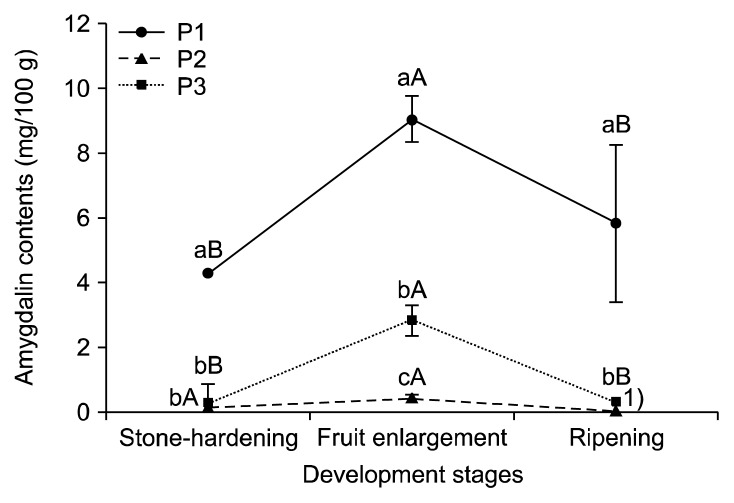
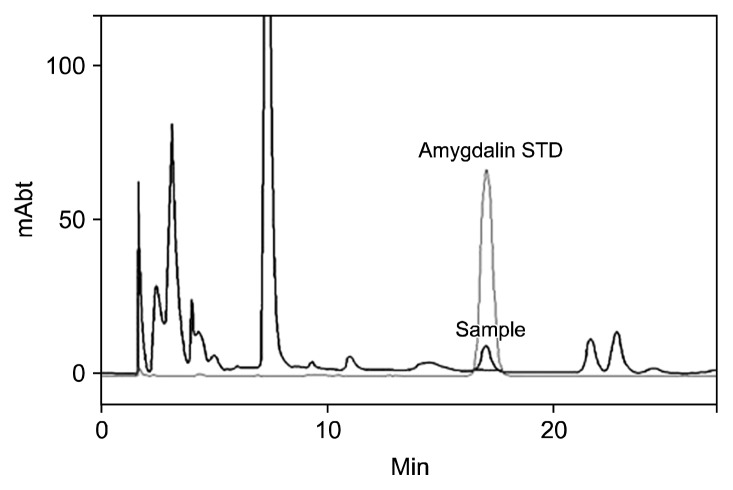
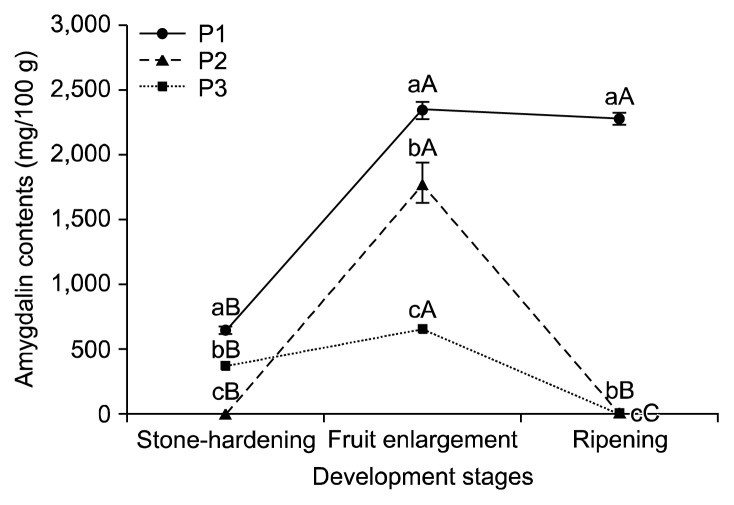
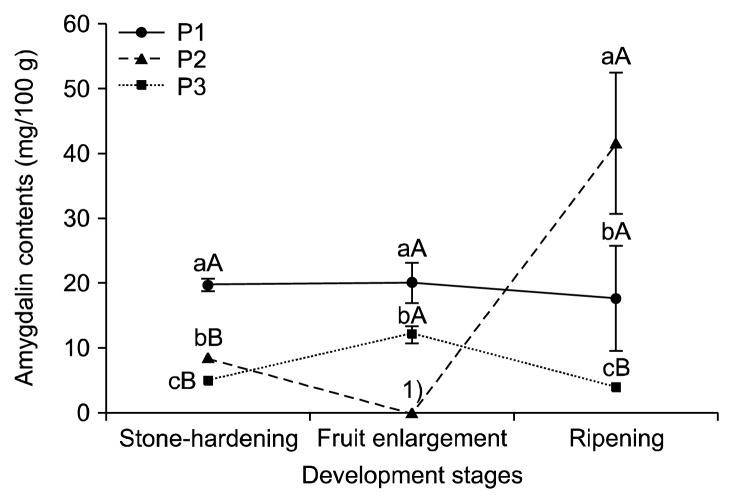
Amygdalin contents of the seeds, endocarps, and mesocarps from three peach cultivars (i.e., Stone Peach, Hikawa Hakuho, and Bakhyang) were measured at three stages of fruit development (stone-hardening, fruit enlargement, and ripening). The peach samples were dried and defatted with a Soxhlet apparatus, reflux extracted with methanol, and analyzed using reverse phase high-performance liquid chromatography. During all fruit development stages, the amygdalin contents in the seeds were higher than those in the endocarps and mesocarps. The amygdalin contents of the Stone Peach were comparatively higher than the Hikawa Hakuho and Bakhyang (<0.05). Further, the amygdalin contents during ripening were very low or not detected. Overall, the amygdalin contents of the three peach cultivar samples (seed, endocarp, and mesocarp) increased until the fruit enlargement stage and either remained constant or decreased during ripening.
在果实发育的三个阶段(硬核期、果实膨大期和成熟期),测定了三个桃品种(即石桃、日川白凤和白凤)种子、内果皮和中果皮中的苦杏仁苷含量。将桃样品干燥后用索氏提取器脱脂,用甲醇回流提取,并用反相高效液相色谱法进行分析。在果实发育的所有阶段,种子中的苦杏仁苷含量均高于内果皮和中果皮。石桃的苦杏仁苷含量相对高于日川白凤和白凤(<0.05)。此外,成熟期的苦杏仁苷含量非常低或未检测到。总体而言,三个桃品种样品(种子、内果皮和中果皮)的苦杏仁苷含量在果实膨大期之前增加,在成熟期保持不变或下降。