Pareja Fresia, Geyer Felipe C, Kumar Rahul, Selenica Pier, Piscuoglio Salvatore, Ng Charlotte K Y, Burke Kathleen A, Edelweiss Marcia, Murray Melissa P, Brogi Edi, Weigelt Britta, Reis-Filho Jorge S
Department of Pathology, Memorial Sloan Kettering Cancer Center, New York, NY USA.
Institute of Pathology, University Hospital Basel, Basel, Switzerland.
NPJ Breast Cancer. 2017 Oct 12;3:40. doi: 10.1038/s41523-017-0042-6. eCollection 2017.
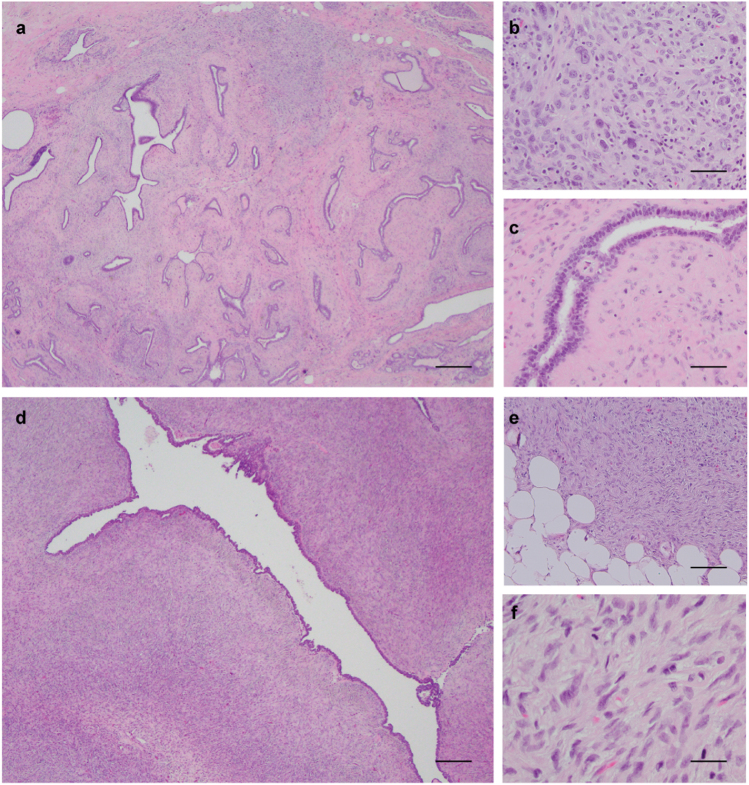
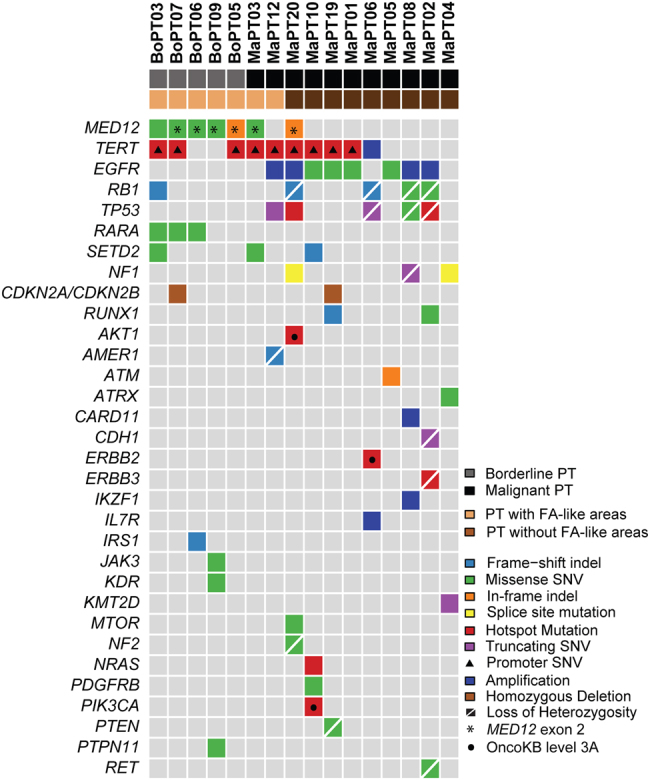
Breast fibroepithelial lesions (fibroadenomas and phyllodes tumors) are underpinned by recurrent exon 2 mutations, which are more common in fibroadenomas and benign phyllodes tumors. promoter hotspot mutations have been documented in phyllodes tumors, and found to be more frequent in borderline and malignant lesions. Several lines of evidence suggest that a subset of phyllodes tumors might arise from fibroadenomas. Here we sought to investigate the genetic differences between phyllodes tumors with fibroadenoma-like areas vs. those without. We retrieved data for 16 borderline/ malignant phyllodes tumors, including seven phyllodes tumors with fibroadenoma-like areas and nine phyllodes tumors without fibroadenoma-like areas, which had been previously subjected to targeted capture massively parallel sequencing. Whilst exon 2 mutations were significantly more frequent in tumors with fibroadenoma-like areas (71 vs. 11%), an enrichment in genetic alterations targeting cancer genes was found in those without fibroadenoma-like areas, in particular in mutations and amplifications (78 vs. 14%). No significant difference in the frequency of genetic alterations was observed (71% in cases with fibroadenoma-like areas vs 56% in those without fibroadenoma-like areas). Our data suggest that the development of phyllodes tumors might follow two different evolutionary pathways: a -mutant pathway that involves the progression from a fibroadenoma to a malignant phyllodes tumor; and a -wild-type pathway, where malignant phyllodes tumors arise de novo through the acquisition of genetic alterations targeting cancer genes. Additional studies are warranted to confirm our observations and define whether the outcome differs between both pathways.
乳腺纤维上皮性病变(纤维腺瘤和叶状肿瘤)由外显子2的反复突变所支撑,这些突变在纤维腺瘤和良性叶状肿瘤中更为常见。叶状肿瘤中已记录到启动子热点突变,且在交界性和恶性病变中更为频繁。有几条证据表明,一部分叶状肿瘤可能起源于纤维腺瘤。在此,我们试图研究具有纤维腺瘤样区域的叶状肿瘤与无纤维腺瘤样区域的叶状肿瘤之间的基因差异。我们检索了16例交界性/恶性叶状肿瘤的数据,其中包括7例具有纤维腺瘤样区域的叶状肿瘤和9例无纤维腺瘤样区域的叶状肿瘤,这些肿瘤先前已进行靶向捕获大规模平行测序。虽然外显子2突变在具有纤维腺瘤样区域的肿瘤中明显更频繁(71%对11%),但在无纤维腺瘤样区域的肿瘤中发现针对癌症基因的基因改变有所富集,特别是在突变和扩增方面(78%对14%)。在基因改变的频率上未观察到显著差异(具有纤维腺瘤样区域的病例中为71%,无纤维腺瘤样区域的病例中为56%)。我们的数据表明,叶状肿瘤的发生可能遵循两种不同的进化途径:一种是涉及从纤维腺瘤进展为恶性叶状肿瘤的α-突变途径;另一种是野生型途径,即恶性叶状肿瘤通过获得针对癌症基因的基因改变而从头发生。需要进一步的研究来证实我们的观察结果,并确定两种途径的结果是否不同。