Department of Pathology, Memorial Sloan Kettering Cancer Center, New York, NY, USA.
Histopathology. 2017 Oct;71(4):626-634. doi: 10.1111/his.13258. Epub 2017 Jul 5.
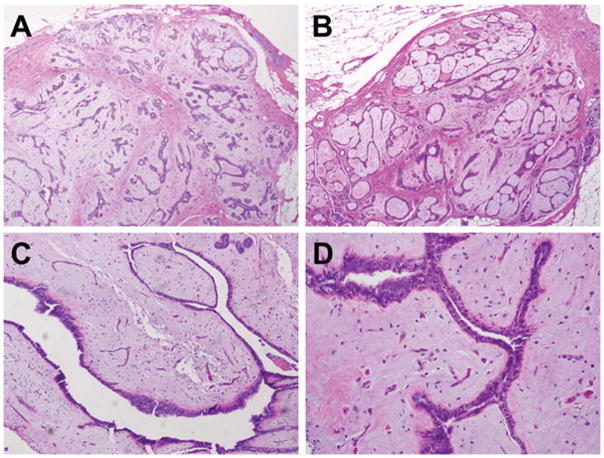
Breast myxoid fibroadenomas (MFAs) are characterized by a distinctive hypocellular myxoid stroma, and occur sporadically or in the context of Carney complex, an inheritable condition caused by PRKAR1A-inactivating germline mutations. Conventional fibroadenomas (FAs) are underpinned by recurrent MED12 mutations in the stromal components of the lesions. The aim of this study was to investigate the genomic landscape of MFAs and compare it with that of conventional FAs.
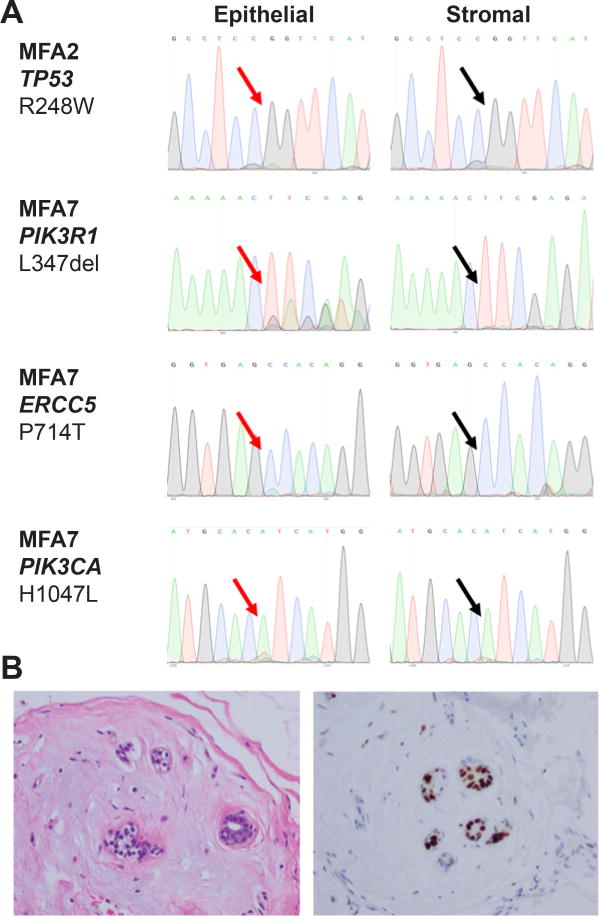
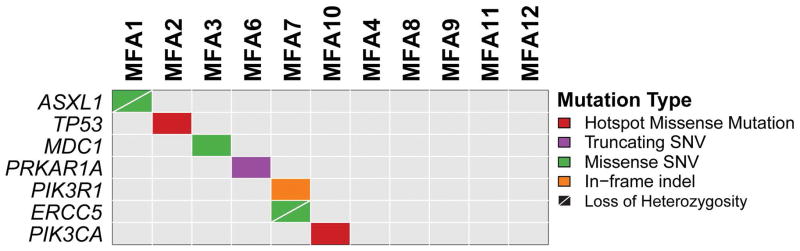
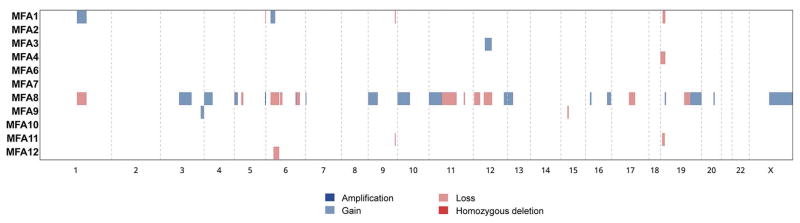
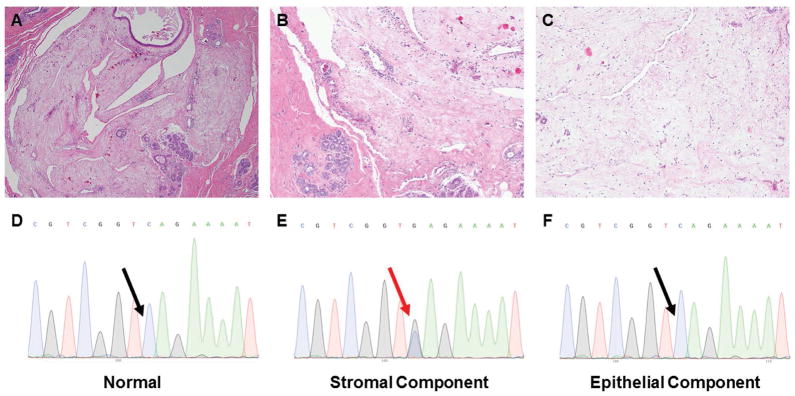
Eleven MFAs from patients without clinical and/or genetic evidence of Carney complex were retrieved. DNA samples of tumour and matching normal tissue were subjected to massively parallel sequencing using the Memorial Sloan Kettering-Integrated Mutation Profiling of Actionable Cancer Targets (MSK-IMPACT) assay, an assay targeting 410 cancer genes. Genetic alterations detected by MSK-IMPACT were tested in samples in which the stromal and epithelial components were separately laser capture-microdissected. Sequencing revealed no germline PRKAR1A mutations and non-synonymous mutations in six MFAs. Interestingly, in three of the MFAs in which the stromal and epithelial components were separately microdissected, the mutations were found to be restricted to the epithelial rather than the stromal component. The sole exception was a lesion harbouring a somatic truncating PRKAR1A mutation. Upon histological re-review, this case was reclassified as a breast myxoma, consistent with the spectrum of tumous observed in Carney complex patients. In this case, the PRKAR1A somatic mutation was restricted to the stromal component.
MFAs lack MED12 mutations, and their stromal components seem not to harbour mutations in the 410 cancer genes tested. Whole-exome and/or whole-genome analyses of MFAs are required to elucidate their genetic drivers.
乳腺黏液纤维腺瘤(MFA)的特征是独特的细胞稀少黏液样基质,并且偶发或发生于卡尼综合征(Carney complex)中,这是一种由 PRKAR1A 失活种系突变引起的遗传性疾病。常规纤维腺瘤(FA)是由病变基质成分中反复发生的 MED12 突变引起的。本研究旨在研究 MFA 的基因组图谱,并将其与常规 FA 进行比较。
从没有卡尼综合征临床和/或遗传证据的患者中检索到 11 例 MFA。对肿瘤和匹配的正常组织的 DNA 样本进行了大规模平行测序,使用纪念斯隆凯特琳综合行动癌症靶标基因测序(MSK-IMPACT)检测方法,该方法靶向 410 个癌症基因。在分别对基质和上皮成分进行激光捕获微切割的样本中测试了 MSK-IMPACT 检测到的遗传改变。测序未发现胚系 PRKAR1A 突变和 6 个 MFA 中的非 synonymous突变。有趣的是,在 3 个分别对基质和上皮成分进行微切割的 MFA 中,突变仅局限于上皮而非基质成分。唯一的例外是一个含有体细胞截断 PRKAR1A 突变的病变。经过组织学重新审查,该病例被重新归类为乳腺黏液瘤,与卡尼综合征患者观察到的肿瘤谱一致。在这种情况下,PRKAR1A 体细胞突变仅限于基质成分。
MFA 缺乏 MED12 突变,其基质成分似乎不携带所检测的 410 个癌症基因中的突变。需要对 MFA 进行全外显子组和/或全基因组分析,以阐明其遗传驱动因素。