Genetic Epidemiology and Genomic Informatics, Faculty of Medicine, University of Southampton, Duthie Building, Mailpoint 808, Tremona Road, Southampton, SO16 6YD, UK.
Wessex Clinical Genetics Service, Level G, Mailpoint 105, Princess Anne Hospital, Coxford Road, Southampton, SO16 5YA, UK.
Sci Rep. 2017 Oct 18;7(1):13509. doi: 10.1038/s41598-017-13841-y.
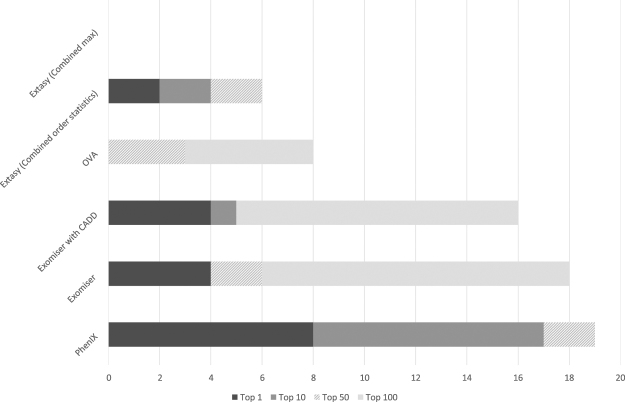
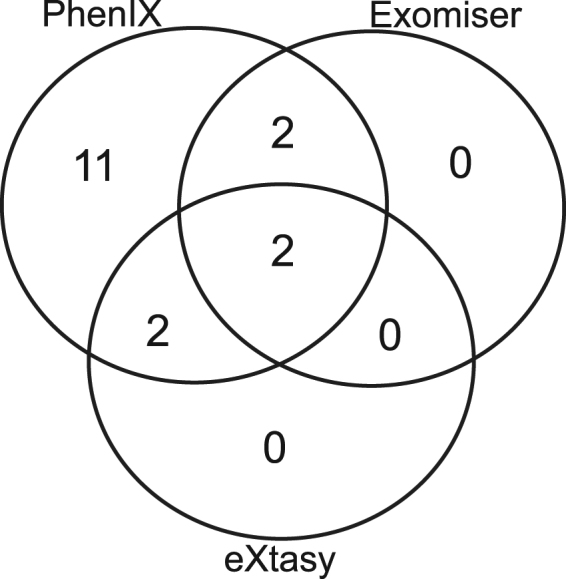
Next generation sequencing is transforming clinical medicine and genome research, providing a powerful route to establishing molecular diagnoses for genetic conditions; however, challenges remain given the volume and complexity of genetic variation. A number of methods integrate patient phenotype and genotypic data to prioritise variants as potentially causal. Some methods have a clinical focus while others are more research-oriented. With clinical applications in mind we compare results from alternative methods using 21 exomes for which the disease causal variant has been previously established through traditional clinical evaluation. In this case series we find that the PhenIX program is the most effective, ranking the true causal variant at between 1 and 10 in 85% of these cases. This is a significantly higher proportion than the combined results from five alternative methods tested (p = 0.003). The next best method is Exomiser (hiPHIVE), in which the causal variant is ranked 1-10 in 25% of cases. The widely different targets of these methods (more clinical focus, considering known Mendelian genes, in PhenIX, versus gene discovery in Exomiser) is perhaps not fully appreciated but may impact strongly on their utility for molecular diagnosis using clinical exome data.
下一代测序正在改变临床医学和基因组研究,为建立遗传条件的分子诊断提供了一条有力途径;然而,鉴于遗传变异的数量和复杂性,仍然存在挑战。许多方法将患者表型和基因型数据整合起来,将变异视为潜在的因果关系。有些方法侧重于临床,而另一些方法则更具研究性。考虑到临床应用,我们使用已经通过传统临床评估确定疾病因果变异的 21 个外显子,比较了替代方法的结果。在这个病例系列中,我们发现 PhenIX 程序是最有效的,在 85%的情况下将真正的因果变异排在 1 到 10 位。这一比例明显高于我们测试的五种替代方法的综合结果(p=0.003)。排名第二的是 Exomiser(hiPHIVE),在 25%的情况下将因果变异排在 1-10 位。这些方法的目标差异很大(PhenIX 更侧重于临床,考虑已知的孟德尔基因,而 Exomiser 则专注于基因发现),这也许还没有得到充分认识,但可能会对它们使用临床外显子组数据进行分子诊断的实用性产生强烈影响。