Cipriani Valentina, Pontikos Nikolas, Arno Gavin, Sergouniotis Panagiotis I, Lenassi Eva, Thawong Penpitcha, Danis Daniel, Michaelides Michel, Webster Andrew R, Moore Anthony T, Robinson Peter N, Jacobsen Julius O B, Smedley Damian
William Harvey Research Institute, Queen Mary University of London, London EC1M 6BQ, UK.
UCL Institute of Ophthalmology, University College London, London EC1V 9EL, UK.
Genes (Basel). 2020 Apr 23;11(4):460. doi: 10.3390/genes11040460.
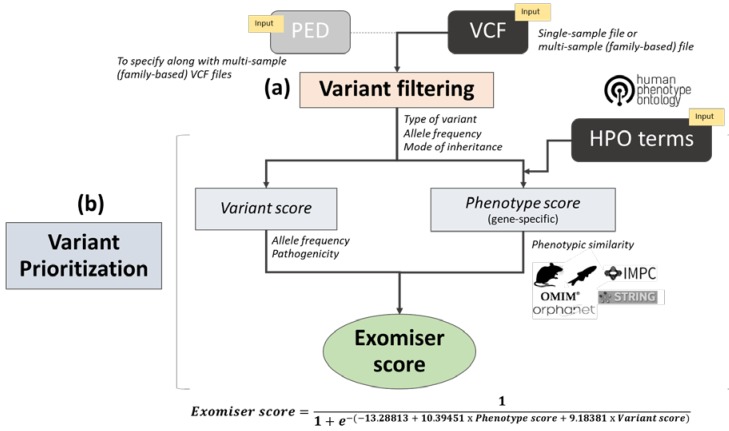
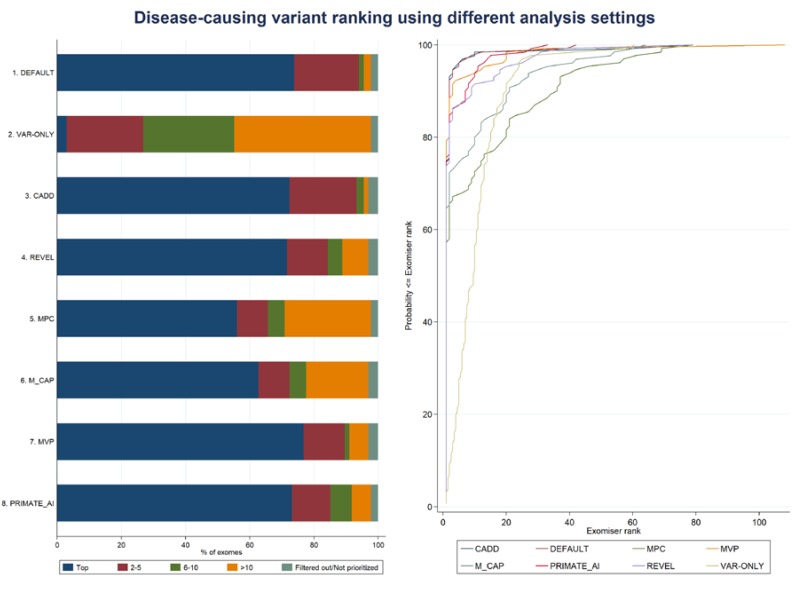
Next-generation sequencing has revolutionized rare disease diagnostics, but many patients remain without a molecular diagnosis, particularly because many candidate variants usually survive despite strict filtering. Exomiser was launched in 2014 as a Java tool that performs an integrative analysis of patients' sequencing data and their phenotypes encoded with Human Phenotype Ontology (HPO) terms. It prioritizes variants by leveraging information on variant frequency, predicted pathogenicity, and gene-phenotype associations derived from human diseases, model organisms, and protein-protein interactions. Early published releases of Exomiser were able to prioritize disease-causative variants as top candidates in up to 97% of simulated whole-exomes. The size of the tested real patient datasets published so far are very limited. Here, we present the latest Exomiser version 12.0.1 with many new features. We assessed the performance using a set of 134 whole-exomes from patients with a range of rare retinal diseases and known molecular diagnosis. Using default settings, Exomiser ranked the correct diagnosed variants as the top candidate in 74% of the dataset and top 5 in 94%; not using the patients' HPO profiles (i.e., variant-only analysis) decreased the performance to 3% and 27%, respectively. In conclusion, Exomiser is an effective support tool for rare Mendelian phenotype-driven variant prioritization.
下一代测序技术彻底改变了罕见病的诊断方式,但仍有许多患者未得到分子诊断,特别是因为尽管经过严格筛选,许多候选变异通常仍能留存下来。Exomiser于2014年推出,是一个Java工具,可对患者的测序数据及其用人表型本体(HPO)术语编码的表型进行综合分析。它通过利用来自人类疾病、模式生物和蛋白质-蛋白质相互作用的变异频率、预测致病性和基因-表型关联信息来对变异进行优先级排序。Exomiser早期发布的版本能够在高达97%的模拟全外显子组中将致病变异优先列为顶级候选。到目前为止,已发布的真实患者测试数据集规模非常有限。在此,我们展示了具有许多新功能的Exomiser最新版本12.0.1。我们使用一组来自患有一系列罕见视网膜疾病且有已知分子诊断的患者的134个全外显子组评估了其性能。使用默认设置时,Exomiser在74%的数据集中将正确诊断的变异列为顶级候选,在94%的数据集中列为前5名;不使用患者的HPO概况(即仅变异分析)时,性能分别降至3%和27%。总之,Exomiser是一种用于罕见孟德尔表型驱动的变异优先级排序的有效支持工具。