Ly Angelica, Nivison-Smith Lisa, Hennessy Michael, Kalloniatis Michael
Centre for Eye Health, Sydney, NSW, Australia.
School of Optometry and Vision Science, UNSW Sydney, Sydney, NSW, Australia.
Ophthalmic Physiol Opt. 2017 Nov;37(6):661-668. doi: 10.1111/opo.12413.
Pigmented ocular lesions are commonly encountered by eye-care professionals, and range from benign to sight or life-threatening. After identifying a lesion, the primary care professional must establish the likely diagnosis and decide either to reassure, to monitor or to refer. The increasing use of ocular imaging technologies has contributed to an increase in the detection rate of pigmented lesions and a higher number of referrals, which may challenge existing pathways of health-care delivery. Specialist services may be over-burdened by referring all patients with pigmented lesions for an opinion, while inter-optometric referrals are underutilised. The aim of this study was to describe the referral patterns of pigmented lesions to an optometry led intermediate-tier collaborative care clinic.
We performed a retrospective review of patient records using the list of patients examined at Centre for Eye Health (CFEH) for an initial or follow up pigmented lesion assessment between the 1/7/2013 and the 30/6/2016. Analysis was performed on: patient demographic characteristics, the referrer's tentative diagnosis, CFEH diagnosis and recommended management plan.
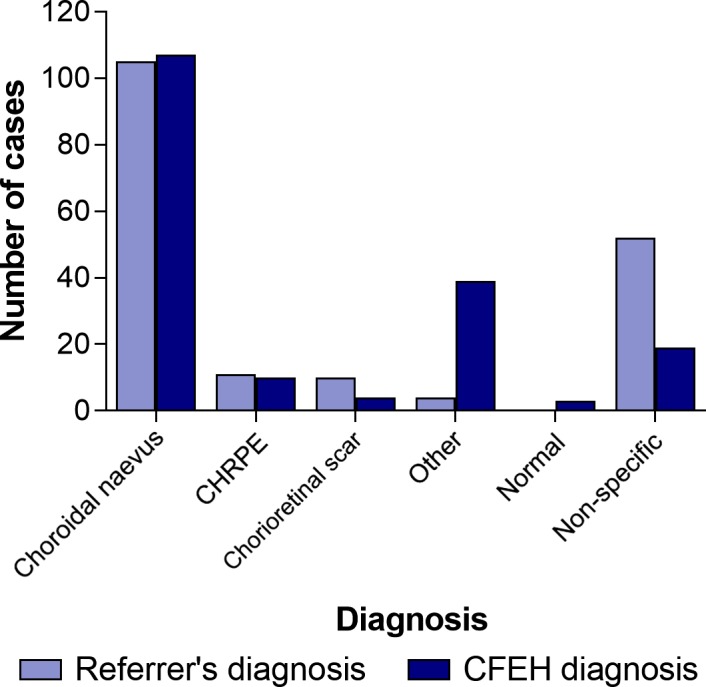
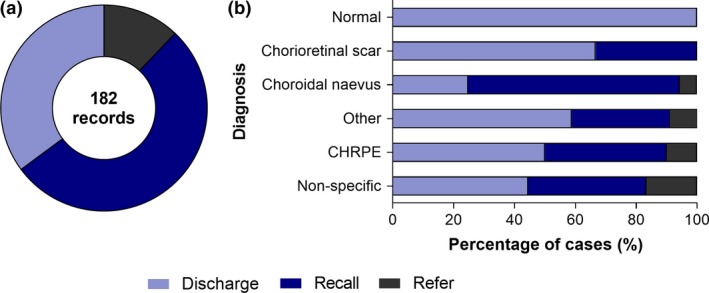
Across 182 patient records, the primary lesion prompting referral was usually located in the posterior segment: choroidal naevus (105/182, 58%), congenital hypertrophy of the retinal pigment epithelium (CHRPE; 11/182, 6%), chorioretinal scarring (10/182, 5%) or not specified (52/182, 29%). Referrals described a specific request for ocular imaging in 25 instances (14%). The number of cases with a non-specific diagnosis was reduced after intermediate-tier care assessment (from 29% to 10%), while the number of diagnoses with less common conditions rose (from 2% to 21%). There was a 2% false positive referral rate to intermediate-tier care and a first visit discharge rate of 35%. A minority required on-referral to an ophthalmologist (22/182, 12%), either for unrelated incidental ocular findings, or suspicious choroidal naevi. Conditions most amenable to optometric follow up included: 1) chorioretinal scarring, 2) choroidal naevus, and 3) CHRPE.
Intermediate-tier optometric eye-care in pigmented lesions (following opportunistic primary care screening) has the potential to reduce the number of cases with non-specific diagnoses and to increase those with less common diagnoses. The majority of cases seen under this intermediate-tier model required only ongoing optometric surveillance.
眼科保健专业人员经常会遇到色素性眼部病变,其范围从良性到威胁视力或生命。在识别出病变后,初级保健专业人员必须确定可能的诊断,并决定是给予安心建议、进行监测还是转诊。眼部成像技术的使用日益增加,导致色素性病变的检出率上升,转诊数量增多,这可能对现有的医疗服务途径构成挑战。将所有色素性病变患者都转诊以获取专业意见,可能会使专科服务负担过重,而验光师之间的转诊则未得到充分利用。本研究的目的是描述色素性病变转诊至由验光师主导的中级协作护理诊所的模式。
我们使用眼健康中心(CFEH)在2013年7月1日至2016年6月30日期间接受初次或后续色素性病变评估的患者名单,对患者记录进行了回顾性审查。分析内容包括:患者人口统计学特征、转诊医生的初步诊断、CFEH诊断以及推荐的管理计划。
在182份患者记录中,促使转诊的主要病变通常位于眼后段:脉络膜痣(105/182,58%)、视网膜色素上皮先天性肥大(CHRPE;11/182,6%)、脉络膜视网膜瘢痕(10/182,5%)或未明确(52/182,29%)。在25例(14%)转诊中提到了对眼部成像的特定要求。经过中级护理评估后,非特异性诊断的病例数量减少(从29%降至10%),而诊断为罕见病症的病例数量增加(从2%增至21%)。转诊至中级护理的假阳性率为2%,首次就诊出院率为35%。少数患者需要再次转诊至眼科医生(22/182,12%),原因要么是无关的偶然眼部发现,要么是可疑的脉络膜痣。最适合验光师随访的病症包括:1)脉络膜视网膜瘢痕,2)脉络膜痣,3)CHRPE。
在色素性病变方面(在机会性初级保健筛查之后)的中级验光师眼部护理有潜力减少非特异性诊断的病例数量,并增加罕见诊断的病例数量。在这种中级模式下见到的大多数病例仅需要持续的验光监测。