Mulligan Jennifer K, Pasquini Whitney N, Carroll William W, Williamson Tucker, Reaves Nicholas, Patel Kunal J, Mappus Elliott, Schlosser Rodney J, Atkinson Carl
Department of Otolaryngology-Head & Neck Surgery, Medical University of South Carolina, Charleston, South Carolina, United States of America.
Department of Pediatrics, Medical University of South Carolina, Charleston, South Carolina, United States of America.
PLoS One. 2017 Oct 18;12(10):e0186374. doi: 10.1371/journal.pone.0186374. eCollection 2017.
Patients with chronic rhinosinusitis with nasal polyps (CRSwNP) have been shown to be vitamin D3 (VD3) deficient, which is associated with more severe disease and increased polyp size. To gain mechanistic insights into these observational studies, we examined the impact of VD3 deficiency on inflammation and VD3 metabolism in an Aspergillus fumigatus (Af) mouse model of chronic rhinosinusitis (Af-CRS).
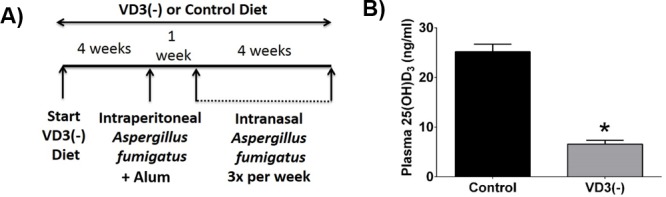
Balb/c mice were fed control or VD3 deficient diet for 4 weeks. Mice were then sensitized with intraperitoneal Af, and one week later given Af intranasally every three days for four weeks while being maintained on control or VD3 deficient diet. Airway function, sinonasal immune cell infiltrate and sinonasal VD3 metabolism profiles were then examined.
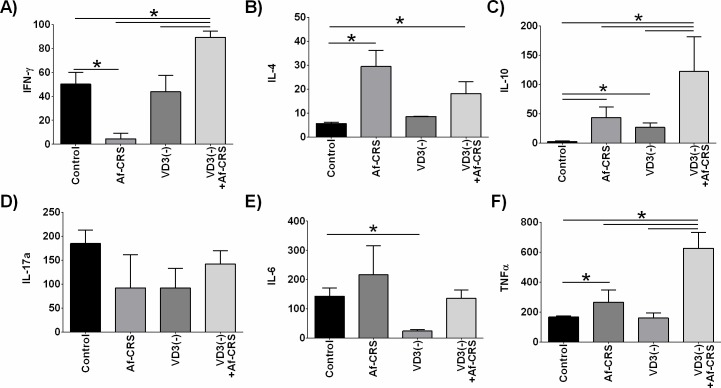
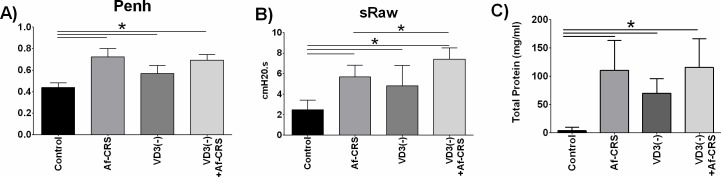
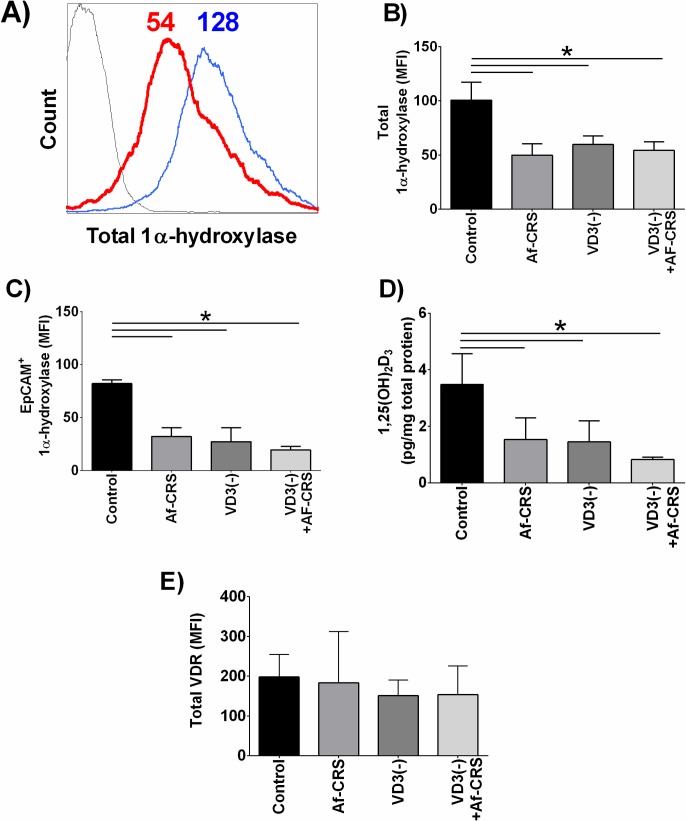
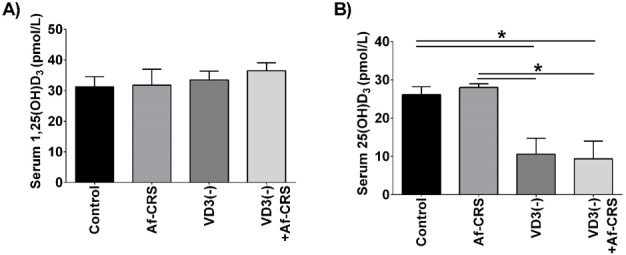
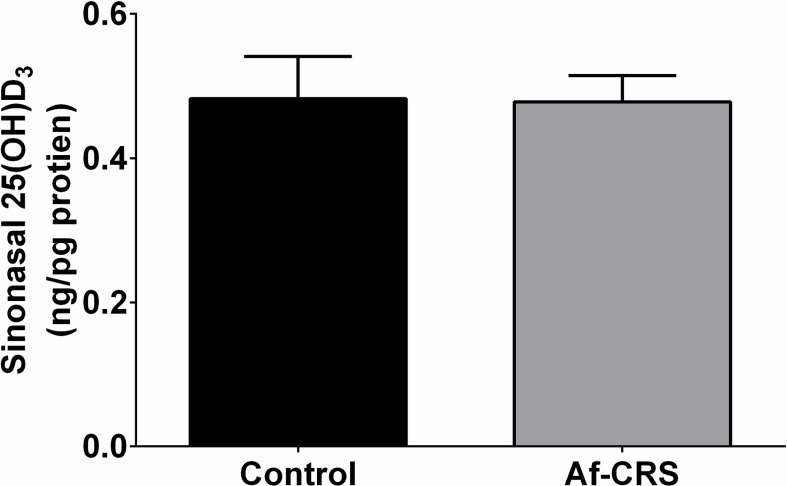
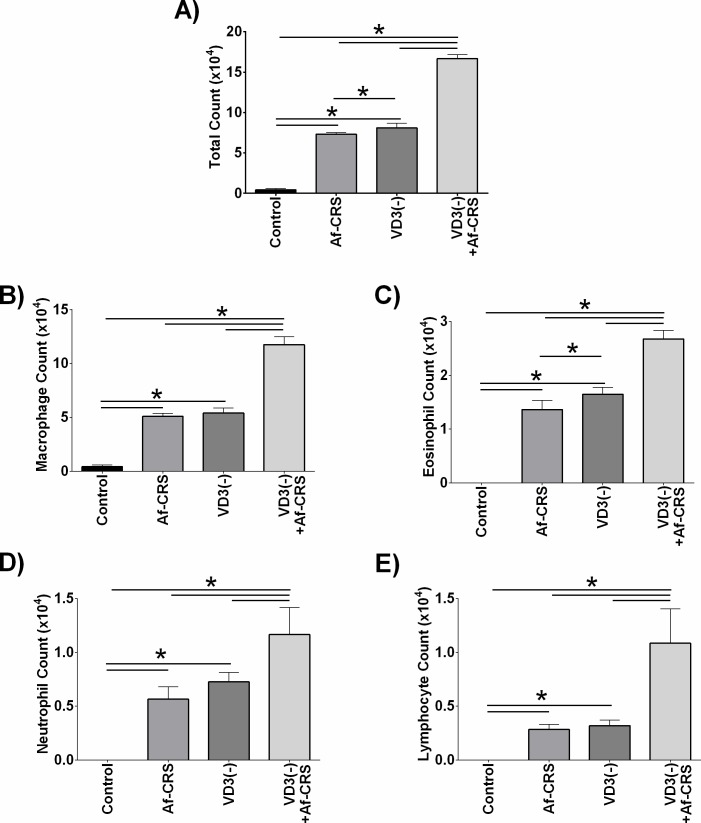
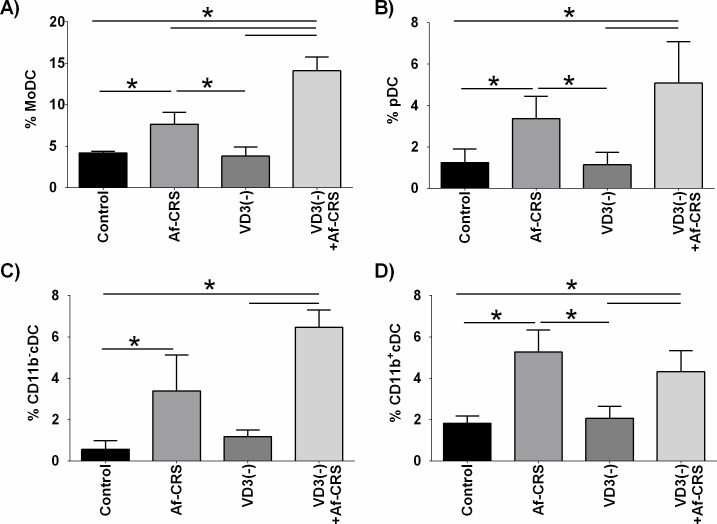
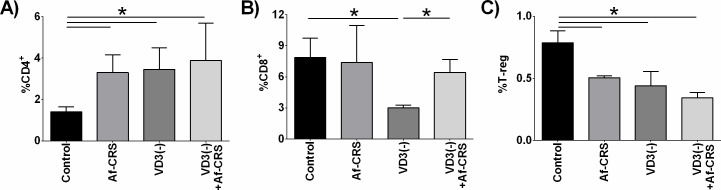
Mice with VD3 deficiency had increased Penh and sRaw values as compared to controls as well as exacerbated changes in sRaw when coupled with Af-CRS. As compared to controls, VD3 deficient and Af-CRS mice had reduced sinonasal 1α-hydroxylase and the active VD3 metabolite, 1,25(OH)2D3. Differential analysis of nasal lavage samples showed that VD3 deficiency alone and in combination with Af-CRS profoundly upregulated eosinophil, neutrophil and lymphocyte numbers. VD3 deficiency exacerbated increases in monocyte-derived dendritic cell (DC) associated with Af-CRS. Conversely, T-regulatory cells were decreased in both Af-CRS mice and VD3 deficient mice, though coupling VD3 deficiency with Af-CRS did not exacerbate CD4 or T-regulatory cells numbers. Lastly, VD3 deficiency had a modifying or exacerbating impact on nasal lavage levels of IFN-γ, IL-6, IL-10 and TNF-α, but had no impact on IL-17A.
VD3 deficiency causes changes in sinonasal immunity, which in many ways mirrors the changes observed in Af-CRS mice, while selectively exacerbating inflammation. Furthermore, both VD3 deficiency and Af-CRS were associated with altered sinonasal VD3 metabolism causing reductions in local levels of the active VD3 metabolite, 1,25(OH)2D3, even with adequate circulating levels.
患有鼻息肉的慢性鼻窦炎(CRSwNP)患者已被证明存在维生素D3(VD3)缺乏,这与更严重的疾病和息肉增大有关。为了深入了解这些观察性研究的机制,我们在烟曲霉(Af)慢性鼻窦炎小鼠模型(Af-CRS)中研究了VD3缺乏对炎症和VD3代谢的影响。
将Balb/c小鼠喂以对照饮食或VD3缺乏饮食4周。然后用腹腔注射Af使小鼠致敏,一周后每三天经鼻给予Af,持续四周,同时维持对照饮食或VD3缺乏饮食。随后检测气道功能、鼻窦免疫细胞浸润和鼻窦VD3代谢谱。
与对照组相比,VD3缺乏的小鼠Penh和sRaw值升高,并且在合并Af-CRS时sRaw的变化加剧。与对照组相比,VD3缺乏和Af-CRS小鼠的鼻窦1α-羟化酶和活性VD3代谢产物1,25(OH)2D3减少。鼻灌洗样本的差异分析表明,单独的VD3缺乏以及与Af-CRS合并时,嗜酸性粒细胞、中性粒细胞和淋巴细胞数量显著上调。VD3缺乏加剧了与Af-CRS相关的单核细胞衍生树突状细胞(DC)的增加。相反,Af-CRS小鼠和VD3缺乏小鼠的调节性T细胞均减少,尽管将VD3缺乏与Af-CRS合并并未加剧CD4或调节性T细胞数量的减少。最后,VD3缺乏对鼻灌洗中IFN-γ、IL-6、IL-10和TNF-α水平有调节或加剧作用,但对IL-17A无影响。
VD3缺乏会导致鼻窦免疫发生变化,这在许多方面反映了在Af-CRS小鼠中观察到的变化,同时选择性地加剧炎症。此外,VD3缺乏和Af-CRS均与鼻窦VD3代谢改变有关,导致活性VD代谢产物局部水平降低,即使循环水平充足。