Goto Michihiko, McDanel Jennifer S, Jones Makoto M, Livorsi Daniel J, Ohl Michael E, Beck Brice F, Richardson Kelly K, Alexander Bruce, Perencevich Eli N
Emerg Infect Dis. 2017 Nov;23(11):1815-1825. doi: 10.3201/eid2311.161214.
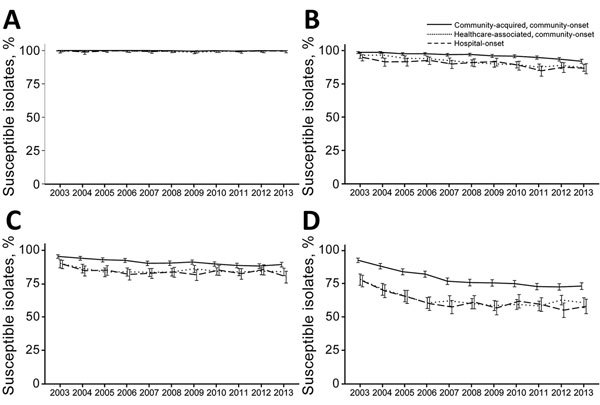
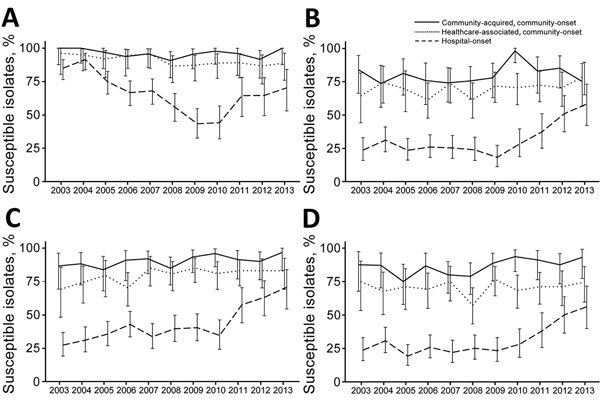
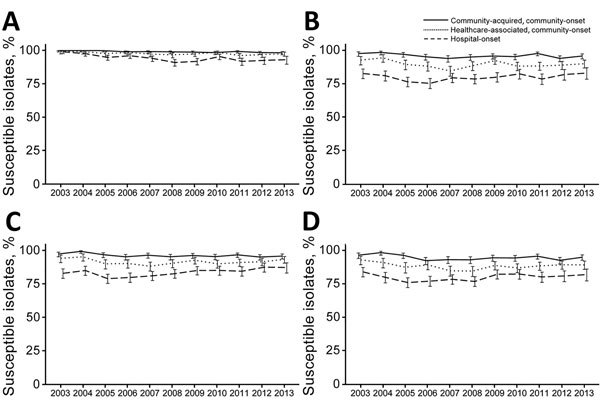
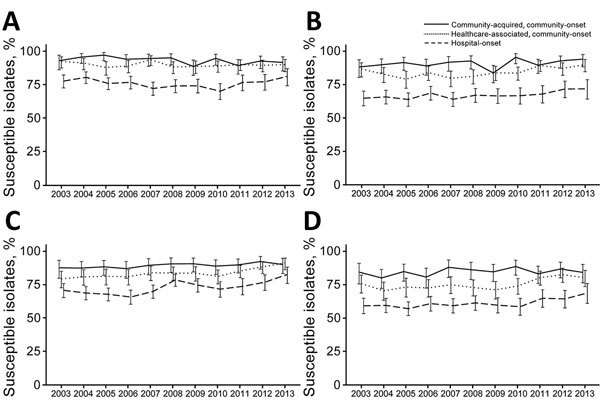
Bacteremia caused by gram-negative bacteria is associated with serious illness and death, and emergence of antimicrobial drug resistance in these bacteria is a major concern. Using national microbiology and patient data for 2003-2013 from the US Veterans Health Administration, we characterized nonsusceptibility trends of community-acquired, community-onset; healthcare-associated, community-onset; and hospital-onset bacteremia for selected gram-negative bacteria (Escherichia coli, Klebsiella spp., Pseudomonas aeruginosa, and Acinetobacter spp.). For 47,746 episodes of bacteremia, the incidence rate was 6.37 episodes/10,000 person-years for community-onset bacteremia and 4.53 episodes/10,000 patient-days for hospital-onset bacteremia. For Klebsiella spp., P. aeruginosa, and Acinetobacter spp., we observed a decreasing proportion of nonsusceptibility across nearly all antimicrobial drug classes for patients with healthcare exposure; trends for community-acquired, community-onset isolates were stable or increasing. The role of infection control and antimicrobial stewardship efforts in inpatient settings in the decrease in drug resistance rates for hospital-onset isolates needs to be determined.
革兰氏阴性菌引起的菌血症与严重疾病和死亡相关,这些细菌中抗菌药物耐药性的出现是一个主要问题。利用美国退伍军人健康管理局2003年至2013年的全国微生物学和患者数据,我们对选定革兰氏阴性菌(大肠杆菌、克雷伯菌属、铜绿假单胞菌和不动杆菌属)的社区获得性、社区起病;医疗保健相关、社区起病;以及医院起病菌血症的不敏感性趋势进行了特征描述。对于47746例菌血症发作,社区起病菌血症的发病率为6.37例/10000人年,医院起病菌血症的发病率为4.53例/10000患者日。对于克雷伯菌属、铜绿假单胞菌和不动杆菌属,我们观察到在几乎所有抗菌药物类别中,有医疗保健接触史的患者不敏感性比例下降;社区获得性、社区起病分离株的趋势稳定或上升。需要确定感染控制和抗菌药物管理措施在住院环境中对医院起病菌株耐药率下降的作用。