Iris Group International, Chapel Hill, North Carolina, USA.
Department of Biology, Stanford University, Stanford, California, USA.
Matern Child Nutr. 2018 Nov;14 Suppl 4(Suppl 4):e12517. doi: 10.1111/mcn.12517. Epub 2017 Oct 19.
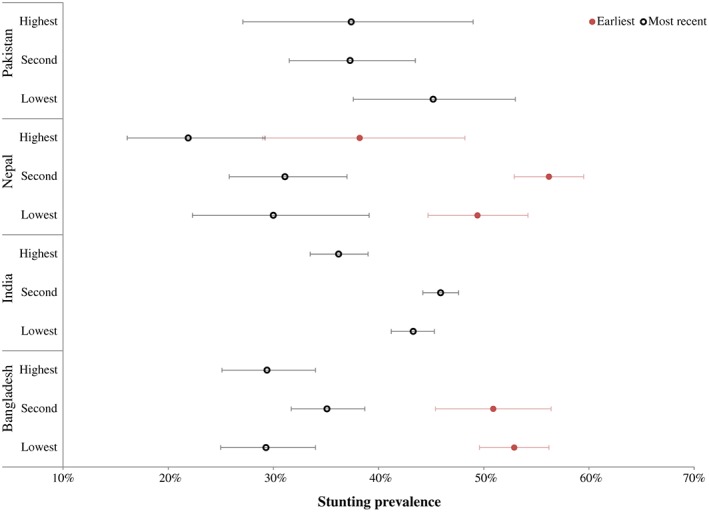
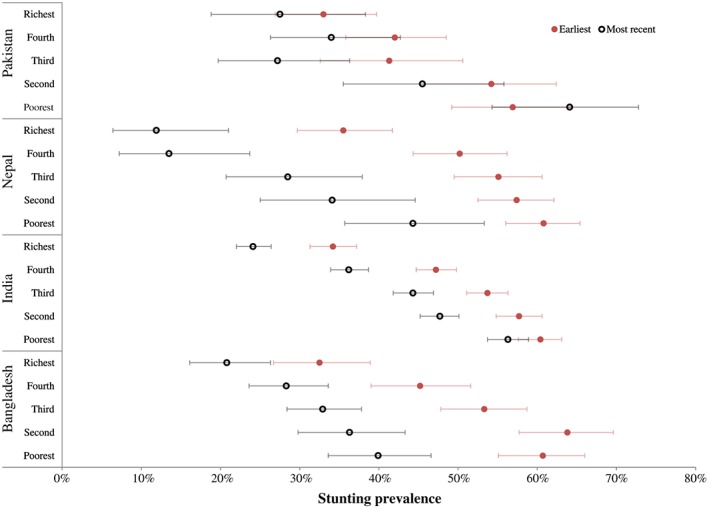
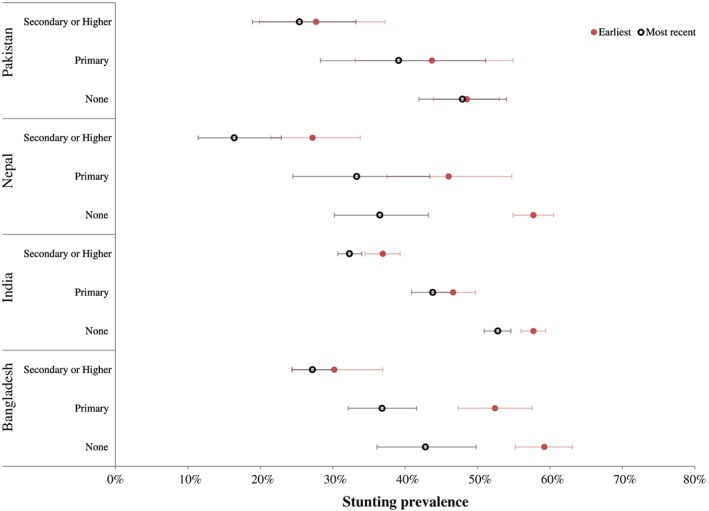
We analysed socio-economic inequalities in stunting in South Asia and investigated disparities associated with factors at the individual, caregiver, and household levels (poor dietary diversity, low maternal education, and household poverty). We used time-series analysis of data from 55,459 children ages 6-23 months from Demographic and Health Surveys in Bangladesh, India, Nepal, and Pakistan (1991-2014). Logistic regression models, adjusted for age, sex, birth order, and place of residency, examined associations between stunting and multiple types of socio-economic disadvantage. All countries had high stunting rates. Bangladesh and Nepal recorded the largest reductions-2.9 and 4.1 percentage points per year, respectively-compared to 1.3 and 0.6 percentage points in India and Pakistan, respectively. Socio-economic adversity was associated with increased risk of stunting, regardless of disadvantage type. Poor children with inadequate diets and with poorly educated mothers experienced greater risk of stunting. Although stunting rates declined in the most deprived groups, socio-economic differences were largely preserved over time and in some cases worsened, namely, between wealth quintiles. The disproportionate burden of stunting experienced by the most disadvantaged children and the worsening inequalities between socio-economic groups are of concern in countries with substantial stunting burdens. Closing the gap between best and worst performing countries, and between most and least disadvantaged groups within countries, would yield substantial improvements in stunting rates in South Asia. To do so, greater attention needs to be paid to addressing the social, economic, and political drivers of stunting with targeted efforts towards the populations experiencing the greatest disadvantage and child growth faltering.
我们分析了南亚儿童发育迟缓的社会经济不平等现象,并调查了与个体、照顾者和家庭层面的因素相关的差异(饮食多样性差、母亲受教育程度低和家庭贫困)。我们使用了来自孟加拉国、印度、尼泊尔和巴基斯坦的 55459 名 6-23 个月大的儿童的人口与健康调查数据的时间序列分析(1991-2014 年)。经过年龄、性别、出生顺序和居住地点调整的逻辑回归模型,检验了发育迟缓与多种类型的社会经济劣势之间的关联。所有国家的发育迟缓率都很高。与印度和巴基斯坦分别每年 0.6 个百分点和 1.3 个百分点的增长率相比,孟加拉国和尼泊尔的发育迟缓率分别下降了 2.9 个百分点和 4.1 个百分点。无论劣势类型如何,社会经济劣势都与发育迟缓的风险增加有关。饮食不足和母亲受教育程度低的贫困儿童发育迟缓的风险更大。尽管最贫困群体的发育迟缓率有所下降,但社会经济差异在很大程度上随着时间的推移而得以保留,在某些情况下甚至恶化,例如在贫富五等分差距方面。处境最不利的儿童所承受的发育迟缓负担不成比例,以及社会经济群体之间不平等状况的恶化,是南亚国家面临的一个令人关切的问题。缩小表现最好和最差的国家之间以及国家内部最有利和最不利群体之间的差距,将使南亚的发育迟缓率得到实质性改善。为此,需要更加关注解决导致发育迟缓的社会、经济和政治驱动因素,并针对最不利群体和儿童生长迟缓问题采取有针对性的措施。