Choi Hye Jeong, Miller-Day Michelle, Shin YoungJu, Hecht Michael L, Pettigrew Jonathan, Krieger Janice L, Lee JeongKyu, Graham John W
Department of Health Sciences, University of Missouri-Columbia.
Department of Communication Studies, Chapman University.
J Fam Commun. 2017;17:15-32. doi: 10.1080/15267431.2016.1251920. Epub 2017 Jan 6.
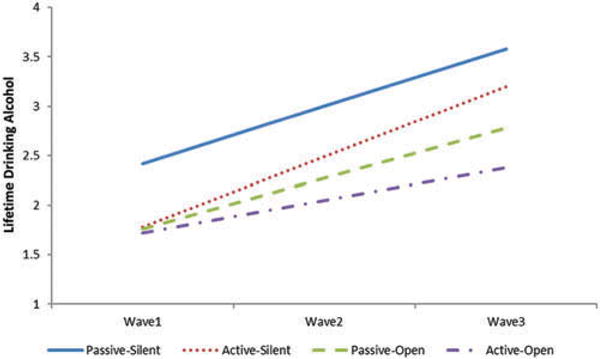
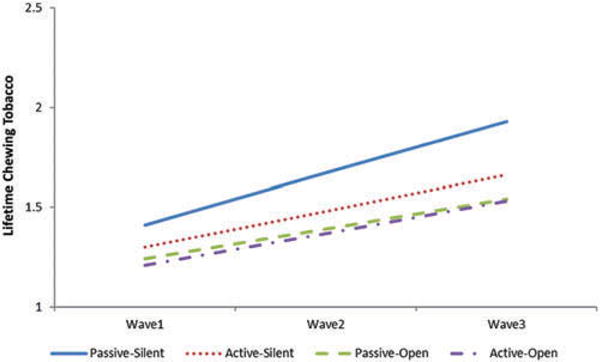
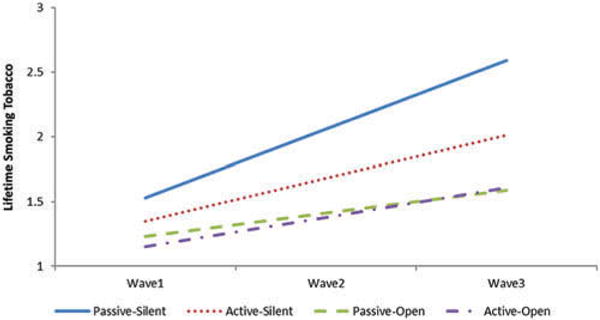
This current study identifies distinct parent prevention communication profiles and examines whether youth with different parental communication profiles have varying substance use trajectories over time. Eleven schools in two rural school districts in the Midwestern United States were selected, and 784 students were surveyed at three time points from the beginning of 7th grade to the end of 8th grade. A series of latent profile analyses were performed to identify discrete profiles/subgroups of substance-specific prevention communication (SSPC). The results revealed a 4-profile model of SSPC: Active-Open, Passive-Open, Active-Silent, and Passive-Silent. A growth curve model revealed different rates of lifetime substance use depending on the youth's SSPC profile. These findings have implications for parenting interventions and tailoring messages for parents to fit specific SSPC profiles.
本研究确定了不同的家长预防沟通模式,并探讨了具有不同家长沟通模式的青少年在一段时间内是否有不同的物质使用轨迹。在美国中西部两个农村学区的11所学校中进行了抽样,从7年级开始到8年级结束的三个时间点对784名学生进行了调查。进行了一系列潜在特征分析,以确定特定物质预防沟通(SSPC)的离散特征/亚组。结果揭示了一个SSPC的四特征模型:积极开放型、消极开放型、积极沉默型和消极沉默型。生长曲线模型显示,根据青少年的SSPC特征,其终身物质使用发生率有所不同。这些发现对育儿干预以及为家长量身定制适合特定SSPC特征的信息具有启示意义。