
迷走神经刺激的心理效应是否部分介导了迷走神经对疼痛的调节作用?
Do the psychological effects of vagus nerve stimulation partially mediate vagal pain modulation?
作者信息
Frangos Eleni, Richards Emily A, Bushnell M Catherine
机构信息
National Center for Complementary and Integrative Health, National Institutes of Health, Bethesda, MD 20892.
出版信息
Neurobiol Pain. 2017 Jan-Jul;1:37-45. doi: 10.1016/j.ynpai.2017.03.002. Epub 2017 May 17.
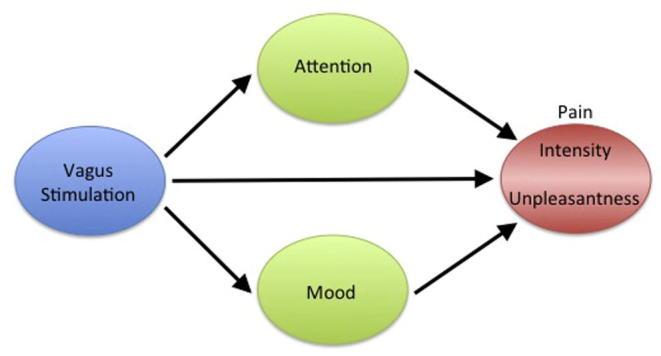
There is preclinical and clinical evidence that vagus nerve stimulation modulates both pain and mood state. Mechanistic studies show brainstem circuitry involved in pain modulation by vagus nerve stimulation, but little is known about possible indirect descending effects of altered mood state on pain perception. This possibility is important, since previous studies have shown that mood state affects pain, particularly the affective dimension (pain unpleasantness). To date, human studies investigating the effects of vagus nerve stimulation on pain perception have not reliably measured psychological factors to determine their role in altered pain perception elicited by vagus nerve stimulation. Thus, it remains unclear how much of a role psychological factors play in vagal pain modulation. Here, we present a rationale for including psychological measures in future vagus nerve stimulation studies on pain.
有临床前和临床证据表明,迷走神经刺激可调节疼痛和情绪状态。机制研究表明,脑干神经回路参与迷走神经刺激对疼痛的调节,但对于情绪状态改变对疼痛感知可能产生的间接下行效应知之甚少。这种可能性很重要,因为先前的研究表明情绪状态会影响疼痛,尤其是情感维度(疼痛不适感)。迄今为止,研究迷走神经刺激对疼痛感知影响的人体研究尚未可靠地测量心理因素,以确定它们在迷走神经刺激引起的疼痛感知改变中所起的作用。因此,心理因素在迷走神经疼痛调节中发挥多大作用仍不清楚。在此,我们提出了在未来关于疼痛的迷走神经刺激研究中纳入心理测量的理论依据。
 Zotero 插件