Department of Anesthesiology, University Medicine of Greifswald, Greifswald, Germany.
Department of Anesthesia, McMaster University, Hamilton, Ontario, Canada.
JAMA Netw Open. 2022 Feb 1;5(2):e220517. doi: 10.1001/jamanetworkopen.2022.0517.
A pharmacological approach to pain control after cesarean delivery is often insufficient on its own. Acupuncture is a promising method for mitigating postoperative pain and reducing postoperative opioid requirements.
To evaluate the efficacy and effectiveness of acupuncture as an adjunctive therapy for pain control after cesarean delivery, compared with a placebo intervention and standard care alone.
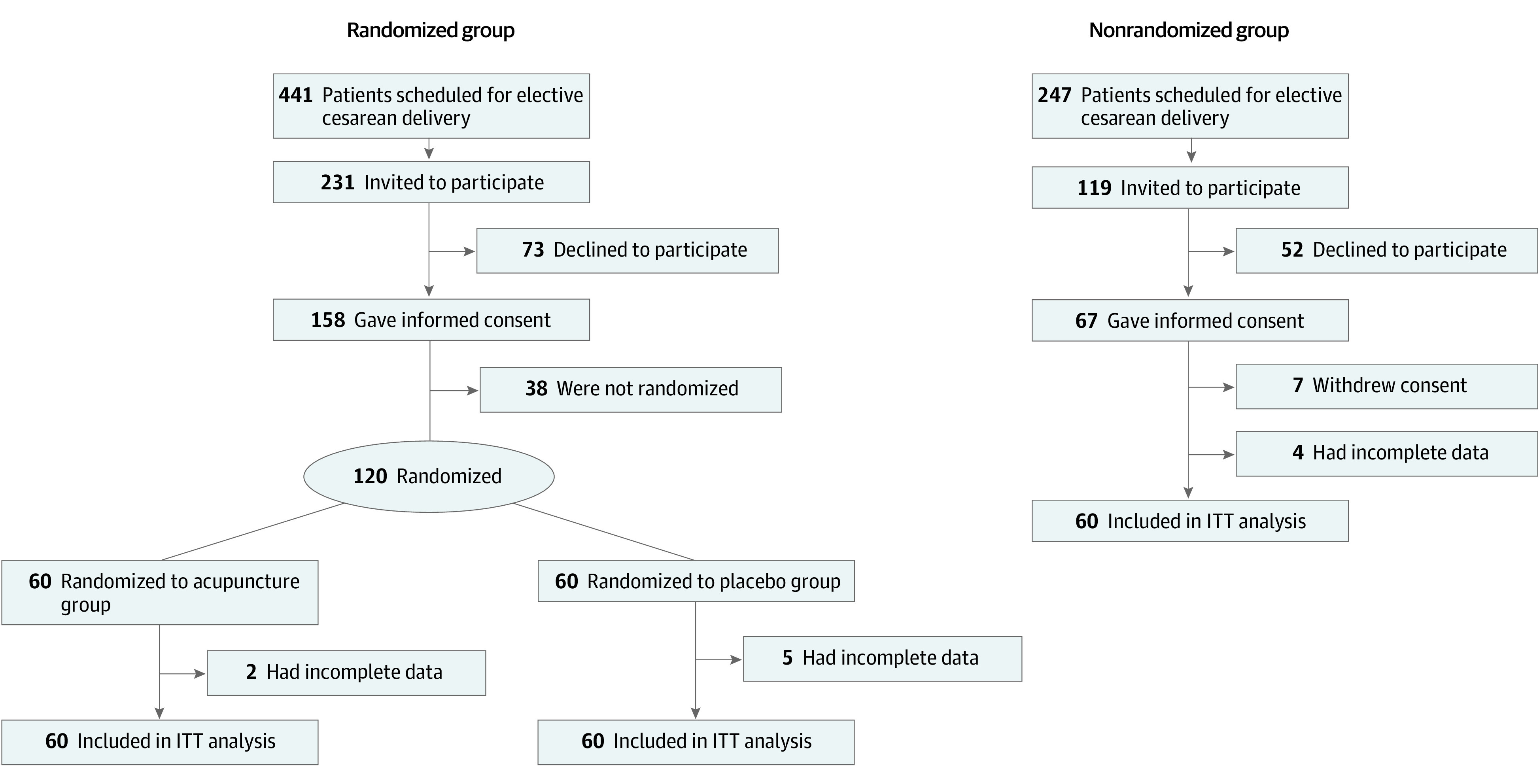
DESIGN, SETTING, AND PARTICIPANTS: This single-center, placebo-controlled, patient- and assessor-blinded randomized clinical trial was conducted from January 13, 2015, to June 27, 2018, at a tertiary university hospital in Greifswald, Germany. Participants were women who were scheduled for elective cesarean delivery under spinal anesthesia and were randomized to either the acupuncture group (n = 60) or placebo group (n = 60). Another 60 consecutive patients who met the eligibility criteria and received the standard postoperative analgesia were selected to form a nonrandomized standard care group. The intention-to-treat analysis was performed from August 19, 2019, to September 13, 2019.
In addition to standard pain treatment, each patient in the acupuncture group received auricular and body acupuncture with indwelling intradermal needles, whereas patients in the placebo group were treated with nonpenetrating placebo needles.
The primary outcome was pain intensity on movement, which was measured using an 11-item verbal rating scale. Secondary outcomes were analgesia-related adverse effects, analgesics consumption, time to mobilization and Foley catheter removal, quality of patient blinding to randomization, and patient satisfaction with treatment of pain.
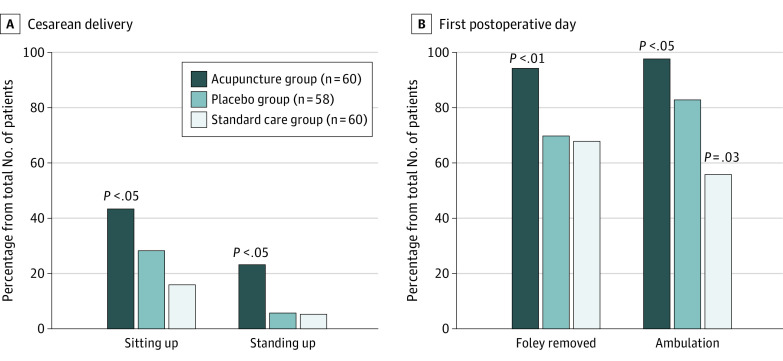
A total of 180 female patients (mean [SD] age, 31 [5] years) were included in the intention-to-treat analysis. The mean pain intensity on movement in the acupuncture group on the first postoperative day was lower than in the placebo group (4.7 [1.8] vs 6.0 [2.0] points; Cohen d, 0.73; 95% CI, 0.31-1.01; P = .001) and the standard care group (6.3 [1.3] points; Cohen d, 1.01; 95% CI, 0.63-1.40; P < .001). On the first postoperative day, 59 patients (98%) in the acupuncture group were fully mobilized vs 49 patients (83%) in the placebo group (relative risk [RR], 1.18; 95% CI, 1.06-1.33; P = .01) and 35 patients (58%) in the standard care group (RR, 1.69; 95% CI, 1.36-2.09; P < .001). The Foley catheter was removed in a total of 57 patients (93%) from the acupuncture group vs 43 patients (72%) from the placebo group (RR, 1.33; 95% CI, 1.12-1.57; P = .003) and 42 patients (70%) from the standard care group (RR, 1.37; 95% CI, 1.14-1.62; P = .002). Other parameters were comparable across the 3 study groups.
Results of this trial showed that acupuncture was safe and effective in reducing pain and accelerating mobilization of patients after cesarean delivery. With consideration for personnel and time expenditures, acupuncture can be recommended as routine, supplemental therapy for pain control in patients after elective cesarean delivery.
ClinicalTrials.gov Identifier: NCT02364167.
剖宫产术后单独采用药理学方法控制疼痛往往效果不足。针刺是减轻术后疼痛和减少术后阿片类药物需求的一种很有前途的方法。
评估针刺作为剖宫产术后辅助镇痛疗法的疗效和有效性,与安慰剂干预和单独标准护理相比。
设计、地点和参与者:这是一项单中心、安慰剂对照、患者和评估者双盲随机临床试验,于 2015 年 1 月 13 日至 2018 年 6 月 27 日在德国格赖夫斯瓦尔德的一所三级大学医院进行。参与者为计划在脊髓麻醉下进行选择性剖宫产的女性,并随机分为针刺组(n=60)或安慰剂组(n=60)。另外 60 名符合入选标准并接受标准术后镇痛的连续患者被选为非随机标准护理组。意向治疗分析于 2019 年 8 月 19 日至 2019 年 9 月 13 日进行。
除了标准疼痛治疗外,针刺组的每位患者还接受耳针和体针治疗,使用留置皮内针,而安慰剂组的患者则接受非穿透性安慰剂针治疗。
主要结局是运动时的疼痛强度,使用 11 项言语评分量表进行测量。次要结局包括与镇痛相关的不良反应、镇痛药消耗、活动和 Foley 导管拔除时间、患者对随机分组的盲目性质量以及患者对疼痛治疗的满意度。
共有 180 名女性患者(平均[标准差]年龄,31[5]岁)纳入意向治疗分析。针刺组患者在术后第 1 天的运动时疼痛强度低于安慰剂组(4.7[1.8] vs 6.0[2.0]分;Cohen d,0.73;95%置信区间,0.31-1.01;P=.001)和标准护理组(6.3[1.3]分;Cohen d,1.01;95%置信区间,0.63-1.40;P<.001)。术后第 1 天,针刺组 59 名患者(98%)完全活动,安慰剂组 49 名患者(83%)(相对风险[RR],1.18;95%置信区间,1.06-1.33;P=.01),标准护理组 35 名患者(58%)(RR,1.69;95%置信区间,1.36-2.09;P<.001)。针刺组共有 57 名患者(93%)拔除 Foley 导管,安慰剂组 43 名患者(72%)(RR,1.33;95%置信区间,1.12-1.57;P=.003),标准护理组 42 名患者(70%)(RR,1.37;95%置信区间,1.14-1.62;P=.002)。其他参数在 3 个研究组之间无差异。
这项试验的结果表明,针刺在减轻剖宫产术后疼痛和加速患者活动方面是安全有效的。考虑到人员和时间的投入,针刺可以被推荐作为选择性剖宫产术后患者疼痛控制的常规补充治疗。
ClinicalTrials.gov 标识符:NCT02364167。