Al Dhaibani Muna A, Allingham-Hawkins Diane, El-Hattab Ayman W
Pediatrics Department, Tawam Hospital, Al-Ain, United Arab Emirates.
PreventionGenetics, LLC, Marshfield, WI, USA.
BMC Med Genet. 2017 Oct 23;18(1):118. doi: 10.1186/s12881-017-0482-8.
Studying human genome using chromosomal microarrays has significantly improved the accuracy and yield of diagnosing genomic disorders. Chromosome 7q36 deletions and duplications are rare genomic disorders that have been reported in a limited number of children with developmental delay, growth retardation, and congenital malformation. Altered dosage of SHH and HLXB9, both located in 7q36.3, is believed to play roles in the phenotypes associated with these rearrangements. In this report we describe a child with 7q36.1q36.2 triplication that is proximal to the 7q36.3 region. In addition to the clinical description, we discuss the genes located in the triplicated region.
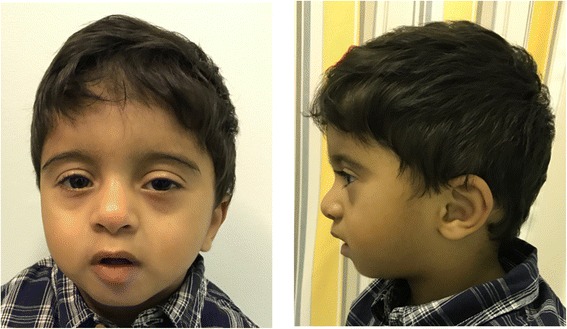
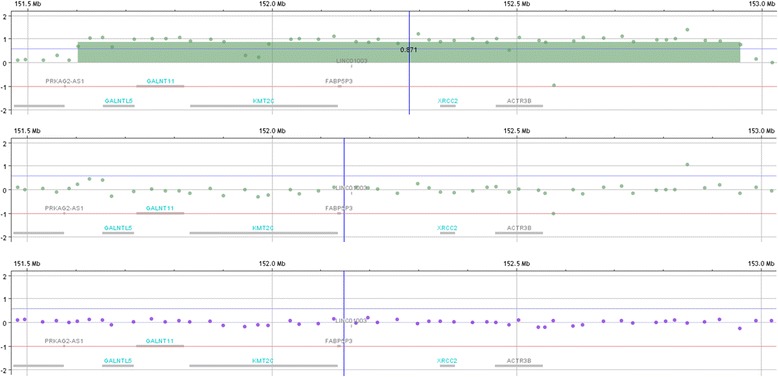
We report a 22 month old male child with a de novo 1.35 Mb triplication at 7q36.1q36.2. His prenatal course was complicated by oligohydramnios, intrauterine growth restriction, and decreased fetal movement. Hypotonia, respiratory distress, and feeding difficulty were observed in the neonatal period. He also had developmental delay, cardiovascular malformation, growth failure with microcephaly, short stature, and underweight, sensorineural hearing loss, myopia, astigmatism, cryptorchidism, hypospadias, microphallus, lower extremity length discrepancy, bifid uvula, single palmer creases, and distinctive facial features including straight eyebrows, ptosis, up-slanted palpebral fissures, broad nasal bridge, low-set and posteriorly rotated ears, small mouth with thick lower lip, microretrognathia, and high-arched palate.
The child presented here had developmental delay, distinctive facial features, multiple congenital anomalies, and 7q36.1q36.2 triplication. This triplication, which was found to be de novo, has not been previously described and is believed to result in the observed phenotype. The triplicated region harbors the GALNTL5, GALNT11, KMT2C, XRCC2, and ACTR3B genes. GALNT11 encodes a membrane-bound polypeptide N-acetylgalactosaminyltransferase that can O-glycosylate NOTCH1 leading to the activation of the Notch signaling pathway. Therefore, increased GALNT11 dosage can potentially alter the Notch signaling pathway explaining the pathogenicity of 7q36 triplication. Studying further cases with similar genomic rearrangements is needed to make final conclusions about the pathogenicity of this triplication.
使用染色体微阵列研究人类基因组显著提高了诊断基因组疾病的准确性和检出率。7号染色体q36缺失和重复是罕见的基因组疾病,在少数发育迟缓、生长发育迟缓及先天性畸形儿童中有所报道。位于7q36.3的SHH和HLXB9基因剂量改变被认为与这些重排相关的表型有关。在本报告中,我们描述了一名患有7q36.1q36.2重复的儿童,该重复位于7q36.3区域近端。除了临床描述外,我们还讨论了位于重复区域的基因。
我们报告一名22个月大的男童,其7q36.1q36.2存在1.35Mb的新发重复。他的产前过程因羊水过少、宫内生长受限和胎动减少而复杂化。新生儿期观察到肌张力低下、呼吸窘迫和喂养困难。他还存在发育迟缓、心血管畸形、小头畸形伴生长发育不良、身材矮小、体重不足、感音神经性听力损失、近视、散光、隐睾、尿道下裂、小阴茎、下肢长度差异、悬雍垂裂、单掌褶,以及独特的面部特征,包括眉毛平直、上睑下垂、睑裂向上倾斜、鼻梁宽、耳朵低位且向后旋转、小嘴伴下唇增厚、小下颌后缩和高拱腭。
本文报道的患儿存在发育迟缓、独特的面部特征、多种先天性异常及7q36.1q36.2重复。该重复为新发,此前未见报道,据信导致了所观察到的表型。重复区域包含GALNTL5、GALNT11、KMT2C、XRCC2和ACTR3B基因。GALNT11编码一种膜结合多肽N - 乙酰半乳糖胺基转移酶,可对NOTCH1进行O - 糖基化,从而激活Notch信号通路。因此,GALNT11剂量增加可能会改变Notch信号通路,解释了7q36重复的致病性。需要进一步研究具有类似基因组重排的病例,以对该重复的致病性得出最终结论。