Department of Psychiatry and Neurochemistry, Institute of Neuroscience and Physiology, Sahlgrenska Academy at the University of Gothenburg, Gothenburg, Sweden.
Clinical Neurochemistry Laboratory, Sahlgrenska University Hospital, Mölndal, Sweden.
Alzheimers Res Ther. 2017 Oct 23;9(1):87. doi: 10.1186/s13195-017-0313-3.
From earlier studies it is known that the APOE ε2/ε3/ε4 polymorphism modulates the concentrations of cerebrospinal fluid (CSF) beta-amyloid (Aβ42) in patients with cognitive decline due to Alzheimer's disease (AD), as well as in cognitively healthy controls. Here, in a large cohort consisting solely of cognitively healthy individuals, we aimed to evaluate how the effect of APOE on CSF Aβ42 varies by age, to understand the association between APOE and the onset of preclinical AD.
APOE genotype and CSF Aβ42 concentration were determined in a cohort comprising 716 cognitively healthy individuals aged 17-99 from nine different clinical research centers.
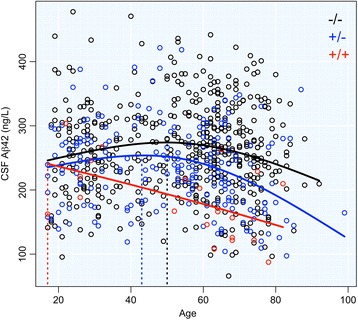
CSF concentrations of Aβ42 were lower in APOE ε4 carriers than in noncarriers in a gene dose-dependent manner. The effect of APOE ε4 on CSF Aβ42 was age dependent. The age at which CSF Aβ42 concentrations started to decrease was estimated at 50 years in APOE ε4-negative individuals and 43 years in heterozygous APOE ε4 carriers. Homozygous APOE ε4 carriers showed a steady decline in CSF Aβ42 concentrations with increasing age throughout the examined age span.
People possessing the APOE ε4 allele start to show a decrease in CSF Aβ42 concentration almost a decade before APOE ε4 noncarriers already in early middle age. Homozygous APOE ε4 carriers might deposit Aβ42 throughout the examined age span. These results suggest that there is an APOE ε4-dependent period of early alterations in amyloid homeostasis, when amyloid slowly accumulates, that several years later, together with other downstream pathological events such as tau pathology, translates into cognitive decline.
从早期的研究中可知,APOE ε2/ε3/ε4 多态性调节了因阿尔茨海默病(AD)导致认知能力下降的患者以及认知健康对照者的脑脊液(CSF)β-淀粉样蛋白(Aβ42)的浓度。在这里,在一个仅由认知健康个体组成的大型队列中,我们旨在评估 APOE 对 CSF Aβ42 的影响如何随年龄而变化,以了解 APOE 与临床前 AD 发病之间的关联。
在一个由来自九个不同临床研究中心的 716 名认知健康个体组成的队列中,确定了 APOE 基因型和 CSF Aβ42 浓度。
CSF Aβ42 浓度在 APOE ε4 携带者中以基因剂量依赖性方式低于非携带者。APOE ε4 对 CSF Aβ42 的影响取决于年龄。CSF Aβ42 浓度开始下降的年龄在 APOE ε4 阴性个体中估计为 50 岁,在杂合 APOE ε4 携带者中为 43 岁。纯合 APOE ε4 携带者在整个研究年龄范围内表现出 CSF Aβ42 浓度随年龄增加而持续下降。
携带 APOE ε4 等位基因的人在中年早期就开始表现出 CSF Aβ42 浓度下降,比 APOE ε4 非携带者早近十年。纯合 APOE ε4 携带者可能在整个研究年龄范围内沉积 Aβ42。这些结果表明,存在 APOE ε4 依赖性的淀粉样蛋白动态平衡早期改变期,在此期间淀粉样蛋白缓慢积累,几年后,与 tau 病理学等其他下游病理事件一起,导致认知能力下降。