
衰老如何影响皮肤生物力学:小鼠的多尺度研究
How aging impacts skin biomechanics: a multiscale study in mice.
作者信息
Lynch Barbara, Bonod-Bidaud Christelle, Ducourthial Guillaume, Affagard Jean-Sébastien, Bancelin Stéphane, Psilodimitrakopoulos Sotiris, Ruggiero Florence, Allain Jean-Marc, Schanne-Klein Marie-Claire
机构信息
LMS, Ecole Polytechnique, CNRS, Université Paris-Saclay, Palaiseau, France.
Institut de Génomique Fonctionnelle de Lyon, ENS-Lyon, CNRS UMR 5242, Université de Lyon, Lyon, France.
出版信息
Sci Rep. 2017 Oct 23;7(1):13750. doi: 10.1038/s41598-017-13150-4.
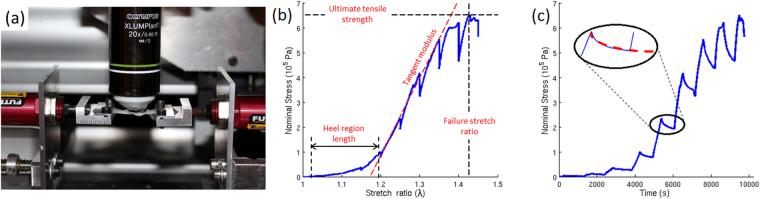
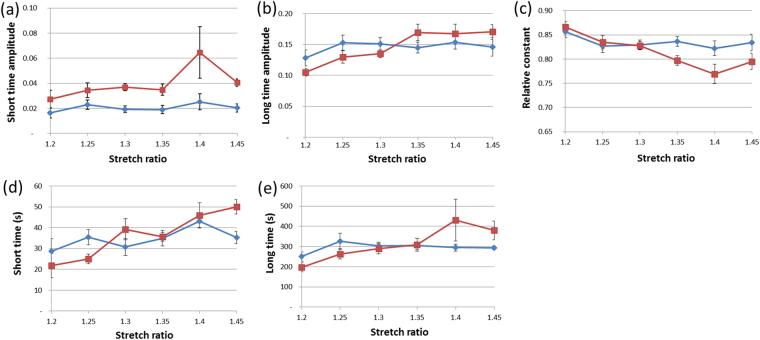
Skin aging is a complex process that strongly affects the mechanical behavior of skin. This study aims at deciphering the relationship between age-related changes in dermis mechanical behavior and the underlying changes in dermis microstructure. To that end, we use multiphoton microscopy to monitor the reorganization of dermal collagen during mechanical traction assays in ex vivo skin from young and old mice. The simultaneous variations of a full set of mechanical and microstructural parameters are analyzed in the framework of a multiscale mechanical interpretation. They show consistent results for wild-type mice as well as for genetically-modified mice with modified collagen V synthesis. We mainly observe an increase of the tangent modulus and a lengthening of the heel region in old murine skin from all strains, which is attributed to two different origins that may act together: (i) increased cross-linking of collagen fibers and (ii) loss of water due to proteoglycans deterioration, which impedes inner sliding within these fibers. In contrast, the microstructure reorganization upon stretching shows no age-related difference, which can be attributed to opposite effects of the decrease of collagen content and of the increase of collagen cross-linking in old mice.
皮肤老化是一个复杂的过程,会强烈影响皮肤的力学行为。本研究旨在解读真皮力学行为的年龄相关变化与真皮微观结构潜在变化之间的关系。为此,我们使用多光子显微镜在来自年轻和年老小鼠的离体皮肤的力学牵引试验中监测真皮胶原蛋白的重组。在多尺度力学解释的框架内分析了一整套力学和微观结构参数的同时变化。它们对野生型小鼠以及胶原蛋白V合成改变的基因改造小鼠显示出一致的结果。我们主要观察到所有品系的老年小鼠皮肤中切线模量增加和足跟区域变长,这归因于可能共同起作用的两个不同原因:(i)胶原纤维交联增加,以及(ii)由于蛋白聚糖降解导致的水分流失,这阻碍了这些纤维内部的滑动。相比之下,拉伸时的微观结构重组没有显示出与年龄相关的差异,这可归因于老年小鼠中胶原蛋白含量降低和胶原蛋白交联增加的相反作用。




 Zotero 插件