
基于模型靶向培养原代肝细胞中白细胞介素-6诱导的炎症反应以改善JAK抑制剂鲁索替尼的应用
Model Based Targeting of IL-6-Induced Inflammatory Responses in Cultured Primary Hepatocytes to Improve Application of the JAK Inhibitor Ruxolitinib.
作者信息
Sobotta Svantje, Raue Andreas, Huang Xiaoyun, Vanlier Joep, Jünger Anja, Bohl Sebastian, Albrecht Ute, Hahnel Maximilian J, Wolf Stephanie, Mueller Nikola S, D'Alessandro Lorenza A, Mueller-Bohl Stephanie, Boehm Martin E, Lucarelli Philippe, Bonefas Sandra, Damm Georg, Seehofer Daniel, Lehmann Wolf D, Rose-John Stefan, van der Hoeven Frank, Gretz Norbert, Theis Fabian J, Ehlting Christian, Bode Johannes G, Timmer Jens, Schilling Marcel, Klingmüller Ursula
机构信息
Division Systems Biology of Signal Transduction, German Cancer Research Center, Heidelberg, Germany.
Discovery Division, Merrimack Pharmaceuticals, Cambridge, MA, United States.
出版信息
Front Physiol. 2017 Oct 9;8:775. doi: 10.3389/fphys.2017.00775. eCollection 2017.
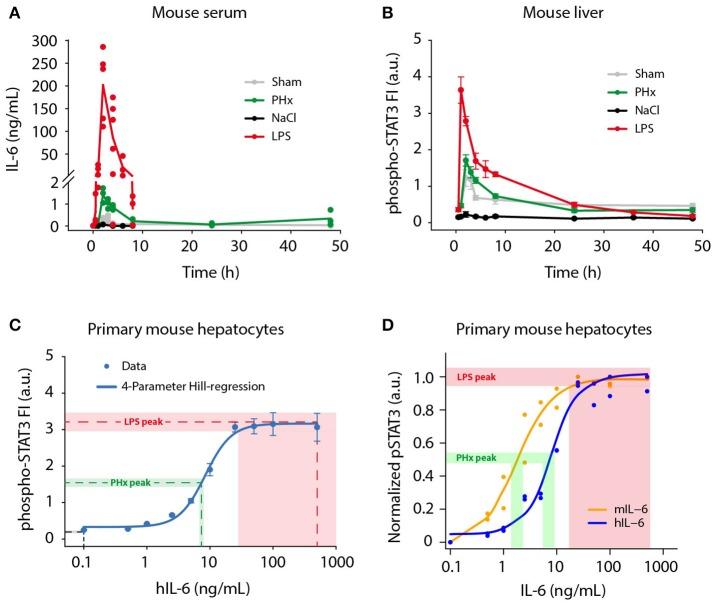
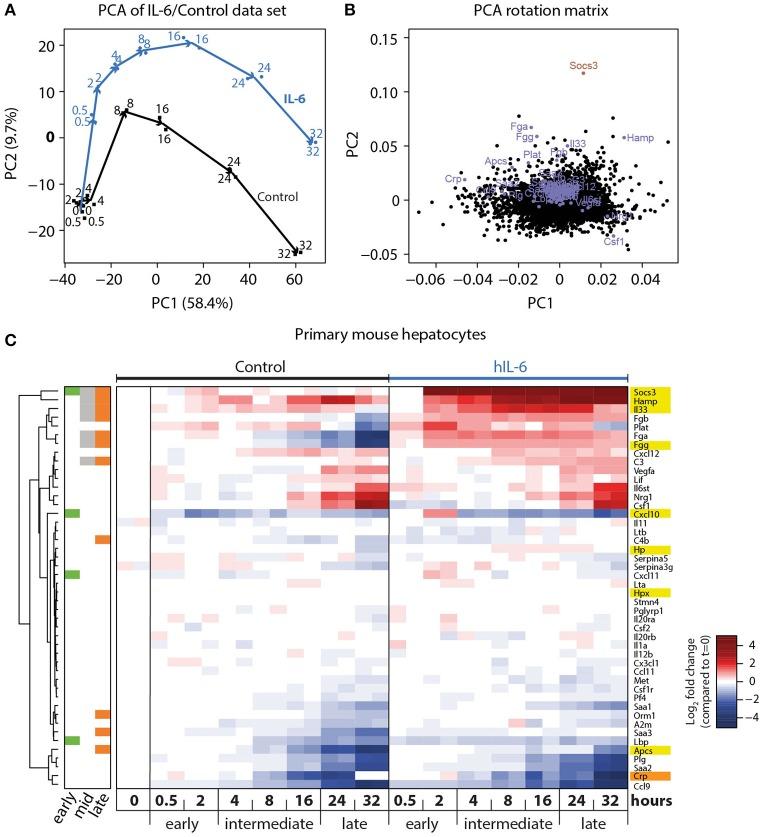
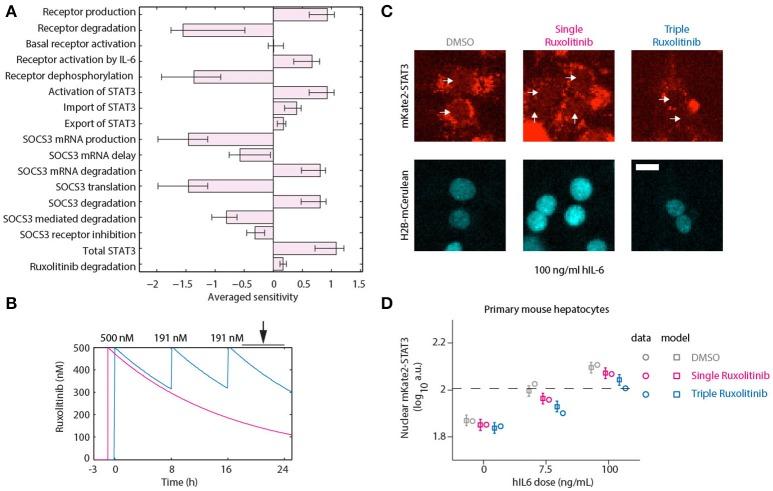
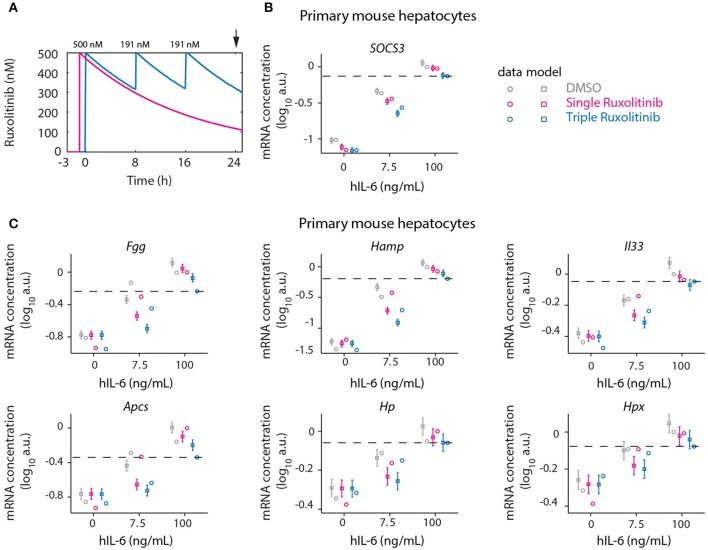
IL-6 is a central mediator of the immediate induction of hepatic acute phase proteins (APP) in the liver during infection and after injury, but increased IL-6 activity has been associated with multiple pathological conditions. In hepatocytes, IL-6 activates JAK1-STAT3 signaling that induces the negative feedback regulator SOCS3 and expression of APPs. While different inhibitors of IL-6-induced JAK1-STAT3-signaling have been developed, understanding their precise impact on signaling dynamics requires a systems biology approach. Here we present a mathematical model of IL-6-induced JAK1-STAT3 signaling that quantitatively links physiological IL-6 concentrations to the dynamics of IL-6-induced signal transduction and expression of target genes in hepatocytes. The mathematical model consists of coupled ordinary differential equations (ODE) and the model parameters were estimated by a maximum likelihood approach, whereas identifiability of the dynamic model parameters was ensured by the Profile Likelihood. Using model simulations coupled with experimental validation we could optimize the long-term impact of the JAK-inhibitor Ruxolitinib, a therapeutic compound that is quickly metabolized. Model-predicted doses and timing of treatments helps to improve the reduction of inflammatory APP gene expression in primary mouse hepatocytes close to levels observed during regenerative conditions. The concept of improved efficacy of the inhibitor through multiple treatments at optimized time intervals was confirmed in primary human hepatocytes. Thus, combining quantitative data generation with mathematical modeling suggests that repetitive treatment with Ruxolitinib is required to effectively target excessive inflammatory responses without exceeding doses recommended by the clinical guidelines.
白细胞介素-6(IL-6)是感染期间及损伤后肝脏中急性时相蛋白(APP)即刻诱导的关键介质,但IL-6活性增加与多种病理状况相关。在肝细胞中,IL-6激活JAK1-STAT3信号通路,该通路可诱导负反馈调节因子SOCS3以及APP的表达。虽然已开发出不同的IL-6诱导的JAK1-STAT3信号通路抑制剂,但要了解它们对信号动力学的确切影响需要采用系统生物学方法。在此,我们提出了一个IL-6诱导的JAK1-STAT3信号通路的数学模型,该模型将生理IL-6浓度与IL-6诱导的信号转导动力学以及肝细胞中靶基因的表达进行了定量关联。该数学模型由耦合的常微分方程(ODE)组成,模型参数通过最大似然法进行估计,而动态模型参数的可识别性则通过轮廓似然法得以确保。通过结合模型模拟与实验验证,我们能够优化JAK抑制剂鲁索替尼(一种代谢迅速的治疗性化合物)的长期影响。模型预测的治疗剂量和时间有助于在原代小鼠肝细胞中更有效地降低炎症性APP基因表达,使其接近再生条件下观察到的水平。在原代人肝细胞中证实了通过在优化的时间间隔进行多次治疗可提高抑制剂疗效的概念。因此,将定量数据生成与数学建模相结合表明,需要重复使用鲁索替尼进行治疗,以有效靶向过度的炎症反应,同时又不超过临床指南推荐的剂量。



 Zotero 插件