Xie Huimin, Hoffmann Hanne M, Iyer Anita K, Brayman Melissa J, Ngo Cindy, Sunshine Mary Jean, Mellon Pamela L
Department of Reproductive Medicine, Center for Reproductive Science and Medicine, University of California, 9500 Gilman Drive La Jolla, San Diego, CA, 92093-0674, USA.
Illumina Inc, 5200 Illumina Way, San Diego, CA, 92122, USA.
Reprod Biol Endocrinol. 2017 Oct 24;15(1):86. doi: 10.1186/s12958-017-0304-z.
Proper expression of key reproductive hormones from gonadotrope cells of the pituitary is required for pubertal onset and reproduction. To further our understanding of the molecular events taking place during embryonic development, leading to expression of the glycoproteins luteinizing hormone (LH) and follicle-stimulating hormone (FSH), we characterized chromatin structure changes, imparted mainly by histone modifications, in model gonadotrope cell lines.
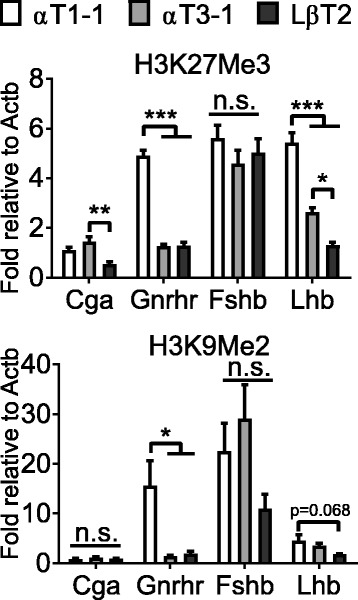
We evaluated chromatin status and gene expression profiles by chromatin immunoprecipitation assays, DNase sensitivity assay, and RNA sequencing in three developmentally staged gonadotrope cell lines, αT1-1 (progenitor, expressing Cga), αT3-1 (immature, expressing Cga and Gnrhr), and LβT2 (mature, expressing Cga, Gnrhr, Lhb, and Fshb), to assess changes in chromatin status and transcription factor access of gonadotrope-specific genes.
We found the common mRNA α-subunit of LH and FSH, called Cga, to have an open chromatin conformation in all three cell lines. In contrast, chromatin status of Gnrhr is open only in αT3-1 and LβT2 cells. Lhb begins to open in LβT2 cells and was further opened by activin treatment. Histone H3 modifications associated with active chromatin were high on Gnrhr in αT3-1 and LβT2, and Lhb in LβT2 cells, while H3 modifications associated with repressed chromatin were low on Gnrhr, Lhb, and Fshb in LβT2 cells. Finally, chromatin status correlates with the progressive access of LHX3 to Cga and Gnrhr, followed by PITX1 binding to the Lhb promoter.
Our data show the gonadotrope-specific genes Cga, Gnrhr, Lhb, and Fshb are not only controlled by developmental transcription factors, but also by epigenetic mechanisms that include the modulation of chromatin structure, and histone modifications.
青春期启动和生殖需要垂体促性腺激素细胞正确表达关键生殖激素。为了进一步了解胚胎发育过程中导致糖蛋白促黄体生成素(LH)和促卵泡激素(FSH)表达的分子事件,我们对模型促性腺激素细胞系中主要由组蛋白修饰引起的染色质结构变化进行了表征。
我们通过染色质免疫沉淀分析、DNase敏感性分析和RNA测序,评估了三种处于不同发育阶段的促性腺激素细胞系αT1-1(祖细胞,表达Cga)、αT3-1(未成熟细胞,表达Cga和Gnrhr)和LβT2(成熟细胞,表达Cga、Gnrhr、Lhb和Fshb)的染色质状态和基因表达谱,以评估促性腺激素特异性基因的染色质状态变化和转录因子的可及性。
我们发现LH和FSH的共同mRNAα亚基Cga在所有三种细胞系中都具有开放的染色质构象。相比之下,Gnrhr的染色质状态仅在αT3-1和LβT2细胞中开放。Lhb在LβT2细胞中开始开放,并通过激活素处理进一步开放。与活性染色质相关的组蛋白H3修饰在αT3-1和LβT2细胞中的Gnrhr以及LβT2细胞中的Lhb上较高,而与抑制染色质相关的H3修饰在LβT2细胞中的Gnrhr、Lhb和Fshb上较低。最后,染色质状态与LHX3对Cga和Gnrhr的逐步可及性相关,随后PITX1与Lhb启动子结合。
我们的数据表明,促性腺激素特异性基因Cga、Gnrhr、Lhb和Fshb不仅受发育转录因子控制,还受包括染色质结构调节和组蛋白修饰在内的表观遗传机制控制。