Verleger Rolf, Cäsar Stephanie, Siller Bastian, Śmigasiewicz Kamila
Department of Neurology, University of Lübeck, Lübeck, Germany.
Institute of Psychology II, University of Lübeck, Lübeck, Germany.
Front Hum Neurosci. 2017 Oct 10;11:497. doi: 10.3389/fnhum.2017.00497. eCollection 2017.
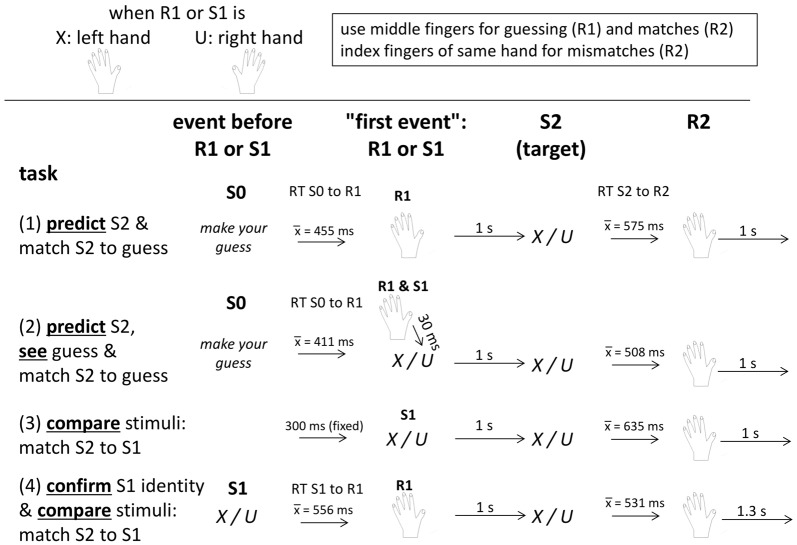
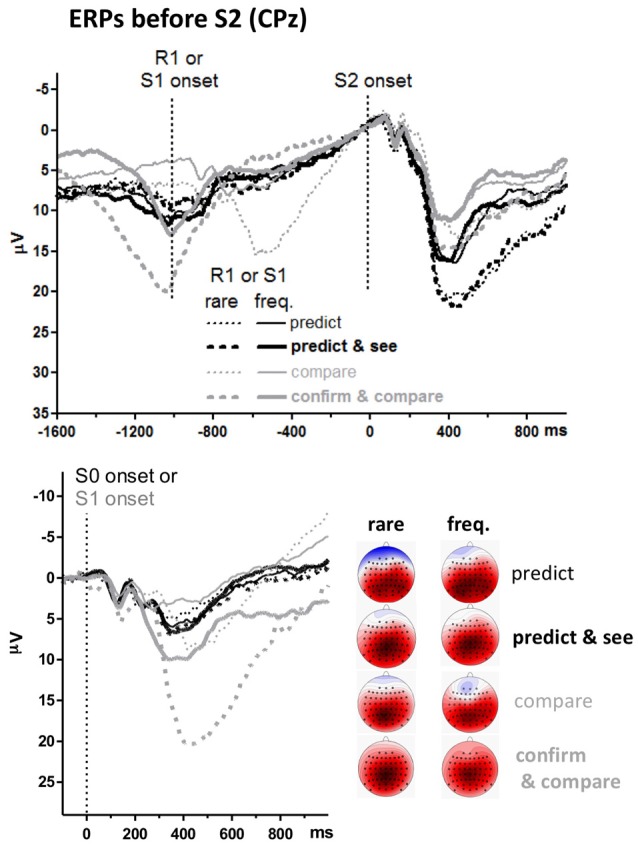
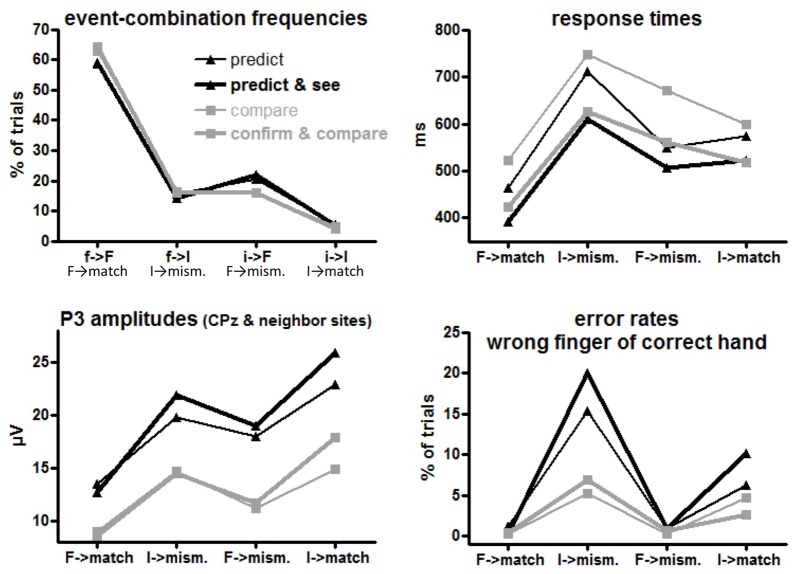
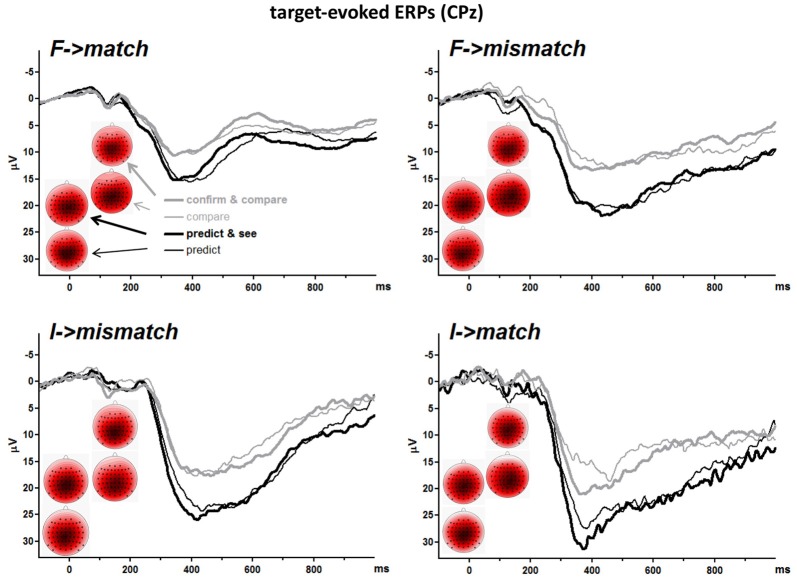
P3 is the most conspicuous component in recordings of stimulus-evoked EEG potentials from the human scalp, occurring whenever some task has to be performed with the stimuli. The process underlying P3 has been assumed to be the updating of expectancies. More recently, P3 has been related to decision processing and to activation of established stimulus-response associations (S/R-link hypothesis). However, so far this latter approach has not provided a conception about how to explain the occurrence of P3 with predicted stimuli, although P3 was originally discovered in a prediction task. The present article proposes such a conception. We assume that the internal responses or both become associatively linked to each predicted target and that one of these two response alternatives gets activated as a function of match or mismatch of the target to the preceding prediction. This seems similar to comparison tasks where responses depend on the matching of the target stimulus with a preceding first stimulus (S1). Based on this idea, this study compared the effects of frequencies of first events (predictions or S1) on target-evoked P3s in prediction and comparison tasks. Indeed, frequencies not only of targets but also of first events had similar effects across tasks on target-evoked P3s. These results support the notion that P3 evoked by predicted stimuli reflects activation of appropriate internal "match" or "mismatch" responses, which is compatible with S/R-link hypothesis.
P3是从人类头皮记录的刺激诱发脑电图电位中最显著的成分,每当必须对刺激执行某些任务时就会出现。P3背后的过程被认为是预期的更新。最近,P3与决策过程以及已建立的刺激-反应关联的激活(S/R链接假说)有关。然而,到目前为止,后一种方法尚未提供关于如何用预测刺激来解释P3出现的概念,尽管P3最初是在一个预测任务中发现的。本文提出了这样一种概念。我们假设内部反应或两者都与每个预测目标形成联想联系,并且这两种反应选择之一会根据目标与先前预测的匹配或不匹配而被激活。这似乎类似于比较任务,其中反应取决于目标刺激与先前的第一个刺激(S1)的匹配。基于这一想法,本研究比较了第一个事件(预测或S1)的频率对预测和比较任务中目标诱发P3的影响。事实上,不仅目标的频率,而且第一个事件的频率在不同任务中对目标诱发P3都有类似的影响。这些结果支持了这样一种观点,即由预测刺激诱发的P3反映了适当的内部“匹配”或“不匹配”反应的激活,这与S/R链接假说相符。