Ahmad H R, Hashmi Satwat
Dr. HR Ahmad, MD PhD Bochum, FCPS. Department of Biological and Biomedical Sciences, Aga Khan University, Karachi, Pakistan.
Dr. Satwat Hashmi, MBBS MS PhD. Department of Biological and Biomedical Sciences, Aga Khan University, Karachi, Pakistan.
Pak J Med Sci. 2017 Jul-Aug;33(4):1042-1046. doi: 10.12669/pjms.334.12938.
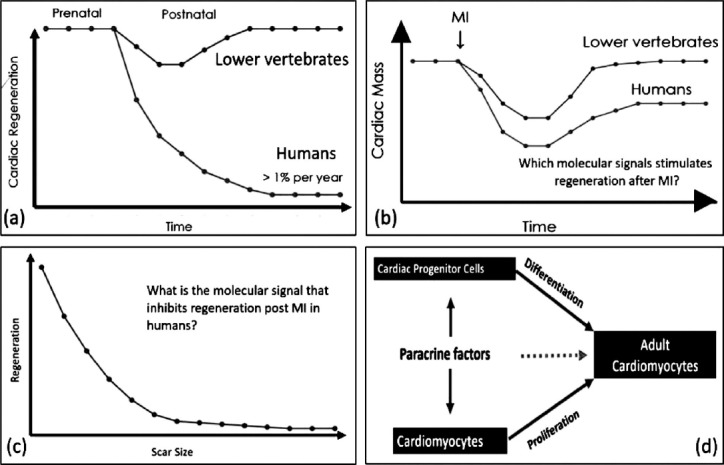
The stem cells keep us young by endogenously repairing us upon need. They do so bysmartly one step forward towards differentiation while another step backward to nurturethe undifferentiated stem cells. They are building blocks for every organ witha differential rate of repair of worn out tissues. Since stem cells can be cultured with a normal karyo type, they could be the ideal source for heart repair after myocardial infarction. As opposed to lower vertebrates and neonatal mice, cardiac regeneration in adult mammalian heart seems to be difficult to assess with a solid evidence of cytokinesis. It becomes more difficult to quantify the level of regeneration after myocardial infarction injury against a background of a large invasion of proliferating inflammatory cells. The question to beraised is how the renewal of a piece of myocardium follows the time line of picking upcell types in series: cardiomyocytes, endothelial cells, smooth muscle cells, fibroblast, pacemaker cells, conducting and Purkinje cells to bring the orchestration of rhythmically contracting and relaxing heart. This review focuses on where we are onthe status of heart repair and cardiac regeneration.
干细胞通过在需要时进行内源性修复来维持我们的年轻状态。它们通过巧妙地向分化前进一步,同时向后退一步以滋养未分化的干细胞来做到这一点。它们是每个器官的组成部分,对磨损组织的修复速度各不相同。由于干细胞可以在正常核型下培养,它们可能是心肌梗死后心脏修复的理想来源。与低等脊椎动物和新生小鼠不同,成年哺乳动物心脏中的心脏再生似乎难以通过确凿的胞质分裂证据来评估。在增殖性炎症细胞大量侵入的背景下,量化心肌梗死后损伤后的再生水平变得更加困难。需要提出的问题是,一块心肌的更新如何按照依次选取细胞类型(心肌细胞、内皮细胞、平滑肌细胞、成纤维细胞、起搏细胞、传导细胞和浦肯野细胞)的时间线进行,从而实现心脏有节奏地收缩和舒张的协调。本综述重点关注我们在心脏修复和心脏再生方面的现状。