Wang Chang Yi, Wang Pei-Ning, Chiu Ming-Jang, Finstad Connie L, Lin Feng, Lynn Shugene, Tai Yuan-Hung, De Fang Xin, Zhao Kesheng, Hung Chung-Ho, Tseng Yiting, Peng Wen-Jiun, Wang Jason, Yu Chih-Chieh, Kuo Be-Sheng, Frohna Paul A
United Biomedical, Inc. (UBI), Hauppauge, NY, USA.
United Biomedical Inc., Asia (UBI-Asia), Hsinchu, Taiwan.
Alzheimers Dement (N Y). 2017 Apr 14;3(2):262-272. doi: 10.1016/j.trci.2017.03.005. eCollection 2017 Jun.
A novel amyloid β (Aβ) synthetic peptide vaccine (UB-311) has been evaluated in a first-in-human trial with patients of mild-to-moderate Alzheimer's disease. We describe translational research covering vaccine design, preclinical characterization, and phase-I clinical trial with supportive outcome that advances UB-311 into an ongoing phase-II trial.
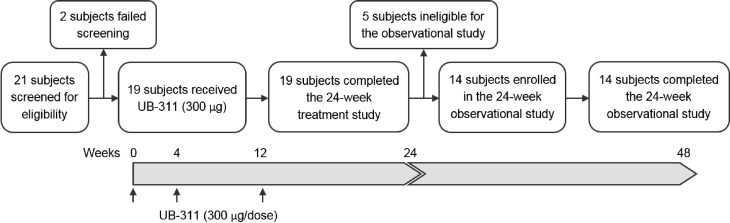
UB-311 is constructed with two synthetic Aβ-targeting peptides (B-cell epitope), each linked to different helper T-cell peptide epitopes (UBITh) and formulated in a Th2-biased delivery system. The hAPP751 transgenic mouse model was used to perform the proof-of-concept study. Baboons and macaques were used for preclinical safety, tolerability, and immunogenicity evaluation. Patients with mild-to-moderate Alzheimer's disease (AD) were immunized by intramuscular route with 3 doses of UB-311 at weeks 0, 4, and 12, and monitored until week 48. Safety and immunogenicity were assessed per protocol, and preliminary efficacy was analyzed by Alzheimer's Disease Assessment Scale-Cognitive Subscale (ADAS-Cog), Mini-Mental State Examination (MMSE), and Alzheimer's Disease Cooperative Study-Clinician's Global Impression of Change (ADCS-CGIC).
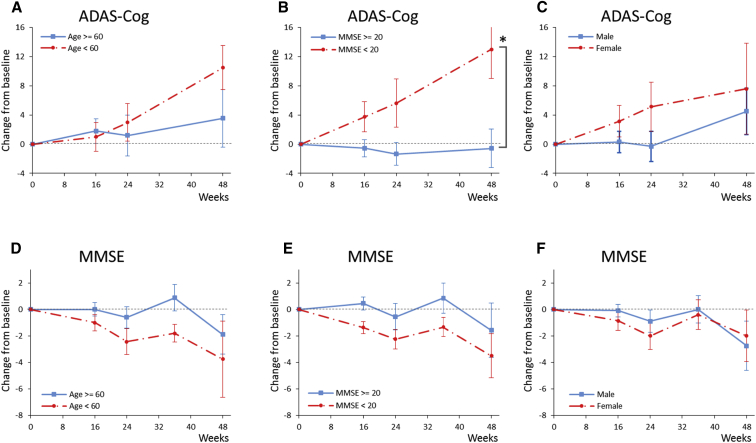
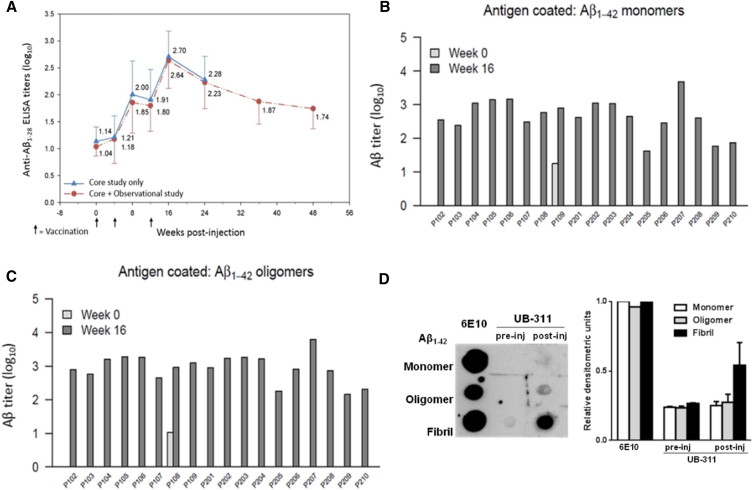
UB-311 covers a diverse genetic background and facilitates strong immune response with high responder rate. UB-311 reduced the levels of Aβ oligomers, protofibrils, and plaque load in hAPP751 transgenic mice. Safe and well-tolerated UB-311 generated considerable site-specific (Aβ) antibodies across all animal species examined. In AD patients, UB-311 induced a 100% responder rate; injection site swelling and agitation were the most common adverse events (4/19 each). A slower rate of increase in ADAS-Cog from baseline to week 48 was observed in the subgroup of mild AD patients (MMSE ≥ 20) compared with the moderate AD subgroup, suggesting that UB-311 may have a potential of cognition improvement in patients with early stage of Alzheimer's dementia.
The UBITh platform can generate a high-precision molecular vaccine with high responder rate, strong on-target immunogenicity, and a potential of cognition improvement, which support UB-311 for active immunotherapy in early-to-mild AD patients currently enrolled in a phase-II trial (NCT02551809).
一种新型淀粉样β(Aβ)合成肽疫苗(UB - 311)已在轻度至中度阿尔茨海默病患者中进行了首次人体试验。我们描述了涵盖疫苗设计、临床前特征分析以及I期临床试验的转化研究,其支持性结果推动UB - 311进入正在进行的II期试验。
UB - 311由两种合成的Aβ靶向肽(B细胞表位)构建而成,每种肽与不同的辅助性T细胞肽表位(UBITh)相连,并配制在偏向Th2的递送系统中。使用hAPP751转基因小鼠模型进行概念验证研究。狒狒和猕猴用于临床前安全性、耐受性和免疫原性评估。轻度至中度阿尔茨海默病(AD)患者在第0、4和12周通过肌肉注射途径接受3剂UB - 311免疫,并监测至第48周。按照方案评估安全性和免疫原性,并通过阿尔茨海默病评估量表 - 认知分量表(ADAS - Cog)、简易精神状态检查表(MMSE)和阿尔茨海默病协作研究 - 临床医生对变化的整体印象(ADCS - CGIC)分析初步疗效。
UB - 311涵盖多种遗传背景,能促进强烈的免疫反应,应答率高。UB - 311降低了hAPP751转基因小鼠中Aβ寡聚体、原纤维和斑块负荷的水平。安全且耐受性良好的UB - 311在所有检测的动物物种中均产生了可观的位点特异性(Aβ)抗体。在AD患者中,UB - 311诱导的应答率为100%;注射部位肿胀和激动是最常见的不良事件(各4/19)。与中度AD亚组相比,轻度AD患者亚组(MMSE≥20)从基线到第48周ADAS - Cog的升高速度较慢,这表明UB - 311可能对早期阿尔茨海默病痴呆患者具有改善认知的潜力。
UBITh平台可生成一种高精度分子疫苗,具有高应答率、强大的靶向免疫原性以及改善认知的潜力,这支持UB - 311用于目前正在进行II期试验(NCT02551809)的早期至轻度AD患者的主动免疫治疗。