Peking University China-Japan Friendship School of Clinical Medicine; Department of Orthopaedic Surgery, Center for Osteonecrosis and Joint Preserving and Reconstruction, Beijing Key Laboratory of Arthritic and Rheumatic Diseases, China-Japan Friendship Hospital, Beijing 100029, China.
Peking University China-Japan Friendship School of Clinical Medicine; Department of Orthopaedic Surgery, Center for Osteonecrosis and Joint Preserving and Reconstruction, Beijing Key Laboratory of Arthritic and Rheumatic Diseases, China-Japan Friendship Hospital, Beijing 100029; Beijing University of Chinese Medicine, Beijing 100029, China.
Chin Med J (Engl). 2017 Nov 5;130(21):2563-2568. doi: 10.4103/0366-6999.217076.
Lateral compartmental osteoarthritis (LCOA), a major complication after medial mobile-bearing unicompartmental knee arthroplasty (UKA), is highly associated with the increased stress of the lateral compartment. This study aimed to analyze the effects on the stress and load distribution of the lateral compartment induced by lower limb alignment and coronal inclination of the tibial component in UKA through a finite element analysis.
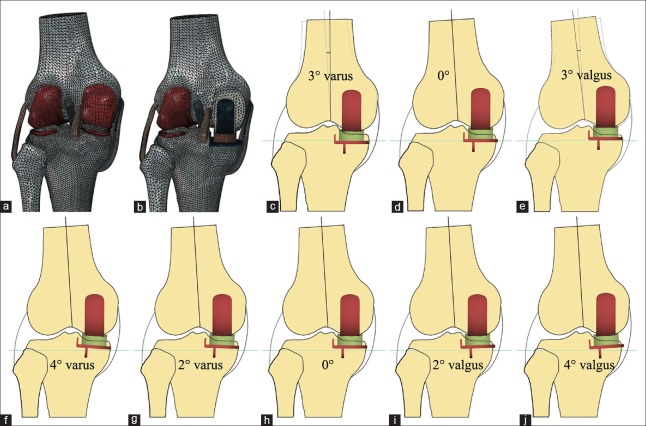
Eight three-dimensional models were constructed based on a validated model for analyzing the biomechanical effects of implantation parameters on the lateral compartment after medial Oxford UKA: postoperative lower limb alignment of 3° valgus, neutral and 3° varus, and the inclination of tibial components placed in 4°, 2° valgus, square, and 2° and 4° varus. The contact stress of femoral and tibial cartilage and load distribution were calculated for all models.
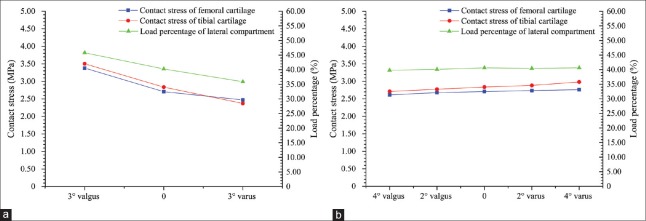
In the 3° valgus lower limb alignment model, the contact stress of femoral (3.38 MPa) and tibial (3.50 MPa) cartilage as well as load percentage (45.78%) was highest compared to any other model, and was increased by 36.75%, 47.70%, and 27.63%, respectively when compared to 3° varus. In the condition of a neutral position, the outcome was comparable for the different tibial tray inclination models. The inclination did not greatly affect the lateral compartmental stress and load distribution.
This study suggested that slightly varus (undercorrection) lower limb alignment might be a way to prevent LCOA in medial mobile-bearing UKA. However, the inclination (4° varus to 4° valgus) of the tibial component in the coronal plane would not be a risk factor for LCOA in neutral position.
外侧间室骨关节炎(LCOA)是内侧单髁膝关节置换术(UKA)后主要的并发症,与外侧间室的压力增加高度相关。本研究旨在通过有限元分析,分析下肢对线和胫骨组件冠状倾斜对 UKA 中外侧间室应力和负荷分布的影响。
基于内侧牛津 UKA 植入物参数对外侧间室生物力学影响的验证模型,构建了 8 个三维模型:术后下肢对线 3°外翻、中立和 3°内翻,胫骨组件倾斜 4°、2°外翻、方形和 2°和 4°内翻。计算了所有模型的股骨和胫骨软骨的接触压力和负荷分布。
在 3°外翻的下肢对线模型中,与其他任何模型相比,股骨(3.38MPa)和胫骨(3.50MPa)软骨的接触压力以及负荷百分比(45.78%)最高,与 3°内翻相比,分别增加了 36.75%、47.70%和 27.63%。在中立位置,不同胫骨托倾斜模型的结果相似。倾斜度对外侧间室的压力和负荷分布没有太大影响。
本研究表明,轻微的外翻(矫正不足)下肢对线可能是预防内侧活动平台 UKA 中 LCOA 的一种方法。然而,胫骨组件在冠状面上的倾斜(4°内翻至 4°外翻)在中立位置不会成为 LCOA 的危险因素。