Figueiredo Viviane Maria Gonçalves de, Pereira Sarina Maciel Braga, Bressiani Eduardo, Valera Márcia Carneiro, Bottino Marco Antônio, Zhang Yu, Melo Renata Marques de
Univ. Estadual Paulista, Instituto de Ciência e Tecnologia de São José dos Campos, Departamento de Materiais Odontológicos e Prótese, São Jose dos Campos, SP, Brasil.
Univ. Estadual Paulista, Instituto de Ciência e Tecnologia de São José dos Campos, Departamento de Odontologia Restauradora, São Jose dos Campos, SP, Brasil.
J Appl Oral Sci. 2017 Sep-Oct;25(5):566-574. doi: 10.1590/1678-7757-2015-0479.
This study evaluated the influence of porcelain (VM9, VITA Zahnfabrik, Germany) thickness on the flexural strength and crack propagation in bilayered zirconia systems (YZ, VITA Zahnfabrik, Germany).
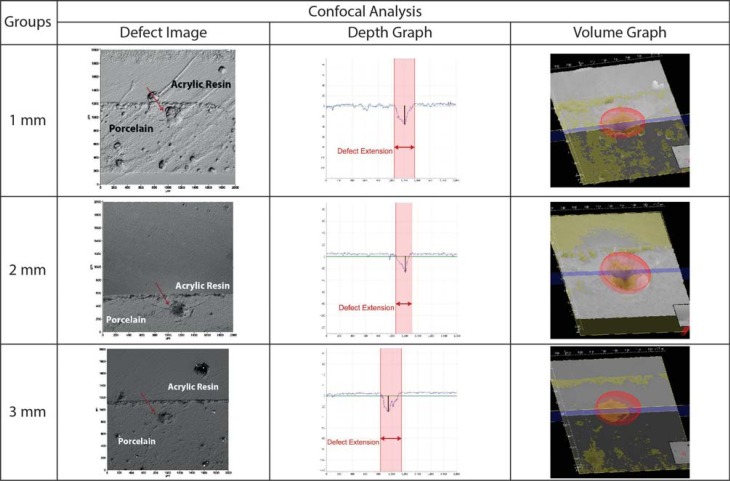
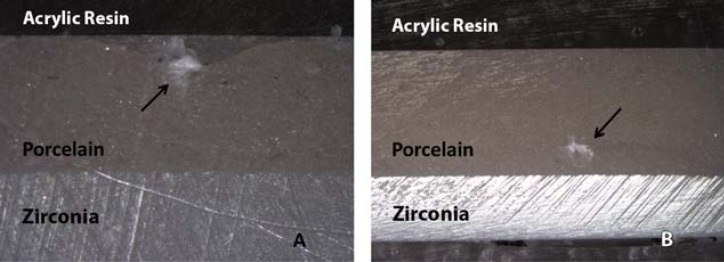
Thirty zirconia bars (20.0x4.0x1.0 mm) and six zirconia blocks (12.0x7.5x1.2 mm) were prepared and veneered with porcelain with different thickness: 1 mm, 2 mm, or 3 mm. The bars of each experimental group (n=10) were subjected to four-point flexural strength testing. In each ceramic block, a Vickers indentation was created under a load of 10 kgf for 10 seconds, for the propagation of cracks.
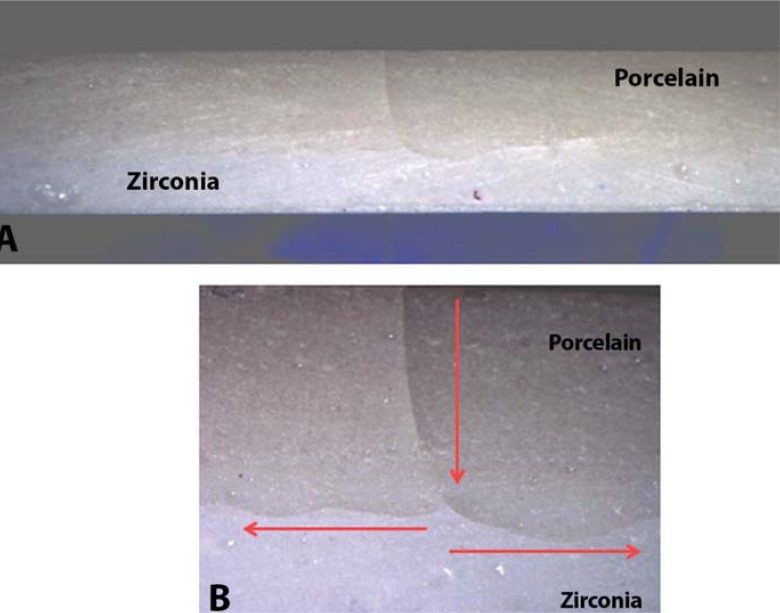
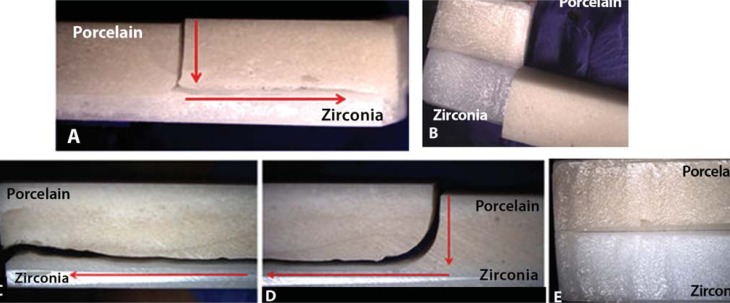
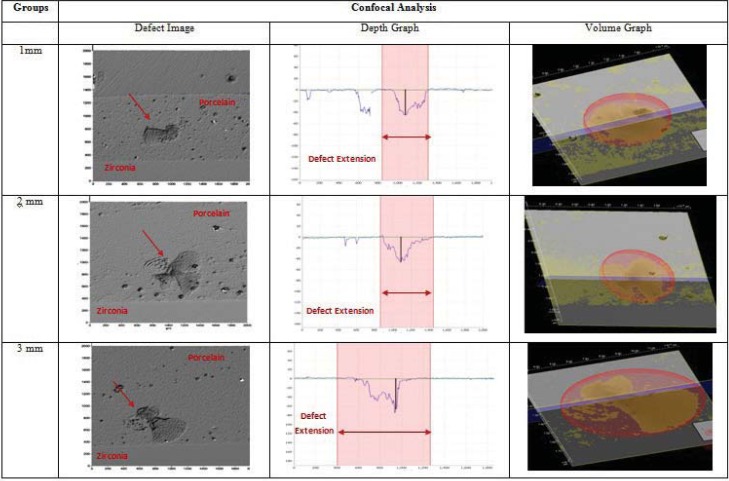
The results of flexural strength were evaluated by One-way ANOVA and Tukey's test, with a significance level of 5%. The factor "thickness of the porcelain" was statistically significant (p=0.001) and the l-mm group presented the highest values of flexural strength. The cracks were predominant among the bending specimens with 1 and 2 mm of porcelain, and catastrophic failures were found in 50% of 3-mm-thick porcelain. After the indentation of blocks, the most severe defects were observed in blocks with 3-mm-thick porcelain.
The smallest (1 mm) thickness of porcelain on the zirconia infrastructure presented higher values of flexural strength. Better resistance to defect propagation was observed near the porcelain/ zirconia interface for all groups. Higher flexural strength was found for a thinner porcelain layer in a bilayered zirconia system. The damage caused by a Vickers indentation near and far the interface with the zirconia shows that the stress profiles are different.
本研究评估了瓷层(VM9,德国维他齿科集团)厚度对双层氧化锆系统(YZ,德国维他齿科集团)弯曲强度和裂纹扩展的影响。
制备30根氧化锆棒(20.0×4.0×1.0mm)和6块氧化锆块(12.0×7.5×1.2mm),并用不同厚度(1mm、2mm或3mm)的瓷进行贴面。每个实验组(n = 10)的棒材进行四点弯曲强度测试。在每个陶瓷块上,在10kgf载荷下保持10秒进行维氏压痕,以观察裂纹扩展情况。
弯曲强度结果采用单因素方差分析和Tukey检验进行评估,显著性水平为5%。“瓷层厚度”因素具有统计学意义(p = 0.001),1mm组的弯曲强度值最高。在瓷层厚度为1mm和2mm的弯曲试样中裂纹占主导,在50%的3mm厚瓷层中发现灾难性破坏。在对块体进行压痕后,在3mm厚瓷层的块体中观察到最严重的缺陷。
氧化锆基体上最小(1mm)厚度的瓷层具有更高的弯曲强度值。所有组在瓷/氧化锆界面附近对缺陷扩展具有更好的抗性。在双层氧化锆系统中,较薄的瓷层具有更高的弯曲强度。氧化锆界面附近和远处的维氏压痕造成的损伤表明应力分布不同。