Wu Junlong, Zhang Peipei, Zhang Guiming, Wang Hongkai, Gu Weijie, Dai Bo, Zhang Hailiang, Shi Guohai, Shen Yijun, Zhu Yiping, Zhu Yao, Ye Dingwei
Department of Urology, Fudan University Shanghai Cancer Center, Shanghai, 200032, China.
Department of Oncology, Shanghai Medical College, Fudan University, Shanghai, China.
Oncotarget. 2017 May 16;8(42):71797-71804. doi: 10.18632/oncotarget.17894. eCollection 2017 Sep 22.
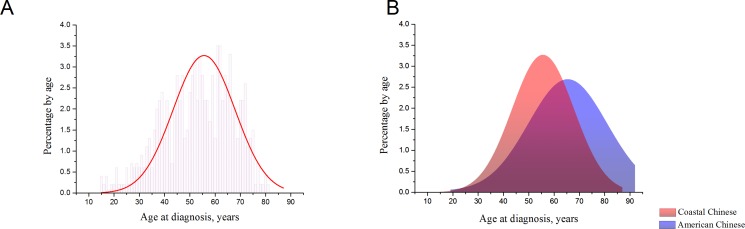
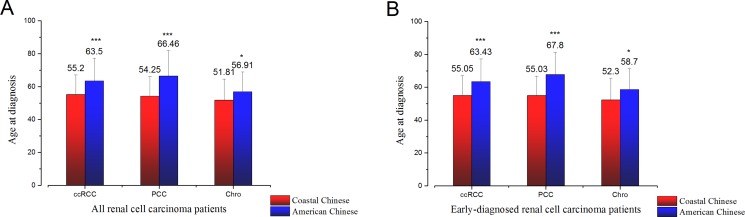
The distribution pattern of renal cell carcinoma (RCC) histological subtypes according to age, gender and tumor size has not been well illustrated in RCC patients living in fast-developing regions of China. We recruited 2941 patients with clear cell renal cell carcinoma (ccRCC), papillary renal cell carcinoma (PCC) or chromophobe from two hospitals in coastal China (2004-2012) consecutively and draw 538 American Chinese RCC patients' data with time matched from the Surveillance, Epidemiology, and End Results database. We found that compared with ccRCC patients, chromophobe patients were more likely to be female (OR: 2.538, 95% CI: 1.923-3.350), younger (OR for 51-60 years old: 0.686; OR for over 60 years old: 0.478; reference: age < 50) and to have a larger maximal diameter (Dmax) (OR for Dmax > 7 cm: 1.883; reference: Dmax ≤ 4 cm). Besides, in comparison with coastal Chinese patients, American Chinese individuals had lower Fuhrman grades ( < 0.001) and had an onset age 10 years delay. In conclusion, we were the first to observe marked gender, age and tumor size differences in the proportional subtype distribution of RCCs in coastal Chinese patients, and also the first to compare coastal Chinese with American Chinese data.
在中国快速发展地区的肾细胞癌(RCC)患者中,肾细胞癌组织学亚型按年龄、性别和肿瘤大小的分布模式尚未得到充分阐明。我们连续招募了来自中国沿海两家医院(2004 - 2012年)的2941例透明细胞肾细胞癌(ccRCC)、乳头状肾细胞癌(PCC)或嫌色细胞癌患者,并从监测、流行病学和最终结果数据库中提取了538例时间匹配的美籍华裔RCC患者的数据。我们发现,与ccRCC患者相比,嫌色细胞癌患者更可能为女性(OR:2.538,95%CI:1.923 - 3.350)、更年轻(51 - 60岁的OR:0.686;60岁以上的OR:0.478;参照:年龄<50岁)且最大直径(Dmax)更大(Dmax>7 cm的OR:1.883;参照:Dmax≤4 cm)。此外,与中国沿海患者相比,美籍华裔个体的Fuhrman分级更低(<0.001)且发病年龄延迟10年。总之,我们首次观察到中国沿海患者RCC比例亚型分布存在明显的性别、年龄和肿瘤大小差异,也是首次比较中国沿海患者与美籍华裔的数据。