Shao Fangyuan, Sun Heng, Deng Chu-Xia
Faculty of Health Sciences, University of Macau, Macau SAR, China.
Oncotarget. 2017 Aug 16;8(42):73329-73344. doi: 10.18632/oncotarget.20274. eCollection 2017 Sep 22.
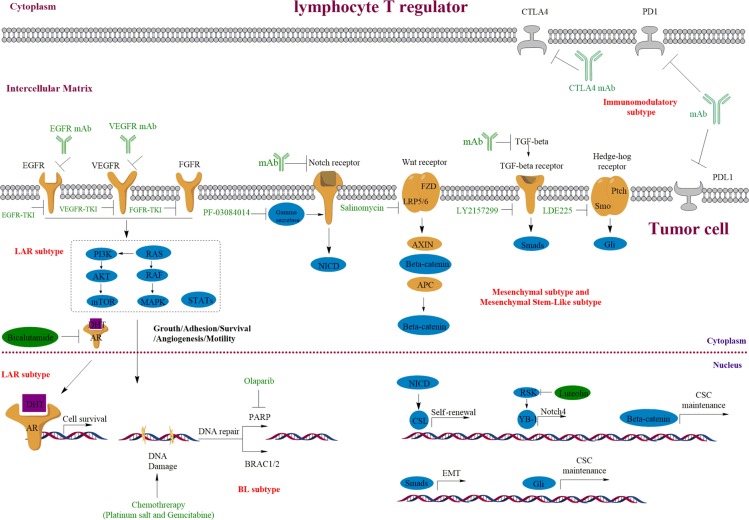
Triple-negative breast cancer (TNBC) is an aggressive subgroup of human breast cancer, which is characterized as estrogen receptor (ER) negative, progesterone receptor (PR) negative, and human epidermal growth factor receptor 2 (HER2) negative. TNBC is the most difficult breast cancer subgroup to treat, due to its unresponsiveness to current clinical targeted therapies, high rate of recurrence, and poor prognosis. Thus, there is an urgent medical need to identify therapeutic targets and develop more effective stratified medicine for the treatment of TNBC. Here we review the potential therapeutic targets for TNBC based on its intrinsic subtype. We also review the aberrant activated signals found in different subgroups of TNBC, including androgen receptor (AR) and PI3K/AKT/mTOR, Notch, Wnt/β-catenin, Hedge-hog, and TGF-β signaling pathways, which play essential roles in multiple development stages of TNBC. The careful analysis of these signaling pathways and therapeutic targets would have significant impact on the drug development and clinical trials, leading to effective therapies for this deadly disease.
三阴性乳腺癌(TNBC)是人类乳腺癌中的一个侵袭性亚组,其特征为雌激素受体(ER)阴性、孕激素受体(PR)阴性和人表皮生长因子受体2(HER2)阴性。由于TNBC对当前临床靶向治疗无反应、复发率高且预后不良,它是最难治疗的乳腺癌亚组。因此,迫切需要确定治疗靶点并开发更有效的分层药物来治疗TNBC。在此,我们基于TNBC的内在亚型综述其潜在的治疗靶点。我们还综述了在TNBC不同亚组中发现的异常激活信号,包括雄激素受体(AR)和PI3K/AKT/mTOR、Notch、Wnt/β-连环蛋白、Hedge-hog和TGF-β信号通路,这些信号通路在TNBC的多个发展阶段中起着至关重要的作用。对这些信号通路和治疗靶点的仔细分析将对药物开发和临床试验产生重大影响,从而为这种致命疾病带来有效的治疗方法。