Giuli M V, Giuliani E, Screpanti I, Bellavia D, Checquolo S
Department of Molecular Medicine, "Sapienza" University of Rome, Rome, Italy.
Department of Medico-Surgical Sciences and Biotechnology, Sapienza University, Latina, Italy.
J Oncol. 2019 Jul 11;2019:8707053. doi: 10.1155/2019/8707053. eCollection 2019.
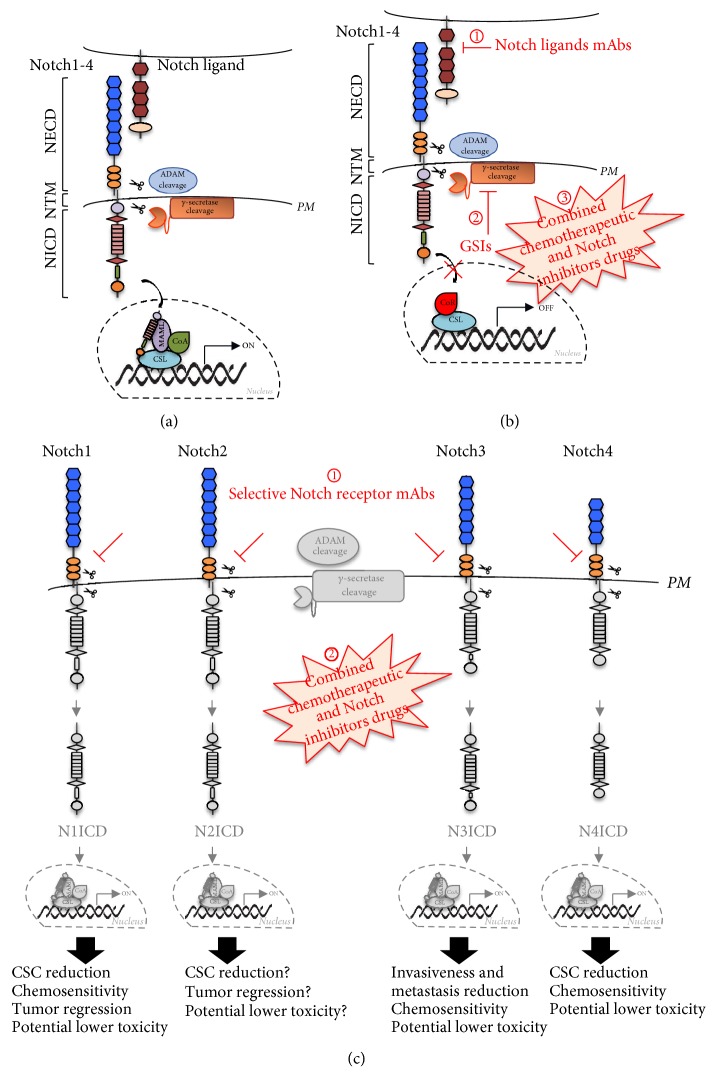
Triple-negative breast cancer (TNBC) is a subgroup of 15%-20% of diagnosed breast cancer patients. It is generally considered to be the most difficult breast cancer subtype to deal with, due to the lack of estrogen receptor (ER), progesterone receptor (PR), and human epidermal growth factor receptor 2 (HER2), which usually direct targeted therapies. In this scenario, the current treatments of TNBC-affected patients rely on tumor excision and conventional chemotherapy. As a result, the prognosis is overall poor. Thus, the identification and characterization of targets for novel therapies are urgently required. The Notch signaling pathway has emerged to act in the pathogenesis and tumor progression of TNBCs. Firstly, Notch receptors are associated with the regulation of tumor-initiating cells (TICs) behavior, as well as with the aetiology of TNBCs. Secondly, there is a strong evidence that Notch pathway is a relevant player in mammary cancer stem cells maintenance and expansion. Finally, Notch receptors expression and activation strongly correlate with the aggressive clinicopathological and biological phenotypes of breast cancer (e.g., invasiveness and chemoresistance), which are relevant characteristics of TNBC subtype. The purpose of this up-to-date review is to provide a detailed overview of the specific role of all four Notch receptors (Notch1, Notch2, Notch3, and Notch4) in TNBCs, thus identifying the Notch signaling pathway deregulation/activation as a pathognomonic feature of this breast cancer subtype. Furthermore, this review will also discuss recent information associated with different therapeutic options related to the four Notch receptors, which may be useful to evaluate prognostic or predictive indicators as well as to develop new therapies aimed at improving the clinical outcome of TNBC patients.
三阴性乳腺癌(TNBC)是15%-20%已确诊乳腺癌患者中的一个亚组。由于缺乏雌激素受体(ER)、孕激素受体(PR)和人表皮生长因子受体2(HER2),而这些通常是靶向治疗的作用靶点,所以三阴性乳腺癌通常被认为是最难治疗的乳腺癌亚型。在这种情况下,目前对三阴性乳腺癌患者的治疗依赖于肿瘤切除和传统化疗。因此,总体预后较差。因此,迫切需要鉴定和表征新疗法的靶点。Notch信号通路已被证明在三阴性乳腺癌的发病机制和肿瘤进展中起作用。首先,Notch受体与肿瘤起始细胞(TIC)行为的调节以及三阴性乳腺癌的病因有关。其次,有强有力的证据表明Notch通路在乳腺癌干细胞的维持和扩增中起重要作用。最后,Notch受体的表达和激活与乳腺癌侵袭性和化疗耐药性等侵袭性临床病理和生物学表型密切相关,而这些正是三阴性乳腺癌亚型的相关特征。这篇最新综述的目的是详细概述所有四种Notch受体(Notch1、Notch2、Notch3和Notch4)在三阴性乳腺癌中的具体作用,从而将Notch信号通路的失调/激活确定为这种乳腺癌亚型的一个特征性标志。此外,本综述还将讨论与四种Notch受体相关的不同治疗选择的最新信息,这可能有助于评估预后或预测指标,以及开发旨在改善三阴性乳腺癌患者临床结局的新疗法。