Department of Surgery, University of Cambridge, Addenbrooke's Hospital, Cambridge, Hill's Road, CB2 OQQ, UK.
J Transl Med. 2017 Oct 25;15(1):216. doi: 10.1186/s12967-017-1314-5.
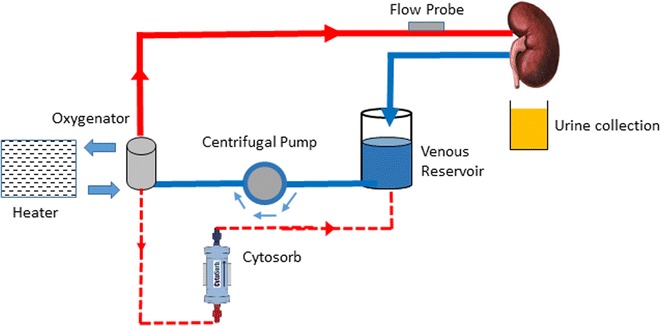
Ex-vivo normothermic perfusion strategies are a promising new instrument in organ transplantation. The perfusion conditions are designed to be protective however the artificial environment can induce a local inflammatory response. The aim of this study was to determine the effect of incorporating a Cytosorb adsorber into an isolated kidney perfusion system.
Porcine kidneys were subjected to 22 h of cold ischaemia then reperfused for 6 h on an ex vivo reperfusion circuit. Pairs of kidneys were randomised to either control (n = 5) or reperfusion with a Cytosorb adsorber (n = 5) integrated into the circuit. Tissue, blood and urine samples were taken for the measurement of inflammation and renal function.
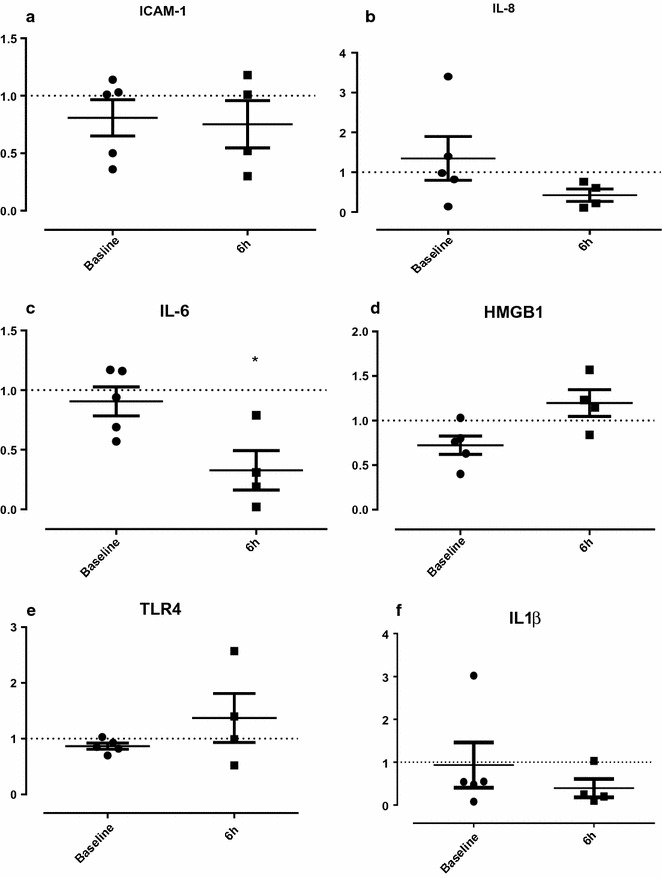
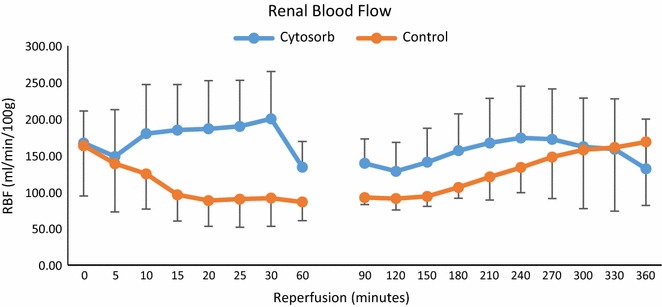
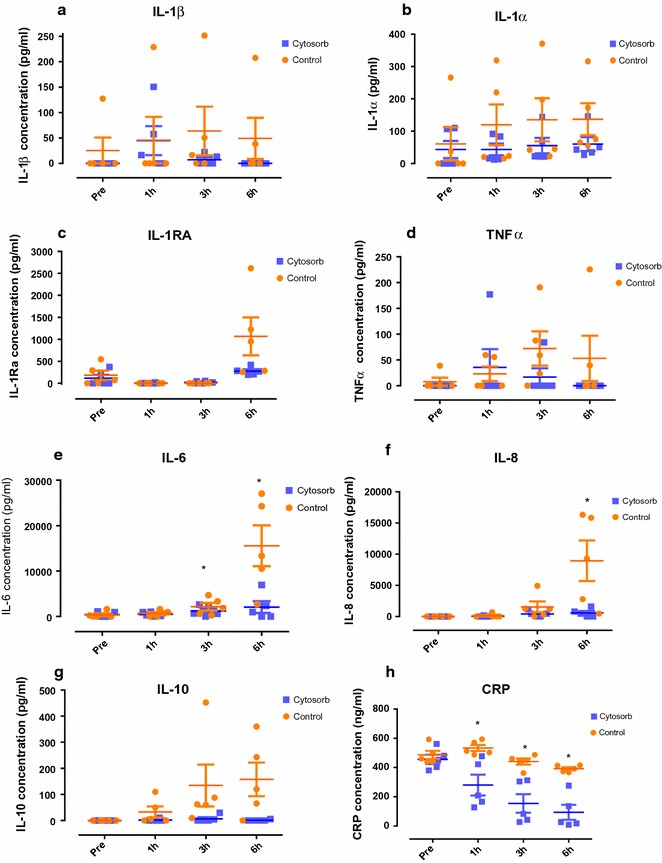
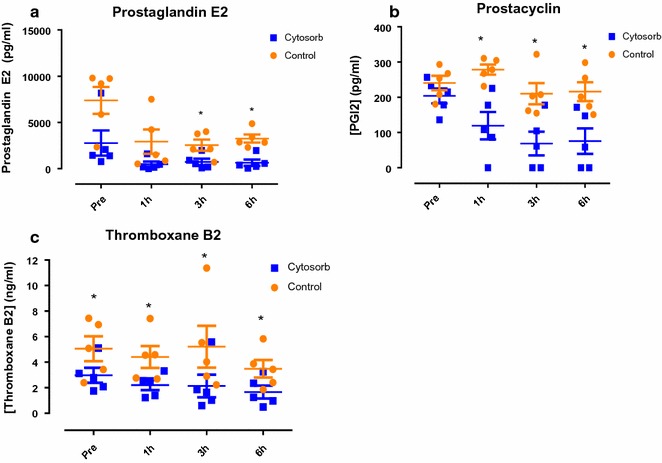
Baseline levels of cytokines (IL-6, TNFα, IL-8, IL-10, IL-1β, IL-1α) were similar between groups. Levels of IL-6 and IL-8 in the perfusate significantly increased during reperfusion in the control group but not in the Cytosorb group (P = 0.023, 0.049). Levels of the other cytokines were numerically lower in the Cytosorb group; however, this did not reach statistical significance. The mean renal blood flow (RBF) was significantly higher in the Cytosorb group (162 ± 53 vs. 120 ± 35 mL/min/100 g; P = 0.022). Perfusate levels of prostaglandin E2 were significantly lower in the Cytosorb group (642 ± 762 vs. 3258 ± 980 pg/mL; P = 0.0001). Levels of prostacyclin were significantly lower in the Cytosorb group at 1, 3 and 6 h of reperfusion (P = 0.008, 0.003, 0.0002). Levels of thromboxane were also significantly lower in the Cytosorb group throughout reperfusion (P = 0.005). Haemoadsorption had no effect on creatinine clearance (P = 0.109).
Haemoadsorption can reduce the inflammatory response and improve renal blood flow during perfusion. Nonetheless, in this model haemoadsorption had no influence on renal function and this may relate to the broad-spectrum action of the Cytosorb adsorber that also removes potentially important anti-inflammatory mediators.
离体常温灌流策略是器官移植中一种有前途的新手段。灌流条件旨在起保护作用,但人工环境会引发局部炎症反应。本研究旨在确定在离体肾脏灌流系统中加入 Cytosorb 吸附剂的效果。
猪肾在冷缺血 22 小时后,在离体再灌注回路中再灌注 6 小时。将成对的肾脏随机分为对照组(n=5)或再灌注时在回路中加入 Cytosorb 吸附剂(n=5)。采集组织、血液和尿液样本,以测量炎症和肾功能。
两组间细胞因子(IL-6、TNFα、IL-8、IL-10、IL-1β、IL-1α)的基线水平相似。对照组再灌注期间灌流液中 IL-6 和 IL-8 的水平显著升高,但 Cytosorb 组没有升高(P=0.023,0.049)。Cytosorb 组的其他细胞因子水平数值较低;然而,这并未达到统计学意义。Cytosorb 组的平均肾血流(RBF)显著较高(162±53 与 120±35 mL/min/100g;P=0.022)。Cytosorb 组灌流液中前列腺素 E2 的水平显著较低(642±762 与 3258±980 pg/mL;P=0.0001)。再灌注 1、3 和 6 小时时,Cytosorb 组的前列环素水平显著较低(P=0.008、0.003、0.0002)。再灌注期间,Cytosorb 组的血栓素水平也显著较低(P=0.005)。血液吸附对肌酐清除率没有影响(P=0.109)。
血液吸附可减少灌流期间的炎症反应并改善肾血流。尽管如此,在该模型中,血液吸附对肾功能没有影响,这可能与 Cytosorb 吸附剂的广谱作用有关,该作用还去除了潜在的重要抗炎介质。