Hangzhou First People's Hospital, Nanjing Medical University, No. 261 Huansha Road, Shangcheng District, Hangzhou, 310006, China.
J Neuroinflammation. 2017 Oct 25;14(1):207. doi: 10.1186/s12974-017-0980-9.
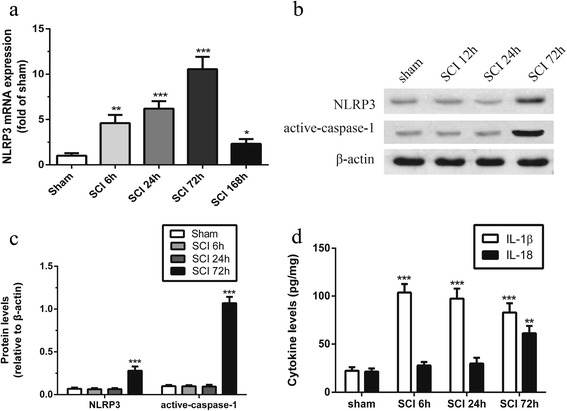
Spinal cord injury (SCI) is a devastating disease, which results in tissue loss and neurologic dysfunction. NLRP3 inflammasome plays an important role in the mechanism of diverse diseases. However, no studies have demonstrated the role of NLRP3 inflammasome and the effects of NLRP3 inflammasome inhibitors in a mouse model of SCI. We investigated whether inhibition of NLRP3 inflammasome activation by the pharmacologic inhibitor BAY 11-7082 or A438079 could exert neuroprotective effects in a mouse model of SCI.
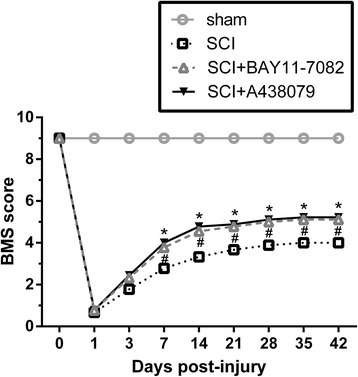
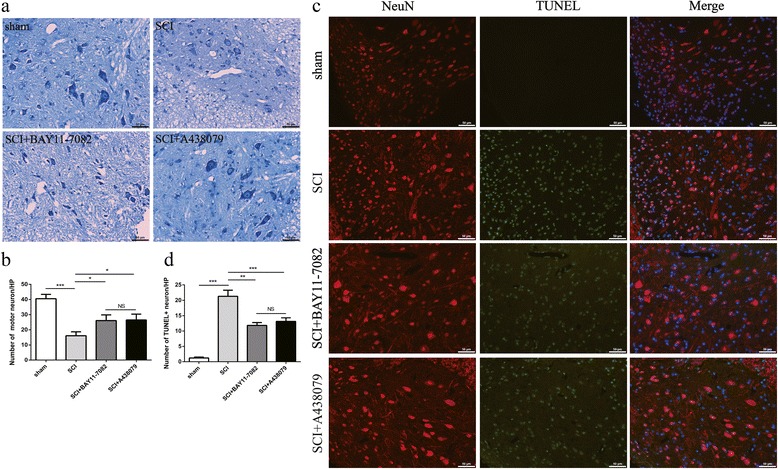
SCI was performed using an aneurysm clip with a closing force of 30 g at the level of the T6-T7 vertebra for 1 min. Motor recovery was evaluated by an open-field test. Neuronal death was assessed by terminal deoxynucleotidyl transferase dUTP nick end labeling and Nissl staining. Mitochondrial dysfunction was determined by quantitative real-time polymerase chain reaction (qPCR), western blot, and detection of mitochondrial membrane potential level. Microglia/macrophage activation and astrocytic response were evaluated by immunofluorescence labeling.
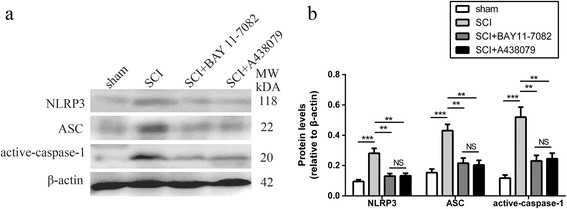
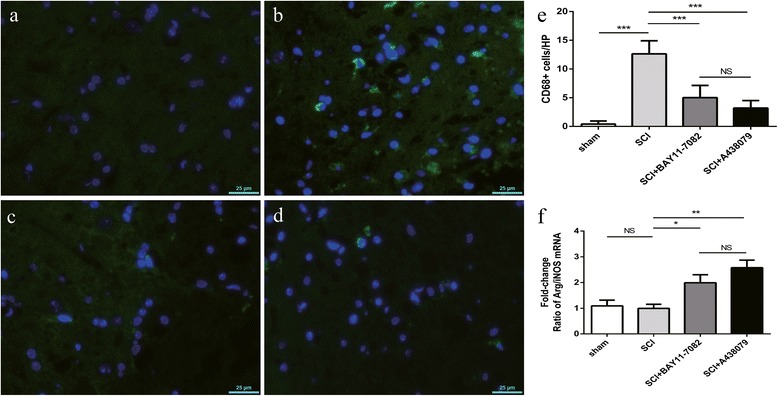
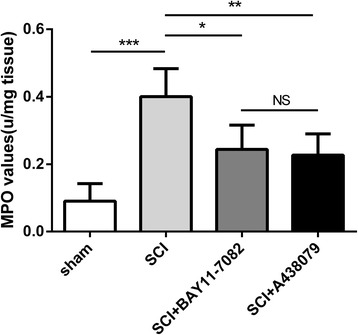
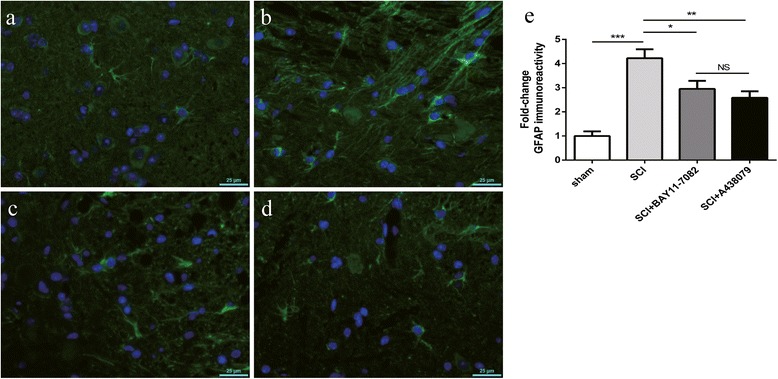
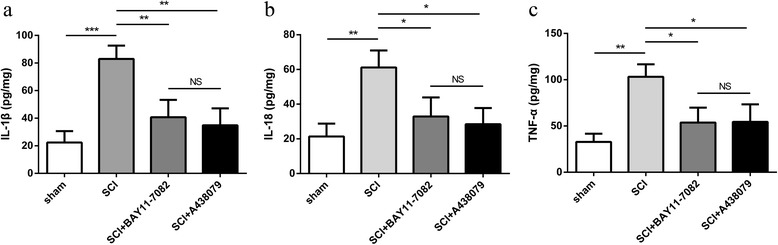
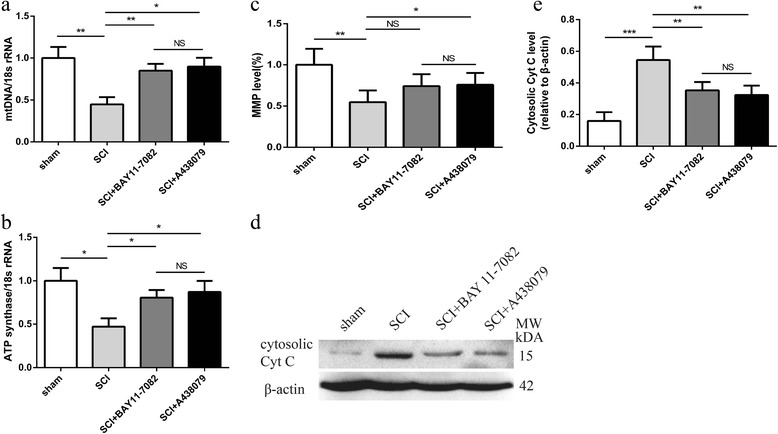
Inhibition of NLRP3 inflammasome activation by pharmacologic inhibitor BAY 11-7082 or A438079 reduced neuronal death, attenuated spinal cord anatomic damage, and promoted motor recovery. Furthermore, BAY 11-7082 or A438079 directly attenuated the levels of NLRP3 inflammasome and proinflammatory cytokines. Moreover, BAY 11-7082 or A438079 alleviated microglia/macrophage activation, neutrophils infiltration, and reactive gliosis, as well as mitochondrial dysfunction.
Collectively, our results demonstrate that pharmacologic suppression of NLRP3 inflammasome activation controls neuroinflammation, attenuates mitochondrial dysfunction, alleviates the severity of spinal cord damage, and improves neurological recovery after SCI. These data strongly indicate that the NLRP3 inflammasome is a vital contributor to the secondary damage of SCI in mice.
脊髓损伤(SCI)是一种破坏性疾病,会导致组织损失和神经功能障碍。NLRP3 炎性小体在多种疾病的发病机制中发挥着重要作用。然而,目前尚无研究表明 NLRP3 炎性小体及其抑制剂在 SCI 小鼠模型中的作用。我们研究了药理学抑制剂 BAY 11-7082 或 A438079 是否可以通过抑制 NLRP3 炎性小体的激活来发挥 SCI 小鼠模型中的神经保护作用。
使用夹闭力为 30g 的动脉瘤夹在 T6-T7 椎骨水平夹闭 1 分钟,建立 SCI 模型。通过旷场试验评估运动功能恢复情况。末端脱氧核苷酸转移酶 dUTP 缺口末端标记和尼氏染色评估神经元死亡情况。实时定量聚合酶链反应(qPCR)、Western blot 和检测线粒体膜电位水平评估线粒体功能障碍。免疫荧光标记评估小胶质细胞/巨噬细胞激活和星形胶质细胞反应。
通过药理学抑制剂 BAY 11-7082 或 A438079 抑制 NLRP3 炎性小体的激活可减少神经元死亡,减轻脊髓解剖损伤,并促进运动功能恢复。此外,BAY 11-7082 或 A438079 可直接降低 NLRP3 炎性小体和促炎细胞因子的水平。此外,BAY 11-7082 或 A438079 减轻了小胶质细胞/巨噬细胞激活、中性粒细胞浸润和反应性神经胶质增生以及线粒体功能障碍。
综上所述,我们的研究结果表明,药理学抑制 NLRP3 炎性小体的激活可控制神经炎症,减轻线粒体功能障碍,减轻脊髓损伤的严重程度,并改善 SCI 后的神经功能恢复。这些数据强烈表明,NLRP3 炎性小体是 SCI 小鼠继发性损伤的重要因素。