Radwan Samir S A, Al-Mailem Dina M, Kansour Mayada K
Microbiology Program, Department of Biological Sciences, Faculty of Science, Kuwait University, P O Box 5969, Safat, 13060, Kuwait.
Sci Rep. 2017 Oct 25;7(1):13975. doi: 10.1038/s41598-017-14296-x.
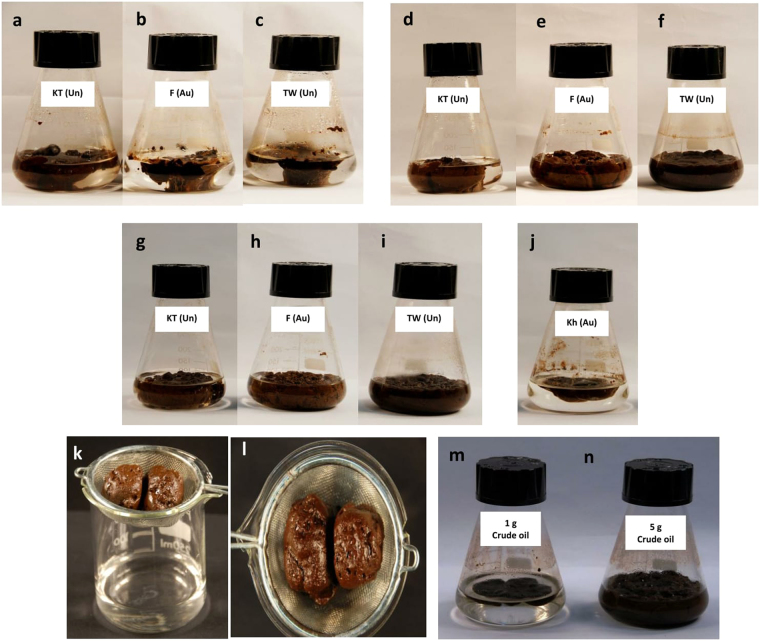
When crude oil samples were shaken (200 rpm) in seawater samples from the Arabian Gulf at 30 °C, usually oil-gels were produced spontaneously leaving the water quite clear. The gelators could probably be based on cholesteryl derivatives. Microscopic examination of the established gels revealed nanofibrellar structures similar to those described by earlier workers for artificially synthesized gelators. Communities of bacteria including prosthetic and stalked members as well as oil-degrading bacteria were recorded in such gels. Chemical analysis revealed that 88.5% of the oil entrapped by gelation was biodegraded after 40 days at 30 °C. Individual bacterial species isolated from the oil-gels biodegraded in batch cultures between 17.8 and 33.3% of the oil added at time zero in 12 days at 30 °C. Gelation is a promising approach, not only for clean, physical removal of oil spilled in aquatic habitats, as so far suggested, but also in its effective microbiological biodegradation, as the current study revealed.
当原油样品在30°C下于来自阿拉伯湾的海水样品中振荡(200转/分钟)时,通常会自发形成油凝胶,使水变得相当清澈。凝胶剂可能基于胆固醇衍生物。对形成的凝胶进行显微镜检查发现,其纳米纤维结构与早期研究人员描述的人工合成凝胶剂的结构相似。在这种凝胶中记录到了包括具柄成员和有柄成员以及石油降解细菌在内的细菌群落。化学分析表明,在30°C下40天后,通过凝胶化截留的88.5%的油被生物降解。从油凝胶中分离出的单个细菌物种在30°C下于12天内对初始添加油的生物降解率在17.8%至33.3%之间。如目前研究所揭示的,凝胶化不仅是一种有望用于清洁、物理去除水生栖息地溢油的方法,正如迄今为止所建议的那样,而且在其有效的微生物生物降解方面也是如此。