Laboratory of Biology and Applied Pharmacology (LBPA), CNRS UMR8113, IDA FR3242, ENS Paris-Saclay, Université Paris-Saclay, F-94235, Cachan, France.
Sci Rep. 2017 Oct 25;7(1):14067. doi: 10.1038/s41598-017-14564-w.
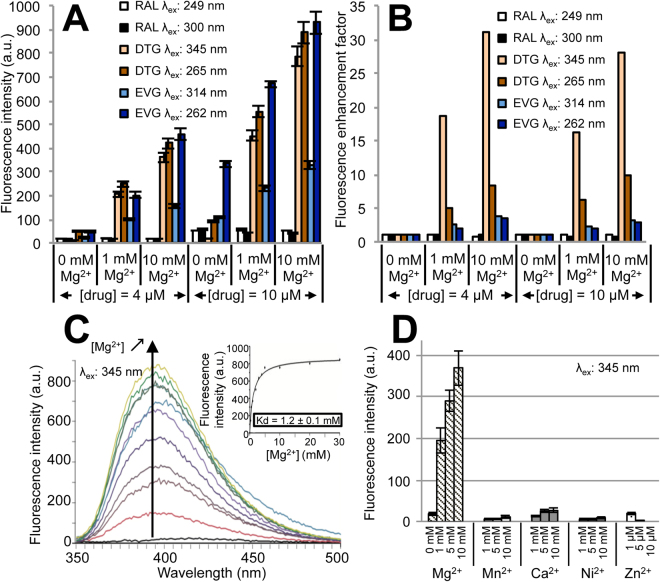
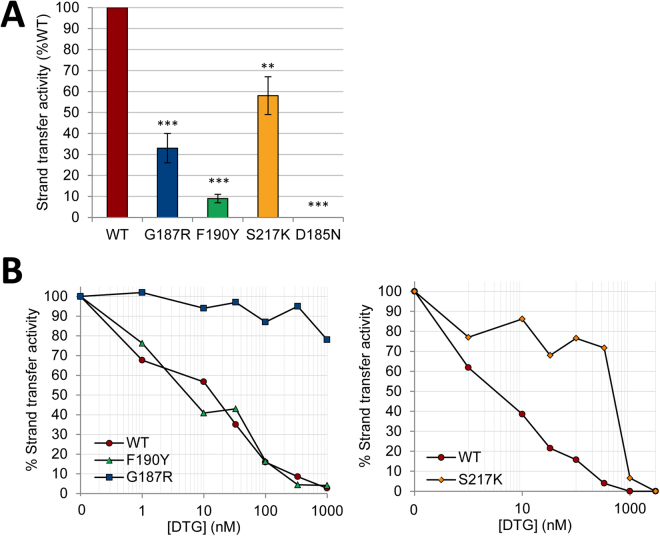
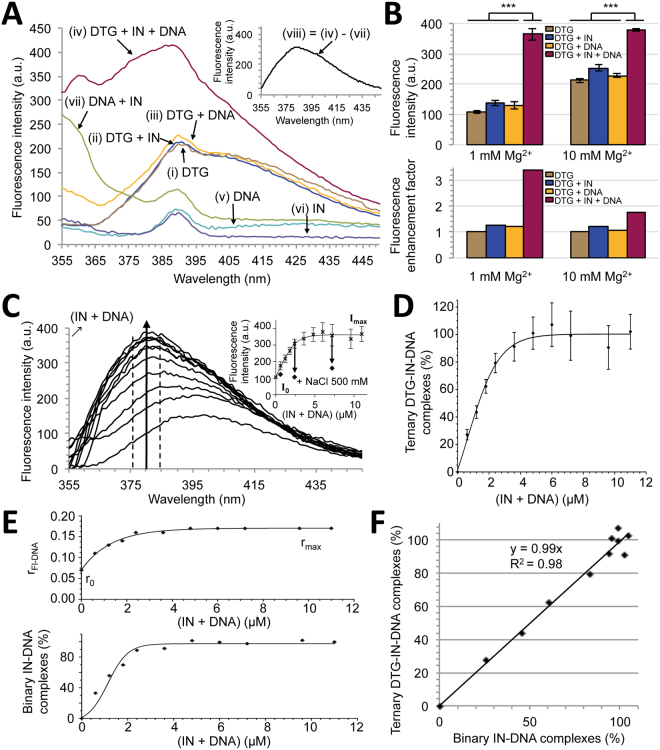
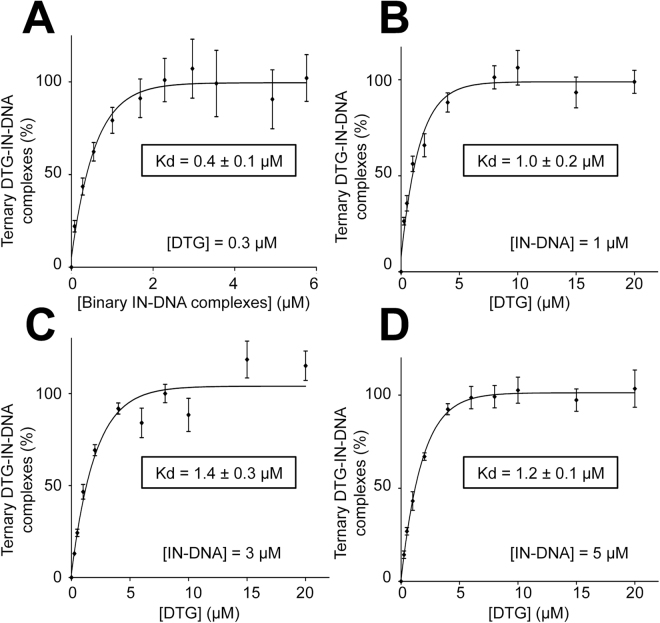
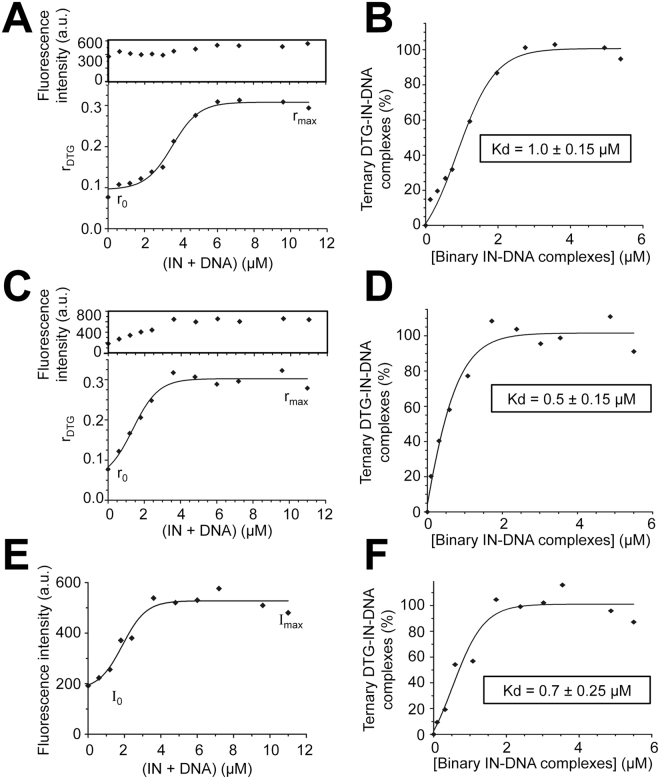
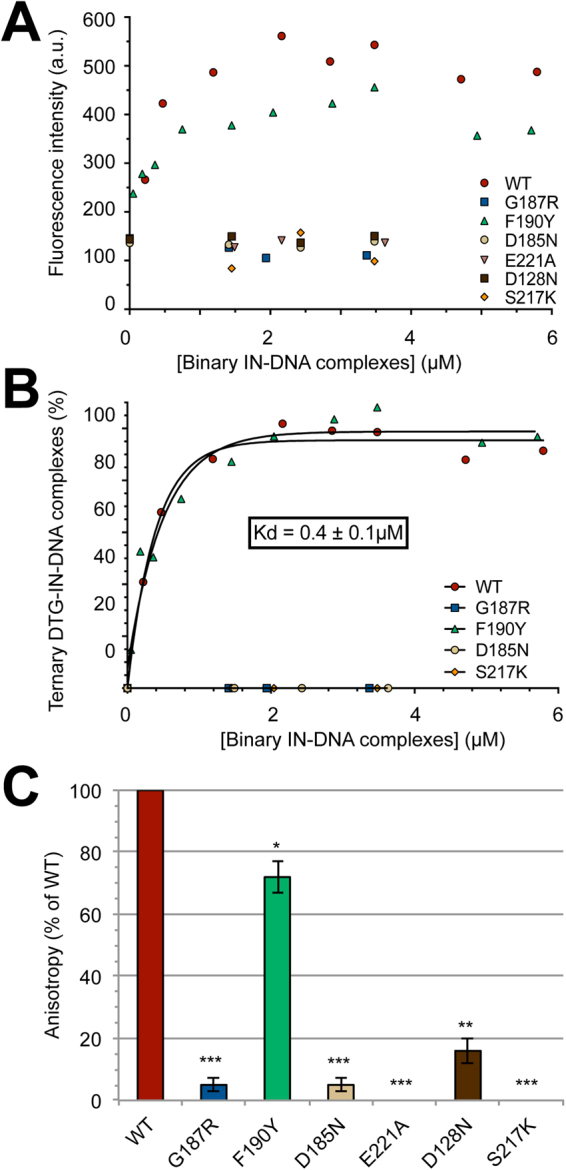
FDA-approved integrase strand transfer inhibitors (raltegravir, elvitegravir and dolutegravir) efficiently inhibit HIV-1 replication. Here, we present fluorescence properties of these inhibitors. Dolutegravir displays an excitation mode particularly dependent on Mg chelation, allowing to directly probe its Mg-dependent binding to the prototype foamy virus (PFV) integrase. Dolutegravir-binding studied by both its fluorescence anisotropy and subsequent emission enhancement, strictly requires a preformed integrase/DNA complex, the ten terminal base pairs from the 3'-end of the DNA reactive strand being crucial to optimize dolutegravir-binding in the context of the ternary complex. From the protein side, mutation of any catalytic residue fully abolishes dolutegravir-binding. We also compared dolutegravir-binding to PFV F190Y, G187R and S217K mutants, corresponding to HIV-1 F121Y, G118R and G140S/Q148K mutations that confer low-to-high resistance levels against raltegravir/dolutegravir. The dolutegravir-binding properties derived from fluorescence-based binding assays and drug susceptibilities in terms of catalytic activity, are well correlated. Indeed, dolutegravir-binding to wild-type and F190Y integrases are comparable while strongly compromised with G187R and S217K. Accordingly, the two latter mutants are highly resistant to dolutegravir while F190Y shows only moderate or no resistance. Intrinsic fluorescence properties of dolutegravir are thus particularly suitable for a thorough characterization of both DNA-binding properties of integrase and resistance mutations.
美国食品和药物管理局批准的整合酶链转移抑制剂(拉替拉韦、艾维雷格和多替拉韦)能有效地抑制 HIV-1 的复制。在此,我们介绍了这些抑制剂的荧光特性。多替拉韦显示出一种特别依赖于镁螯合的激发模式,使其能够直接探测其对原型泡沫病毒(PFV)整合酶的镁依赖性结合。通过荧光各向异性和随后的发射增强研究多替拉韦的结合,严格要求预先形成整合酶/DNA 复合物,DNA 反应链的 3'端的十个末端碱基对对于优化多替拉韦在三元复合物中的结合至关重要。从蛋白质方面来看,任何催化残基的突变都会完全阻止多替拉韦的结合。我们还比较了多替拉韦与 PFV F190Y、G187R 和 S217K 突变体的结合,这些突变体对应于 HIV-1 F121Y、G118R 和 G140S/Q148K 突变,这些突变赋予了对拉替拉韦/多替拉韦的低至高耐药水平。基于荧光结合测定和催化活性方面的药物敏感性得出的多替拉韦结合特性具有良好的相关性。实际上,野生型和 F190Y 整合酶与多替拉韦的结合相当,而与 G187R 和 S217K 的结合则严重受损。因此,后两种突变体对多替拉韦高度耐药,而 F190Y 仅表现出中度或无耐药性。多替拉韦的固有荧光特性因此非常适合于整合酶的 DNA 结合特性和耐药突变的全面表征。