Kuk J L, Wharton S
School of Kinesiology and Health Science York University Toronto Canada.
The Wharton Medical Clinic Hamilton Canada.
Obes Sci Pract. 2016 Mar 23;2(2):215-223. doi: 10.1002/osp4.35. eCollection 2016 Jun.
To describe differences in weight loss (WL) trajectory patterns at a publicly funded clinical weight management centre.
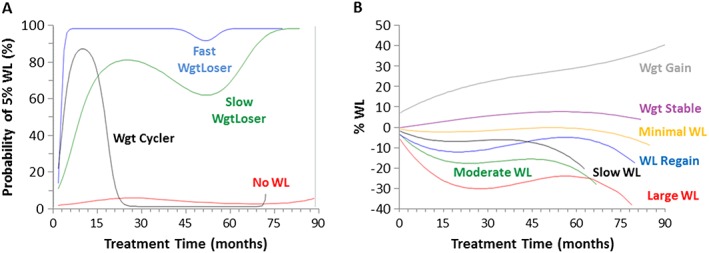
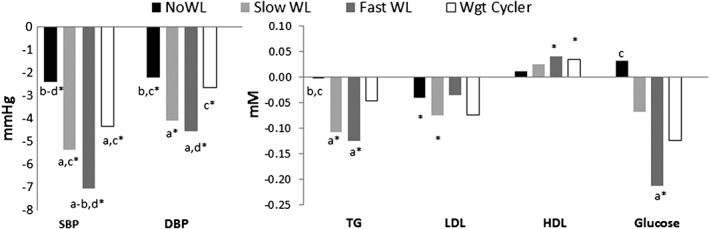
Groups with differences in the attainment of a 5% total body WL and percentage WL patterns over time were identified in 7,121 patients who attended a physician lead multi-disciplinary clinical lifestyle weight management that predominantly focused on education and diet counselling. Resultant health differences were examined.
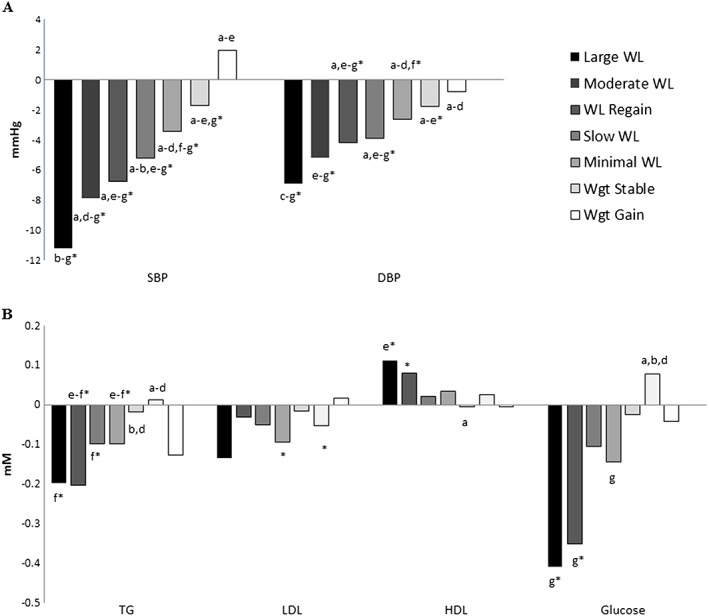
Patients had 3.2 ± 6.3%WL with 35% of patients achieving and maintaining a 5%WL. Half of these patients achieved the 5%WL within 6 months, while the other half had a more gradual approach. Another 10% achieved 5%WL, but regained weight after 6 months. There were seven distinct WL patterns identified: LargeWL (Mean WL: 21.2 ± 8.1%; Probability of group membership (PGM): 2.4%), ModerateWL (15.1 ± 5.1%WL; 5.4%PGM), SlowWL (6.7 ± 3.2%WL; 20.1%PGM) and MinimalWL (2.4 ± 2.2%WL; 34.6%PGM), WL Regain (9.4 ± 3.5%WL; 8.2%PGM), Weight Stable (1.2 ± 3.2%WL; 28.5%PGM) and Weight Gain (18.4 ± 11.2%WG; 0.8%PGM) groups. Improvements in blood pressure, lipids and glucose were generally related to the magnitude of WL achieved more than the pattern or speed of WL.
There are large differences in the absolute WL attained and the pattern of WL during a publicly funded weight management program. Changes in clinical health markers appear to be more strongly related with the absolute WL attained as opposed to patterns of weight change. © 2016 The Authors. Obesity Science & Practice published by John Wiley & Sons Ltd, World Obesity and The Obesity Society.
描述在一个公共资助的临床体重管理中心体重减轻(WL)轨迹模式的差异。
在7121名参加由医生主导的多学科临床生活方式体重管理的患者中,确定了总体重减轻5%以及随时间变化的体重减轻百分比模式存在差异的组。该体重管理主要侧重于教育和饮食咨询。随后对由此产生的健康差异进行了检查。
患者体重减轻了3.2±6.3%,35%的患者实现并维持了5%的体重减轻。其中一半患者在6个月内实现了5%的体重减轻,而另一半则采取了更渐进的方式。另外10%的患者实现了5%的体重减轻,但在6个月后体重又恢复了。确定了七种不同的体重减轻模式:大幅体重减轻(平均体重减轻:21.2±8.1%;组成员概率(PGM):2.4%)、中度体重减轻(15.1±5.1%体重减轻;5.4%PGM)、缓慢体重减轻(6.7±3.2%体重减轻;20.1%PGM)和最小体重减轻(2.4±2.2%体重减轻;34.6%PGM)、体重恢复(9.4±3.5%体重减轻;8.2%PGM)、体重稳定(1.2±3.2%体重减轻;28.5%PGM)和体重增加(18.4±11.2%体重增加;0.8%PGM)组。血压、血脂和血糖的改善通常与实现的体重减轻幅度有关,而不是与体重减轻的模式或速度有关。
在公共资助的体重管理项目中,实现的绝对体重减轻和体重减轻模式存在很大差异。临床健康指标的变化似乎与实现的绝对体重减轻更密切相关,而不是与体重变化模式相关。©2016作者。由约翰·威利父子有限公司、世界肥胖症组织和肥胖症协会出版的《肥胖科学与实践》。