Najm Svetlana, Löfqvist Chatarina, Hellgren Gunnel, Engström Eva, Lundgren Pia, Hård Anna-Lena, Lapillonne Alexandre, Sävman Karin, Nilsson Anders K, Andersson Mats X, Smith Lois E H, Hellström Ann
Department of Paediatrics, Institute of Clinical Sciences, Sahlgrenska Academy, University of Gothenburg, Gothenburg, Sweden.
Section for Ophthalmology, Department of Clinical Neuroscience, Institute of Neuroscience and Physiology, Sahlgrenska Academy, University of Gothenburg, Gothenburg, Sweden.
Clin Nutr ESPEN. 2017 Aug;20:17-23. doi: 10.1016/j.clnesp.2017.04.004. Epub 2017 May 3.
BACKGROUND & AIMS: The purpose of the study was to compare the effects of the parenteral emulsion SMOFlipid, with 15% fish oil, with Clinoleic on retinopathy of prematurity (ROP) and other morbidities and growth, and to compare their impact on longitudinal serum levels of fatty acids. Retinopathy of prematurity, other morbidity and growth were correlated with each parenteral lipid supplement.
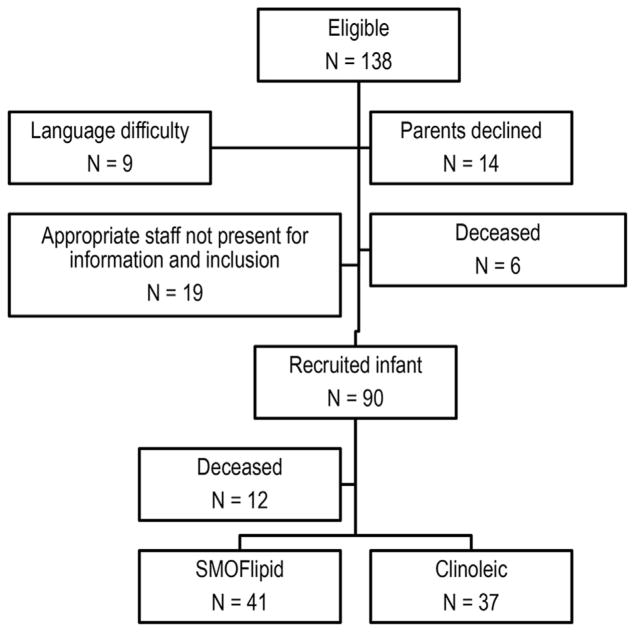
Ninety infants born at gestational age <28 weeks were randomized to treatment with SMOFlipid or Clinoleic. Two thirds (66%) of the infants received parenteral nutrition for up to 14 days birth (median 8, range 2-14 days), and additional 25% of the infants received for up to 28 days after birth (median 21, range 15-28 days). Cord blood samples and then venous blood samples were obtained at ages 1, 7, 14, and 28 days and at postmenstrual age (PMA) 32, 36, and 40 weeks. Breastmilk was collected at postnatal day 7, and at PMA 32 and 40 weeks. Serum phospholipid and breastmilk total fatty acids were analyzed by gas chromatography-mass spectrometry. Treatment groups were compared with regard to ROP, bronchopulmonary dysplasia, necrotizing enterocolitis, patent ductus arteriosus sepsis and growth between birth and 36 weeks.
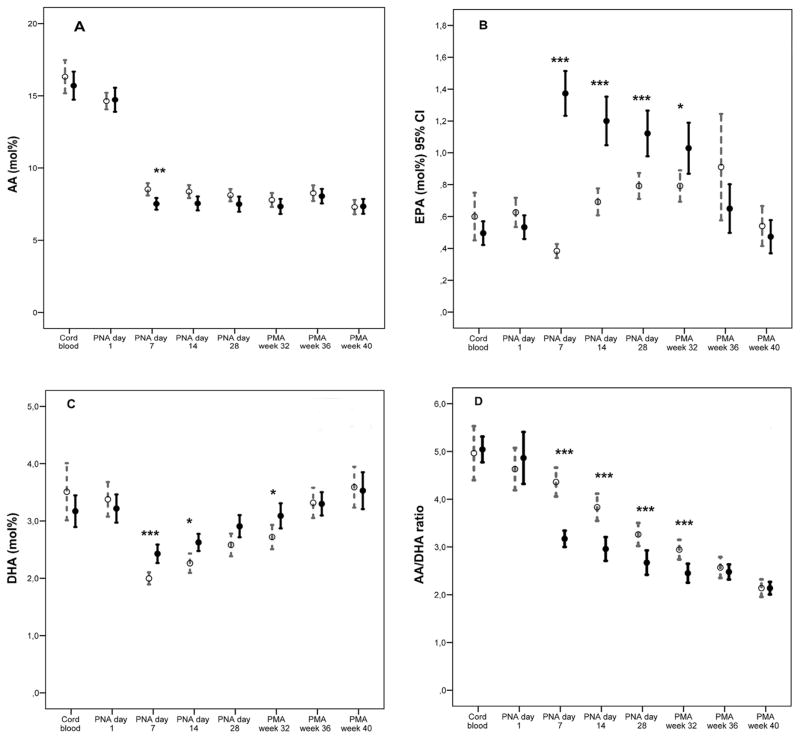
Infants on SMOFlipid had higher fractions of omega-3 LCPUFA eicosapentaenoic acid (EPA) and slightly higher omega-3 LCPUFA docosahexaenoic acid (DHA) fraction and a decreased arachidonic acid (AA) to DHA ratio from one week after birth up to 32 postmenstrual weeks compared to infants on Clinoleic. Treatment groups did not differ in morbidities or growth.
Supplementation with SMOFlipid containing 15% fish oil during parenteral nutrition increased EPA substantially, DHA marginally, reduced AA and decreased AA to DHA ratio. It did not reduce morbidity or affect growth. Since extremely preterm infants accumulate a large deficit of DHA and AA, studies on more prolonged or different levels of DHA and AA supplementation are warranted.
本研究旨在比较含15%鱼油的肠外营养乳剂SMOFlipid与Clinoleic对早产儿视网膜病变(ROP)、其他疾病及生长发育的影响,并比较它们对血清脂肪酸纵向水平的影响。将早产儿视网膜病变、其他疾病及生长发育情况与每种肠外脂质补充剂进行关联分析。
90例孕周小于28周的婴儿被随机分为接受SMOFlipid或Clinoleic治疗组。三分之二(66%)的婴儿出生后接受肠外营养长达14天(中位数8天,范围2 - 14天),另外25%的婴儿出生后接受长达28天(中位数21天,范围15 - 28天)。分别在出生后1、7、14和28天以及孕龄(PMA)32、36和40周采集脐血样本及静脉血样本。在出生后第7天以及孕龄32和40周采集母乳样本。采用气相色谱 - 质谱法分析血清磷脂和母乳中的总脂肪酸。比较治疗组在ROP、支气管肺发育不良、坏死性小肠结肠炎、动脉导管未闭、败血症以及出生至36周生长发育情况方面的差异。
与接受Clinoleic治疗的婴儿相比,接受SMOFlipid治疗的婴儿从出生后1周直至孕龄32周,ω-3长链多不饱和脂肪酸二十碳五烯酸(EPA)比例更高,ω-3长链多不饱和脂肪酸二十二碳六烯酸(DHA)比例略高,花生四烯酸(AA)与DHA的比值降低。治疗组在疾病发生率或生长发育方面无差异。
肠外营养期间补充含15%鱼油的SMOFlipid可显著增加EPA,少量增加DHA,降低AA并降低AA与DHA的比值。它并未降低疾病发生率或影响生长发育。鉴于极早产儿积累了大量的DHA和AA缺乏,有必要开展关于更长时间或不同水平DHA和AA补充的研究。