Dewolf Arthur H, Ivanenko Yuri P, Lacquaniti Francesco, Willems Patrick A
Laboratory of Biomechanics and Physiology of Locomotion, Institute of NeuroScience, Université Catholique de Louvain, Louvain-la-Neuve, Belgium.
Laboratory of Neuromotor Physiology, IRCCS Santa Lucia Foundation, Rome, Italy.
PLoS One. 2017 Oct 26;12(10):e0186963. doi: 10.1371/journal.pone.0186963. eCollection 2017.
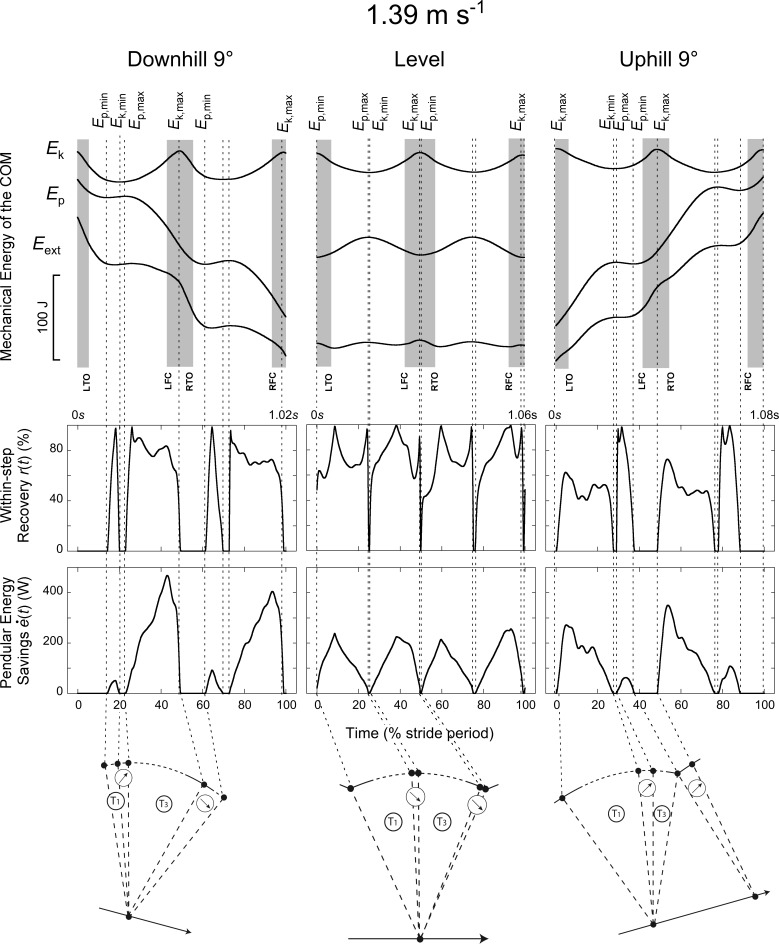
When ascending (descending) a slope, positive (negative) work must be performed to overcome changes in gravitational potential energy at the center of body mass (COM). This modifies the pendulum-like behavior of walking. The aim of this study is to analyze how energy exchange and mechanical work done vary within a step across slopes and speeds. Ten subjects walked on an instrumented treadmill at different slopes (from -9° to 9°), and speeds (between 0.56 and 2.22 m s-1). From the ground reaction forces, we evaluated energy of the COM, recovery (i.e. the potential-kinetic energy transduction) and pendular energy savings (i.e. the theoretical reduction in work due to this recovered energy) throughout the step. When walking uphill as compared to level, pendular energy savings increase during the first part of stance (when the COM is lifted) and decreases during the second part. Conversely in downhill walking, pendular energy savings decrease during the first part of stance and increase during the second part (when the COM is lowered). In uphill and downhill walking, the main phase of external work occurs around double support. Uphill, the positive work phase is extended during the beginning of single support to raise the body. Downhill, the negative work phase starts before double support, slowing the downward velocity of the body. Changes of the pendulum-like behavior as a function of slope can be illustrated by tilting the 'classical compass model' backwards (uphill) or forwards (downhill).
在上坡(下坡)时,必须做正(负)功以克服身体重心(COM)处重力势能的变化。这改变了行走时类似钟摆的行为。本研究的目的是分析在不同坡度和速度下,一步之内能量交换和所做机械功如何变化。十名受试者在装有仪器的跑步机上以不同坡度(从-9°到9°)和速度(在0.56至2.22米/秒之间)行走。根据地面反作用力,我们评估了整个步态周期中身体重心的能量、恢复能量(即势能-动能转换)和摆动能节省量(即由于这种恢复能量而理论上减少的功)。与在平地上行走相比,上坡行走时,在支撑期的第一部分(当身体重心上升时)摆动能节省量增加,而在第二部分减少。相反,在下坡行走时,支撑期的第一部分摆动能节省量减少,而在第二部分(当身体重心下降时)增加。在上坡和下坡行走时,外部做功的主要阶段发生在双支撑期左右。上坡时,正功阶段在单支撑期开始时延长,以抬高身体。下坡时,负功阶段在双支撑期之前开始,减缓身体的下降速度。通过将“经典罗盘模型”向后(上坡)或向前(下坡)倾斜,可以说明类似钟摆行为随坡度的变化。