Department of Bioengineering, University of Pittsburgh, 4420 Bayard Street, Suite 110, Pitt, Pittsburgh, PA, USA.
J Neuroeng Rehabil. 2020 Jun 3;17(1):69. doi: 10.1186/s12984-020-00698-y.
Promising studies have shown that the gait symmetry of individuals with hemiparesis due to brain lesions, such as stroke, can improve through motor adaptation protocols forcing patients to use their affected limb more. However, little is known about how to facilitate this process. Here we asked if increasing propulsion demands during split-belt walking (i.e., legs moving at different speeds) leads to more motor adaptation and more symmetric gait in survivors of a stroke, as we previously observed in subjects without neurological disorders.
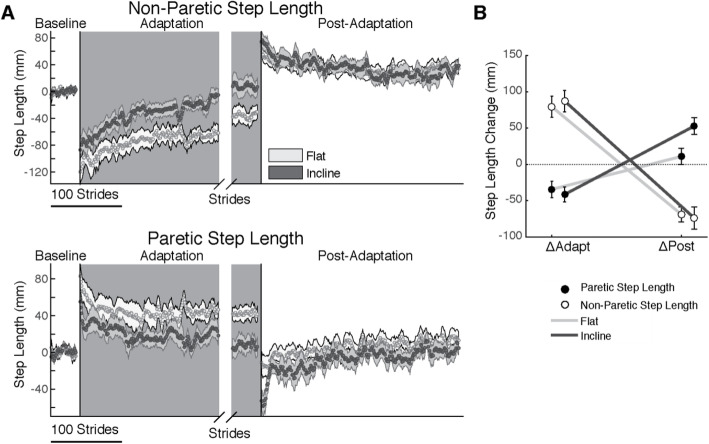
We investigated the effect of propulsion forces on locomotor adaptation during and after split-belt walking in the asymmetric motor system post-stroke. To test this, 12 subjects in the chronic phase post-stroke experienced a split-belt protocol in a flat and incline session so as to contrast the effects of two different propulsion demands. Step length asymmetry and propulsion forces were used to compare the motor behavior between the two sessions because these are clinically relevant measures that are altered by split-belt walking.
The incline session resulted in more symmetric step lengths during late split-belt walking and larger after-effects following split-belt walking. In both testing sessions, subjects who have had a stroke adapted to regain speed and slope-specific leg orientations similarly to young, intact adults. Importantly, leg orientations, which were set by kinetic demands, during baseline walking were predictive of those achieved during split-belt walking, which in turn predicted each individual's post-adaptation behavior. These results are relevant because they provide evidence that survivors of a stroke can generate the leg-specific forces to walk more symmetrically, but also because we provide insight into factors underlying the therapeutic effect of split-belt walking.
Individuals post-stroke at a chronic stage can adapt more during split-belt walking and have greater after-effects when propulsion demands are augmented by inclining the treadmill surface. Our results are promising since they suggest that increasing propulsion demands during paradigms that force patients to use their paretic side more could correct gait asymmetries post-stroke more effectively.
有研究表明,对于因脑损伤(如中风)导致偏瘫的个体,通过迫使患者更多地使用患侧肢体的运动适应方案,可以改善其步态对称性。然而,对于如何促进这一过程,目前我们知之甚少。在这里,我们想知道在分腿带行走(即双腿以不同速度移动)期间增加推进力是否会导致更多的运动适应,并使中风幸存者的步态更加对称,就像我们之前在没有神经障碍的受试者中观察到的那样。
我们研究了在中风后不对称运动系统中,推进力对分腿带行走期间和之后的运动适应的影响。为了进行测试,12 名处于中风后慢性期的受试者在平地和倾斜面上进行了分腿带试验,以对比两种不同推进力需求的影响。步长不对称和推进力用于比较两个试验之间的运动行为,因为这些是受分腿带行走影响的临床相关测量指标。
倾斜试验导致分腿带行走后期的步长更对称,分腿带行走后效应更大。在两个测试试验中,中风患者能够像年轻、完整的成年人一样,适应恢复速度和特定坡度的腿部姿势。重要的是,基线行走时由动力学需求确定的腿部姿势,可预测分腿带行走时达到的腿部姿势,而这又可预测每个个体的适应后行为。这些结果很重要,因为它们提供了证据表明,中风幸存者可以产生腿部特定的力量,从而更对称地行走,并且还提供了有关分腿带行走治疗效果的潜在因素的见解。
处于慢性期的中风患者在分腿带行走时可以进行更多的适应,并且当跑步机表面倾斜增加推进力需求时,他们的适应后效应更大。我们的研究结果很有前景,因为它们表明,在迫使患者更多地使用患侧肢体的方案中增加推进力需求,可能会更有效地纠正中风后的步态不对称。