Sato Wataru, Sawada Reiko, Kubota Yasutaka, Toichi Motomi, Fushiki Tohru
Department of Neurodevelopmental Psychiatry, Habilitation and Rehabilitation, Graduate School of Medicine, Kyoto University, 53 Shogoin-Kawaharacho, Sakyo, Kyoto, 606-8507, Japan.
Health and Medical Services Center, Shiga University, 1-1-1 Baba, Hikone, Shiga, 522-8522, Japan.
BMC Res Notes. 2017 Oct 26;10(1):511. doi: 10.1186/s13104-017-2835-y.
Hedonic/affective responses to food play a critical role in eating behavior. Previous behavioral studies have shown that hedonic responses to food are elicited consciously and unconsciously. Although the studies also showed that hunger and satiation have a modulatory effect on conscious hedonic responses to food, the effect of these homeostatic states on unconscious hedonic responses to food remains unknown.
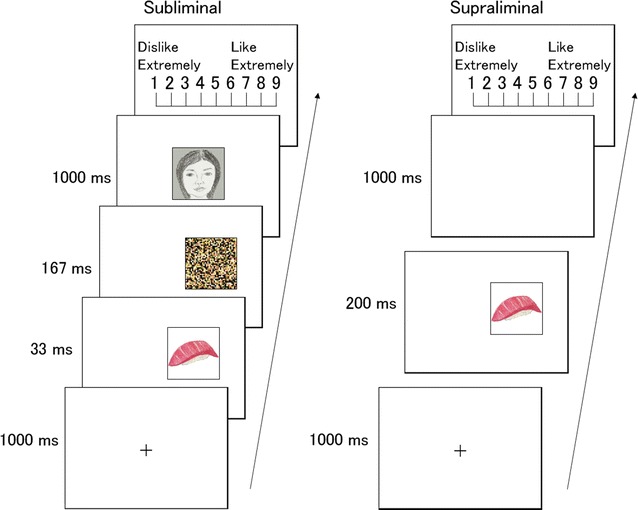
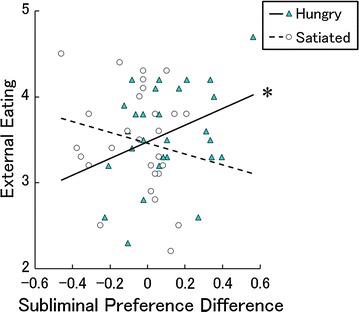
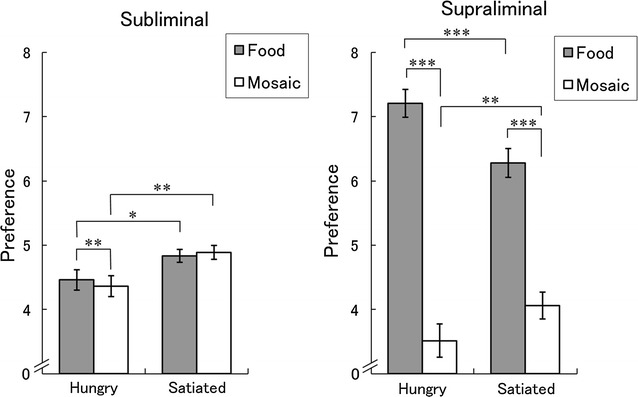
We investigated unconscious hedonic responses to food in hungry and satiated participants using the subliminal affective priming paradigm. Food images or corresponding mosaic images were presented in the left or right peripheral visual field during 33 ms. Then photographs of target faces with emotionally neutral expressions were presented, and the participants evaluated their preference for the faces. Additionally, daily eating behaviors were assessed using questionnaires. Preference for the target faces was increased by food images relative to the mosaics in the hungry, but not the satiated, state. The difference in preference ratings between the food and mosaic conditions was positively correlated with the tendency for external eating in the hungry, but not the satiated, group. Our findings suggest that homeostatic states modulate unconscious hedonic responses to food and that this phenomenon is related to daily eating behaviors.
对食物的享乐/情感反应在进食行为中起关键作用。以往的行为学研究表明,对食物的享乐反应可通过有意识和无意识的方式引发。虽然这些研究还表明饥饿和饱腹感对食物的有意识享乐反应有调节作用,但这些内稳态状态对食物的无意识享乐反应的影响仍不清楚。
我们使用阈下情感启动范式,研究了饥饿和饱腹参与者对食物的无意识享乐反应。在33毫秒内,食物图片或相应的镶嵌图片呈现在左或右外周视野中。然后呈现表情中性的目标面孔照片,参与者对这些面孔的喜好程度进行评价。此外,使用问卷评估日常进食行为。相对于镶嵌图片,饥饿状态而非饱腹状态下,食物图片会增加对目标面孔的喜好。食物和镶嵌图片条件下的喜好评分差异与饥饿组而非饱腹组的外部进食倾向呈正相关。我们的研究结果表明,内稳态状态调节对食物的无意识享乐反应,且这一现象与日常进食行为有关。