Shaw Alice T, Felip Enriqueta, Bauer Todd M, Besse Benjamin, Navarro Alejandro, Postel-Vinay Sophie, Gainor Justin F, Johnson Melissa, Dietrich Jorg, James Leonard P, Clancy Jill S, Chen Joseph, Martini Jean-François, Abbattista Antonello, Solomon Benjamin J
Massachusetts General Hospital, Boston, MA, USA.
Vall d'Hebron Institute of Oncology, Barcelona, Spain.
Lancet Oncol. 2017 Dec;18(12):1590-1599. doi: 10.1016/S1470-2045(17)30680-0. Epub 2017 Oct 23.
Most patients with anaplastic lymphoma kinase (ALK)-rearranged or ROS proto-oncogene 1 (ROS1)-rearranged non-small-cell lung cancer (NSCLC) are sensitive to tyrosine kinase inhibitor (TKI) therapy, but resistance invariably develops, commonly within the CNS. This study aimed to analyse the safety, efficacy, and pharmacokinetic properties of lorlatinib, a novel, highly potent, selective, and brain-penetrant ALK and ROS1 TKI with preclinical activity against most known resistance mutations, in patients with advanced ALK-positive or ROS1-positive NSCLC.
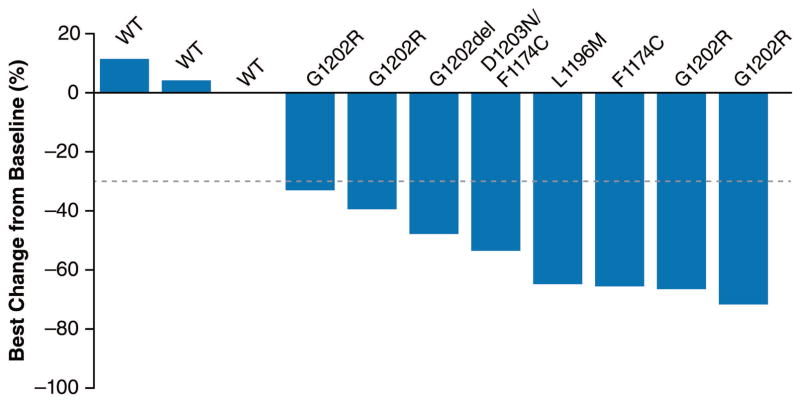
In this international multicentre, open-label, single-arm, first-in-man phase 1 dose-escalation study, eligible patients had advanced ALK-positive or ROS1-positive NSCLC and were older than 18 years, with an Eastern Cooperative Oncology Group performance status of 0 or 1, and adequate end-organ function. Lorlatinib was administered orally to patients at doses ranging from 10 mg to 200 mg once daily or 35 mg to 100 mg twice daily, with a minimum of three patients receiving each dose. For some patients, tumour biopsy was done before lorlatinib treatment to identify ALK resistance mutations. Safety was assessed in patients who received at least one dose of lorlatinib; efficacy was assessed in the intention-to-treat population (patients who received at least one dose of study treatment and had either ALK or ROS1 rearrangement). The primary endpoint was dose-limiting toxicities during cycle 1 according to investigator assessment; secondary endpoints included safety, pharmacokinetics, and overall response. This study is ongoing and is registered with ClinicalTrials.gov, number NCT01970865.
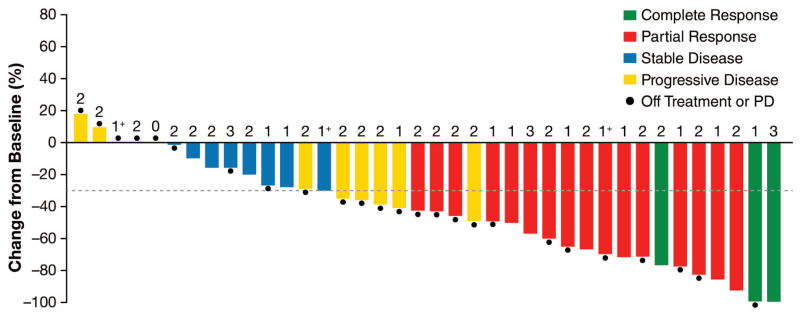
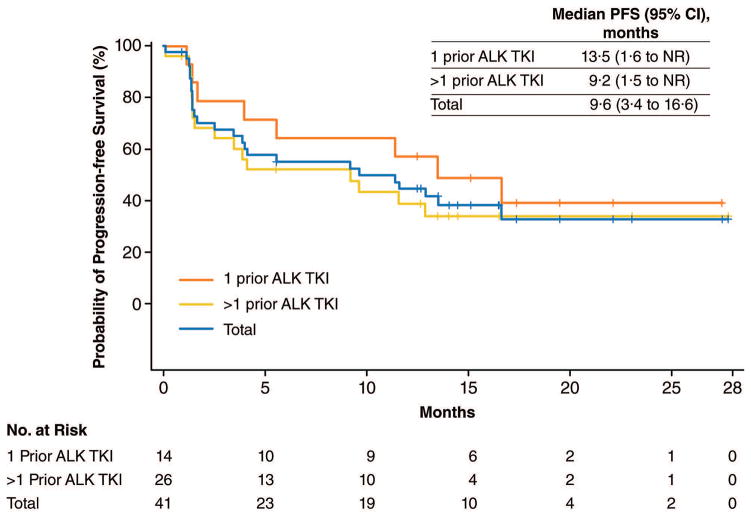
Between Jan 22, 2014, and July 10, 2015, 54 patients received at least one dose of lorlatinib, including 41 (77%) with ALK-positive and 12 (23%) with ROS1-positive NSCLC; one patient had unconfirmed ALK and ROS1 status. 28 (52%) patients had received two or more TKIs, and 39 (72%) patients had CNS metastases. The most common treatment-related adverse events among the 54 patients were hypercholesterolaemia (39 [72%] of 54 patients), hypertriglyceridaemia (21 [39%] of 54 patients), peripheral neuropathy (21 [39%] of 54 patients), and peripheral oedema (21 [39%] of 54 patients). One dose-limiting toxicity occurred at 200 mg (the patient did not take at least 16 of 21 prescribed total daily doses in cycle 1 because of toxicities attributable to study drug, which were grade 2 neurocognitive adverse events comprising slowed speech and mentation and word-finding difficulty). No maximum tolerated dose was identified. The recommended phase 2 dose was selected as 100 mg once daily. For ALK-positive patients, the proportion of patients who achieved an objective response was 19 (46%) of 41 patients (95% CI 31-63); for those who had received two or more TKIs, the proportion of patients with an objective response was 11 (42%) of 26 patients (23-63). In ROS1-positive patients, including seven crizotinib-pretreated patients, an objective response was achieved by six (50%) of 12 patients (95% CI 21-79).
In this phase 1, dose-escalation study, lorlatinib showed both systemic and intracranial activity in patients with advanced ALK-positive or ROS1-positive NSCLC, most of whom had CNS metastases and had previously had two or more TKI treatments fail. Therefore, lorlatinib might be an effective therapeutic strategy for patients with ALK-positive NSCLC who have become resistant to currently available TKIs, including second-generation ALK TKIs, and is being investigated in a phase 3 randomised controlled trial comparing lorlatinib to crizotinib (ClinicalTrials.gov, NCT03052608).
Pfizer.
大多数间变性淋巴瘤激酶(ALK)重排或ROS原癌基因1(ROS1)重排的非小细胞肺癌(NSCLC)患者对酪氨酸激酶抑制剂(TKI)治疗敏感,但总会出现耐药,通常发生在中枢神经系统(CNS)。本研究旨在分析洛拉替尼的安全性、有效性和药代动力学特性,洛拉替尼是一种新型、高效、选择性且具有脑穿透性的ALK和ROS1 TKI,对大多数已知耐药突变具有临床前活性,用于治疗晚期ALK阳性或ROS1阳性NSCLC患者。
在这项国际多中心、开放标签、单臂、首次人体1期剂量递增研究中,符合条件的患者患有晚期ALK阳性或ROS1阳性NSCLC,年龄超过18岁,东部肿瘤协作组体能状态为0或1,且终末器官功能良好。洛拉替尼以每日1次10 mg至200 mg或每日2次35 mg至100 mg的剂量口服给予患者,每个剂量至少有3名患者接受。对于一些患者,在洛拉替尼治疗前进行肿瘤活检以鉴定ALK耐药突变。在接受至少一剂洛拉替尼的患者中评估安全性;在意向性治疗人群(接受至少一剂研究治疗且有ALK或ROS1重排的患者)中评估有效性。主要终点是根据研究者评估的第1周期中的剂量限制性毒性;次要终点包括安全性、药代动力学和总体缓解率。本研究正在进行中,并已在ClinicalTrials.gov注册,编号为NCT01970865。
在2014年1月22日至2015年7月10日期间,54例患者接受了至少一剂洛拉替尼,其中41例(77%)为ALK阳性NSCLC,12例(23%)为ROS1阳性NSCLC;1例患者的ALK和ROS1状态未得到确认。28例(52%)患者接受过两种或更多种TKI治疗,39例(72%)患者有CNS转移。54例患者中最常见的治疗相关不良事件为高胆固醇血症(54例患者中的39例[72%])、高甘油三酯血症(54例患者中的21例[39%])、周围神经病变(54例患者中的21例[39%])和外周水肿(54例患者中的21例[39%])。在200 mg剂量时发生1例剂量限制性毒性(该患者在第1周期中由于研究药物所致毒性,未服用21剂规定总日剂量中的至少16剂,这些毒性为2级神经认知不良事件,包括言语和思维迟缓以及找词困难)。未确定最大耐受剂量。推荐的2期剂量选定为每日1次100 mg。对于ALK阳性患者,41例患者中有19例(46%)达到客观缓解(95% CI 31 - 63);对于接受过两种或更多种TKI治疗的患者,26例患者中有11例(42%)达到客观缓解(23 - 63)。在ROS1阳性患者中,包括7例接受过克唑替尼预处理的患者,12例患者中有6例(50%)达到客观缓解(95% CI 21 - 79)。
在这项1期剂量递增研究中,洛拉替尼在晚期ALK阳性或ROS1阳性NSCLC患者中显示出全身和颅内活性,这些患者大多数有CNS转移且先前两种或更多种TKI治疗失败。因此,洛拉替尼可能是对当前可用TKI(包括第二代ALK TKI)耐药的ALK阳性NSCLC患者的一种有效治疗策略,并且正在进行一项3期随机对照试验,比较洛拉替尼与克唑替尼(ClinicalTrials.gov,NCT03052608)。
辉瑞公司。