National Hospital Organization Kyushu Cancer Center, Fukuoka, Japan.
Faculty of Medicine, Kindai University, Osaka, Japan.
Cancer Sci. 2020 Oct;111(10):3726-3738. doi: 10.1111/cas.14576. Epub 2020 Sep 11.
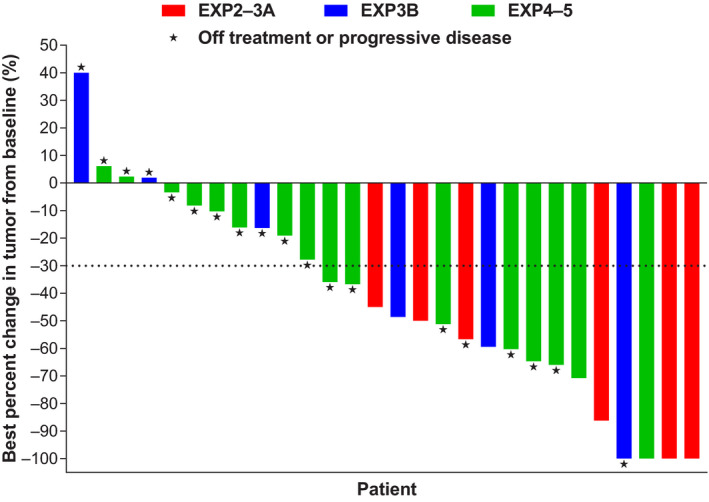
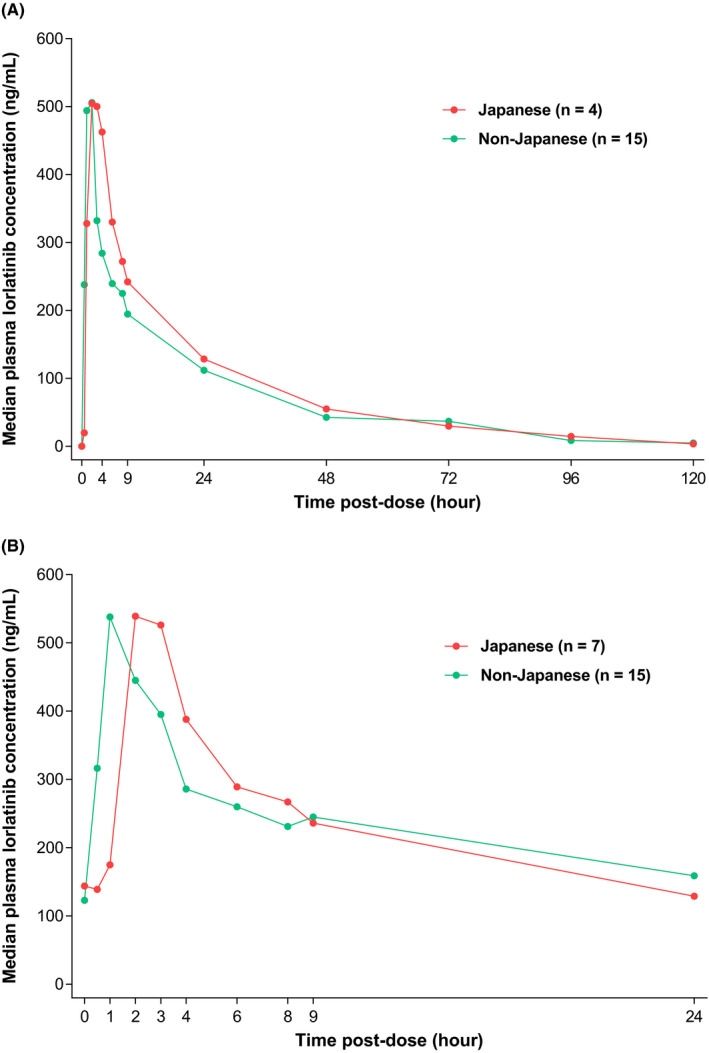
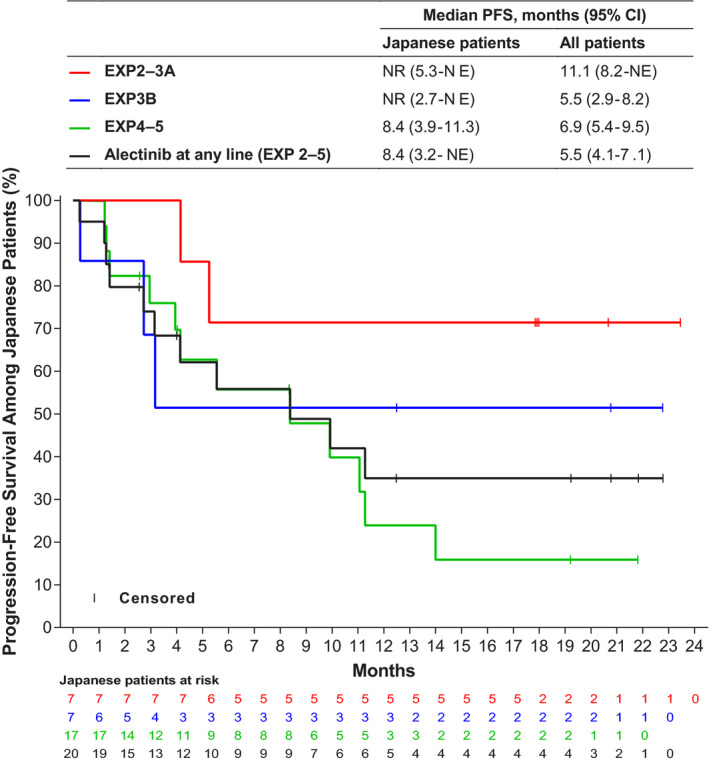
Lorlatinib is a potent, brain-penetrant, third-generation anaplastic lymphoma kinase (ALK)/ROS proto-oncogene 1 (ROS1) tyrosine kinase inhibitor (TKI) that is active against most known resistance mutations. This is an ongoing phase 1/2, multinational study (NCT01970865) investigating the efficacy, safety and pharmacokinetics of lorlatinib in ALK-rearranged/ROS1-rearranged advanced non-small cell lung cancer (NSCLC) with or without intracranial (IC) metastases. Because patterns of ALK TKI use in Japan differ from other regions, we present a subgroup analysis of Japanese patients. Patients were enrolled into six expansion (EXP) cohorts based on ALK/ROS1 mutation status and treatment history. The primary endpoint was the objective response rate (ORR) and the IC-ORR based on independent central review. Secondary endpoints included pharmacokinetic evaluations. At data cutoff, 39 ALK-rearranged/ROS1-rearranged Japanese patients were enrolled across the six expansion cohorts; all received lorlatinib 100 mg once daily. Thirty-one ALK-rearranged patients previously treated with ≥1 ALK TKI (EXP2 to EXP5) were evaluable for ORR and 15 were evaluable for IC-ORR. The ORR and the IC-ORR for Japanese patients in EXP2-5 were 54.8% (95% confidence interval [CI]: 36.0-72.7) and 46.7% (95% CI: 21.3-73.4), respectively. Among patients who had received prior alectinib only (EXP3B), the ORR was 42.9%; 95% CI: 9.9-81.6). The most common treatment-related adverse event (TRAE) was hypercholesterolemia (79.5%). Hypertriglyceridemia was the most common grade 3/4 TRAE (25.6%). Single-dose and multiple-dose pharmacokinetic profiles among Japanese patients were similar to those in non-Japanese patients. Lorlatinib showed clinically meaningful responses and IC responses among ALK-rearranged Japanese patients with NSCLC who received ≥1 prior ALK TKI, including meaningful responses among those receiving prior alectinib only. Lorlatinib was generally well tolerated.
洛拉替尼是一种有效的、可穿透血脑屏障的第三代间变性淋巴瘤激酶(ALK)/ROS1 原癌基因 1(ROS1)酪氨酸激酶抑制剂(TKI),对大多数已知的耐药突变均有活性。这是一项正在进行的 I/II 期、多中心研究(NCT01970865),旨在评估洛拉替尼在伴有或不伴有颅内(IC)转移的 ALK 重排/ROS1 重排的晚期非小细胞肺癌(NSCLC)患者中的疗效、安全性和药代动力学。由于日本的 ALK TKI 使用模式与其他地区不同,因此我们对日本患者进行了亚组分析。患者根据 ALK/ROS1 突变状态和治疗史入组 6 个扩展(EXP)队列。主要终点为客观缓解率(ORR)和独立中心评估的颅内缓解率(IC-ORR)。次要终点包括药代动力学评估。数据截止时,6 个扩展队列共入组了 39 名 ALK 重排/ROS1 重排的日本患者;所有患者均接受洛拉替尼 100mg 每日一次治疗。31 名接受过 1 种或以上 ALK TKI(EXP2 至 EXP5)治疗的 ALK 重排患者可评估 ORR,15 名患者可评估 IC-ORR。EXP2-5 中日本患者的 ORR 和 IC-ORR 分别为 54.8%(95%CI:36.0-72.7)和 46.7%(95%CI:21.3-73.4)。仅接受过阿来替尼治疗的患者(EXP3B)的 ORR 为 42.9%;95%CI:9.9-81.6)。最常见的治疗相关不良事件(TRAE)是高胆固醇血症(79.5%)。最常见的 3/4 级 TRAE 是高甘油三酯血症(25.6%)。日本患者的单次和多次药代动力学特征与非日本患者相似。在接受过 1 种或以上 ALK TKI 治疗的 ALK 重排的日本 NSCLC 患者中,洛拉替尼显示出了有临床意义的缓解和颅内缓解,包括仅接受过阿来替尼治疗的患者。洛拉替尼总体耐受性良好。