Division of Nephrology, St. Paul's Hospital, University of British Columbia, Vancouver, British Columbia, Canada; and.
Centre for Health Evaluation and Outcomes Sciences, Providence Health Care Research Institute, University of British Columbia, Vancouver, British Columbia, Canada.
Clin J Am Soc Nephrol. 2017 Dec 7;12(12):2024-2031. doi: 10.2215/CJN.06100617. Epub 2017 Oct 26.
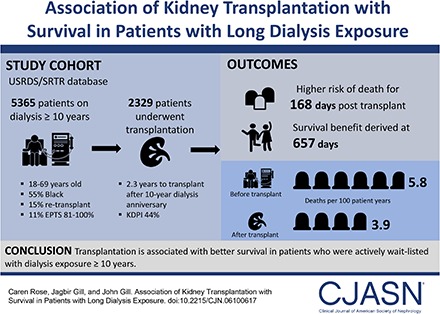
Evidence that kidney transplantation is associated with better survival compared to dialysis stems from data in populations with short durations of dialysis exposure. Recent changes in allocation policy increase access to transplantation for patients with longer dialysis exposure. The objective of this study was to determine the association of transplantation with survival in patients with ≥10 years of dialysis treatment.
DESIGN, SETTING, PARTICIPANTS, & MEASUREMENTS: Our study of =5365 patients in the Scientific Registry of Transplant Recipients determined the adjusted relative risk of death in recipients of a deceased donor kidney transplant after ≥10 years of dialysis treatment compared with waitlisted patients with the same dialysis exposure in a time-dependent nonproportional hazards analysis.
The adjusted relative risk of death in =2320 transplant recipients compared with patients on dialysis who had equal lengths of follow-up from their 10-year dialysis anniversary was 0.60 (95% confidence interval, 0.53 to 0.68), and this benefit was observed in a variety of patient subgroups, including patients ≥65 years of age and patients with diabetes. However, transplant recipients were at higher risk of death for 180 days after transplantation and did not derive survival benefit until 657 days after transplantation, despite receiving good-quality kidneys. The study patients were younger and had higher expected post-transplant survival than patients currently waitlisted with ≥10 years of dialysis.
Transplantation is associated with better survival in patients who were actively waitlisted with dialysis exposure ≥10 years. Whether transplantation is associated with better survival in currently waitlisted patients with similar dialysis exposure and whether transplantation of lower-quality deceased donor kidneys is associated with better survival are uncertain.
与透析相比,肾移植与更好的生存相关,这一证据来自透析暴露时间较短的人群的数据。最近分配政策的变化增加了透析暴露时间较长的患者接受移植的机会。本研究的目的是确定移植与透析治疗时间≥ 10 年的患者生存的关系。
设计、设置、参与者和测量:我们在移植受者科学登记处对 5365 名患者进行的研究,在时间依赖性非比例风险分析中,确定了透析治疗时间≥ 10 年的接受已故供体肾移植的受者与具有相同透析暴露量的等待移植患者相比,死亡的调整相对风险。
与透析患者相比,在透析治疗 10 周年后具有相同随访时间的 2320 例移植受者的死亡调整相对风险为 0.60(95%置信区间,0.53 至 0.68),并且在各种患者亚组中观察到这种益处,包括≥ 65 岁的患者和患有糖尿病的患者。然而,移植受者在移植后 180 天内死亡风险较高,并且尽管接受了高质量的肾脏,但直到移植后 657 天才获得生存益处。研究患者比目前等待透析时间≥ 10 年的患者更年轻,且具有更高的预期移植后生存。
在接受透析暴露时间≥ 10 年的积极等待的患者中,移植与更好的生存相关。目前等待透析时间相似的患者中,移植是否与更好的生存相关,以及低质量已故供体肾脏的移植是否与更好的生存相关,尚不确定。