Manyazewal Tsegahun
Department of Health Studies, College of Human Science, University of South Africa, Pretoria, P.O. BOX 392 South Africa.
Arch Public Health. 2017 Aug 31;75:50. doi: 10.1186/s13690-017-0221-9. eCollection 2017.
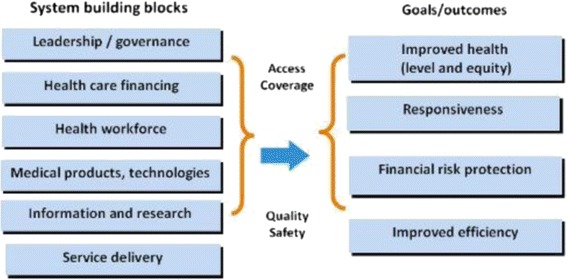
Acknowledging the health system strengthening agenda, the World Health Organization (WHO) has formulated a health systems framework that describes health systems in terms of six building blocks. This study aimed to determine the current status of the six WHO health system building blocks in public healthcare facilities in Ethiopia.
A quantitative, cross-sectional study was conducted in five public hospitals in central Ethiopia which were in a post-reform period. A self-administered, structured questionnaire which covered the WHO's six health system building blocks was used to collect data on healthcare professionals who consented. Data was analyzed using IBM SPSS version 20.
The overall performance of the public hospitals was 60% when weighed against the WHO building blocks which, in this procedure, needed a minimum of 80% score. For each building block, performance scores were: information 53%, health workforce 55%, medical products and technologies 58%, leadership and governance 61%, healthcare financing 62%, and service delivery 69%. There existed a significant difference in performance among the hospitals ( < .001).
The study proved that the WHO's health system building blocks are useful for assessing the process of strengthening health systems in Ethiopia. The six blocks allow identifying different improvement opportunities in each one of the hospitals. There was no contradiction between the indicators of the WHO building blocks and the health sustainable development goal (SDG) objectives. However, such SDG objectives should not be a substitute for strategies to strengthen health systems.
认识到卫生系统加强议程,世界卫生组织(WHO)制定了一个卫生系统框架,从六个组成部分来描述卫生系统。本研究旨在确定埃塞俄比亚公共医疗机构中WHO卫生系统六个组成部分的现状。
在埃塞俄比亚中部处于改革后时期的五家公立医院开展了一项定量横断面研究。使用一份涵盖WHO六个卫生系统组成部分的自填式结构化问卷,收集同意参与的医疗保健专业人员的数据。数据采用IBM SPSS 20版进行分析。
与WHO的组成部分相比,公立医院的总体绩效为60%,在此评估过程中,最低需要达到80%的分数。每个组成部分的绩效得分分别为:信息53%、卫生人力55%、医疗产品和技术58%、领导与治理61%、卫生保健筹资62%、服务提供69%。各医院之间的绩效存在显著差异(<0.001)。
该研究证明,WHO的卫生系统组成部分有助于评估埃塞俄比亚卫生系统的加强过程。这六个组成部分有助于在每家医院识别不同的改进机会。WHO组成部分的指标与卫生可持续发展目标(SDG)的目标之间不存在矛盾。然而,此类SDG目标不应替代加强卫生系统的战略。