Department of Basic Medical Sciences, Neuroscience and Sense Organs University of Bari" Aldo Moro" Bari Italy.
Brain Behav. 2017 Aug 29;7(10):e00804. doi: 10.1002/brb3.804. eCollection 2017 Oct.
Benefits and risks of new therapies in Multiple Sclerosis (MS) must be balanced carefully and tailored to patients. We aimed to describe our experience with Fingolimod (FTY), correlating demographics, clinical and hematological features of the Relapsing MS (RMS) cohort with the occurring Adverse Events (AEs).
Pretreatment screening tests, cardiological observation, and safety follow-up data were analyzed in 225 RMS patients. Changes in continuous data were analyzed post hoc with Wilcoxon ranks test; categorical variables were examined using McNemar test. Two-way repeated-measures analysis of variance (ANOVA) was used to analyze differences between baseline characteristic of the cohorts and Liver Function Tests (LFT) alterations. Binary logistic regression models were used to identify which of the baseline factors influenced LFT alterations and the occurrence of infections.
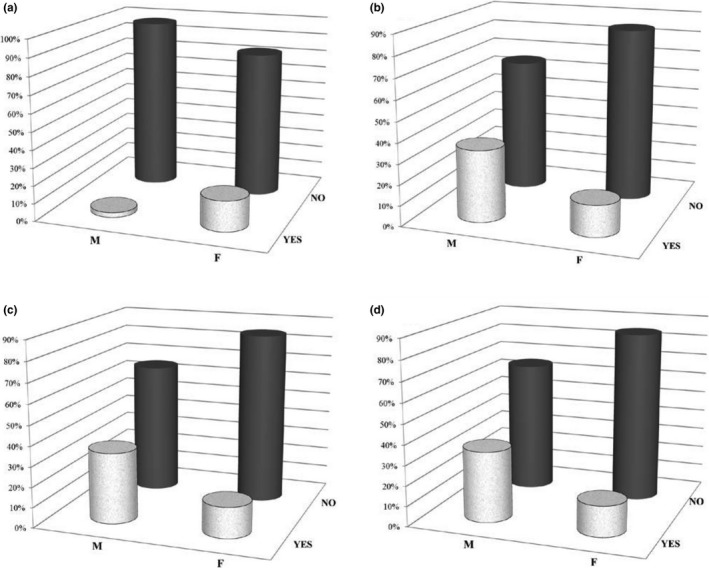
During 2 years of follow-up 24 patients (10%) interrupted FTY. Discontinuation most often was due to AEs (n = 14) or breakthrough disease (n = 5). The most frequently AEs were infections (10.6%). After the first year patients showing an infectious episode were mostly female (= .04). The infections did not correlate with the decrease in white blood cells or to lymphocyte count. AST and ALT alterations were observed mostly in males (= .002 and = .01, respectively), and increase in GGT was reported in subjects older at FTY beginning (< .05).
For a patient-centered safety monitoring of FTY, we may apply gender-specific warnings, for the detection of transaminases abnormalities and infectious episodes.
新疗法在多发性硬化症(MS)中的获益和风险必须仔细平衡,并针对患者进行个体化调整。我们旨在描述我们在芬戈莫德(FTY)方面的经验,将复发性多发性硬化症(RMS)队列的人口统计学、临床和血液学特征与发生的不良事件(AEs)相关联。
对 225 例 RMS 患者的预处理筛查测试、心脏观察和安全性随访数据进行了分析。使用 Wilcoxon 秩和检验对连续数据的变化进行事后分析;使用 McNemar 检验检查分类变量。使用双向重复测量方差分析(ANOVA)分析队列基线特征和肝功能试验(LFT)改变之间的差异。使用二元逻辑回归模型来确定哪些基线因素影响 LFT 改变和感染的发生。
在 2 年的随访期间,有 24 例患者(10%)中断了 FTY 治疗。停药最常见的原因是不良反应(n=14)或突破性疾病(n=5)。最常见的不良反应是感染(10.6%)。在第一年之后,发生感染的患者大多为女性(=0.04)。感染与白细胞或淋巴细胞计数的减少无关。AST 和 ALT 改变主要发生在男性(=0.002 和=0.01),开始 FTY 时年龄较大的患者(<0.05)报告了 GGT 的增加。
为了进行以患者为中心的 FTY 安全性监测,我们可以针对性别特异性警告,以检测转氨酶异常和感染事件。